An aid to teachers
p. 52 · Read in the full issue
teachers
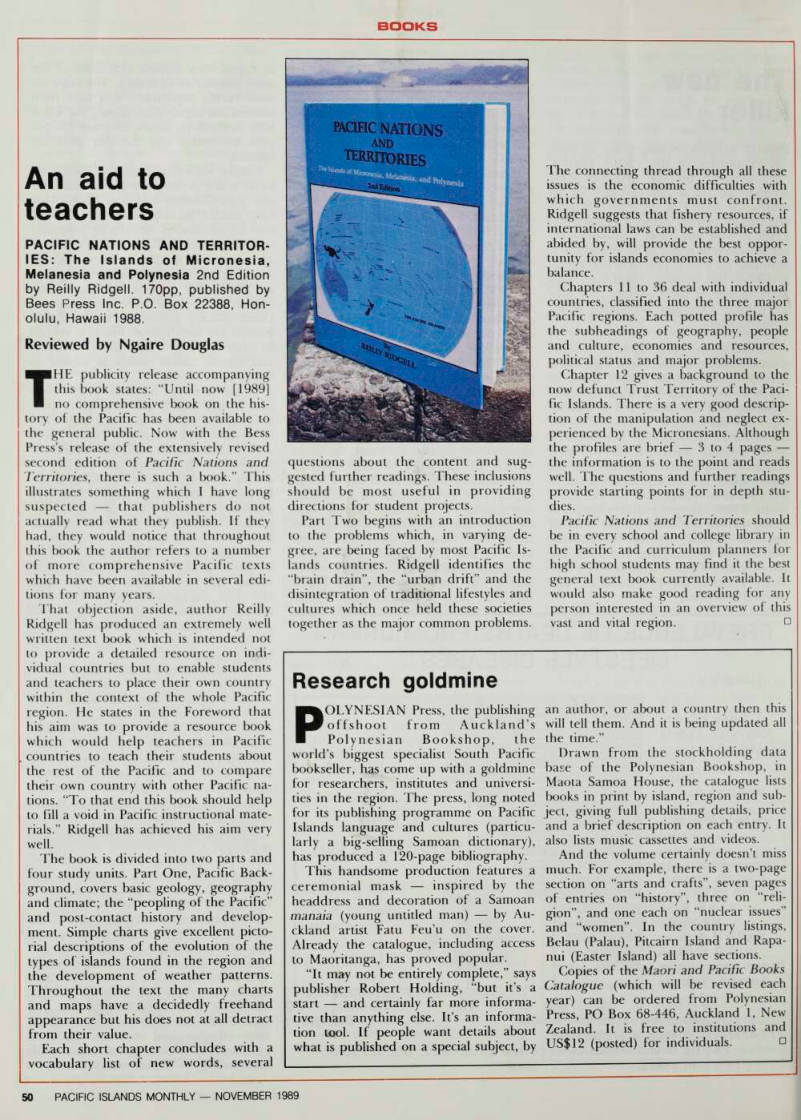
Pacific Nations And Territor
IES: The Islands of Micronesia, Melanesia and Polynesia 2nd Edition by Reilly Ridgell. 170 pp, published by Bees Press Inc. P.O. Box 22388, Hon olulu, Hawaii 1988.
Reviewed by Ngaire Douglas
THE publicity release accompanying
this book states; “Until now [1989] no comprehensive book on the his tory of the Pacific has been available to the general public. Now with the Bess Press’s release of the extensively revised second edition of Pacific Nations and Territories, there is such a book.” This illustrates something which I have long suspected that publishers do not actually read what they publish. If they had, they would notice that throughout this book the author refers to a number of more comprehensive Pacific texts which have been available in several edi tions for many years.
That objection aside, author Reilly
Ridgell has produced an extremely well
written text book which is intended not to provide a detailed resource on indi vidual countries but to enable students and teachers to place their own country within the context of the whole Pacific region. He states in the Foreword that his aim was to provide a resource book which would help teachers in Pacific countries to teach their students about the rest of the Pacific and to compare their own country with other Pacific na tions. “To that end this book should help to fill a void in Pacific instructional mate rials.” Ridgell has achieved his aim very well.
The book is divided into two parts and four study units. Part One, Pacific Back
ground, covers basic geology, geography
and climate; the “peopling of the Pacific” and post-contact history and develop
ment. Simple charts give excellent picto
rial descriptions of the evolution of the types of islands found in the region and the development of weather patterns.
Throughout the text the many charts and maps have a decidedly freehand appearance but his does not at all detract from their value.
Each short chapter concludes with a vocabulary list of new words, several
questions about the content and sug gested further readings. These inclusions should be most useful in providing directions for student projects.
Part Two begins with an introduction to the problems which, in varying de gree, are being faced by most Pacific Is lands countries. Ridgell identifies the “brain drain”, the “urban drift” and the disintegration of traditional lifestyles and cultures which once held these societies
together as the major common problems.
The connecting thread through all these issues is the economic difficulties with which governments must confront.
Ridgell suggests that fishery resources, if international laws can be established and abided by, will provide the best oppor tunity for islands economies to achieve a balance.
Chapters 11 to 36 deal with individual countries, classified into the three major
Pacific regions. Each potted profile has
the subheadings of geography, people
and culture, economies and resources,
political status and major problems.
Chapter 12 gives a background to the now defunct Trust Territory of the Paci fic Islands. There is a very good descrip tion of the manipulation and neglect ex
perienced by the Micronesians. Although
the profiles are brief 3to 4 pages the information is to the point and reads well. The questions and further readings provide starting points for in depth stu dies.
Pacific Nations and Territories should be in every school and college library in the Pacific and curriculum planners for high school students may find it the best general text book currently available. It would also make good reading for any person interested in an overview of this vast and vital region. □