under seige
pp. 43-44 · Read in the full issue
Culture
Western Samoa
Fa’asamoa under seige
FA’SAMOA, the intact cultural way of life of Western Samoans, is under threat from pressures both within and without. The people of West ern Samoa today live very much as they did at the turn of the century. Fa’asamoa has survived a turbulent history of col onialism by such different rationalities as Germany and New Zealand, and it is iro nically only now that Western Samoa is politically independent that it shows signs of changing.
The social building block of fa’asamoa is the aiga, or extended family unit. Each aiga appoints a matai, a chief who assumes title to the aiga’s land, and who represents its interests in the larger com munity. Only matai are enfranchised to vote in the election of regional repre sentatives to the national assembly. To the matai is owed the absolute respect and obedience of every member of the aiga. Fa’asamoa is based very much upon respect and cooperation.
The Samoan Way and the urbanised, modernised West have up until now coexisted quite happily. While Samoa is regarded as one of the most under developed economies in the world, its
people enjoy a surprisingly high stan
dard of living in the villages, which may consist of more than one aiga, most still live in traditional fale, houses with thatched roofs and without permanent walls. Most still rely upon agriculture for
subsistance. But by producing a surplus
from their plantations, aiga can bring in money from the sale of produce in the markets. And most families, of course, have a member overseas working and
remitting. With this excess money, many aiga are able to afford some of the trap pings of a Western lifestyle: cars, TV, video recorders. Modern fa’asamoa is a “best of both worlds” situation.
Underdevelopment, however, which compromises the nation’s hard-won inde pendence, looks set to compromise the Samoan culture as well. An increasing westernising influence and stagnant eco nomy pose a dual threat to fa’asamoa.
Young Samoans are taught a school syl labus designed to equip them to compete within the Australian and New Zealand education systems. Samoan children take New Zealand external examinations.
There is little input from fa’asamoa into
an essentially palagi (foreign, western)
doctrine. Education introduces a com petitive ethic which is more or less opposed to the cooperative Samoan Way.
It is an individualist ethic which opposes the collectivist basis of fa’asamoa, and one which discourages young Samoans from identifying their aspirations with those of their aiga.
In order to further their education, Samoans for the most part must travel overseas. Once qualified, there is little incentive to return home. The underde veloped Samoan economy is simply un able to offer them the wages and oppor tunities that they have been educated to expect, and which they can find outside Samoa. The choice facing Samoans with academic ability is either to exploit their talents or to live the Samoan Way. While many choose to set aside their qualifica tions and seek status within fa’asamoa by gaining appointment as matai, there is evidence that increasing numbers are
abandoning Samoa.
For those without academic ability, the situation is no brighter. An estimated 60 per cent of Samoan youth is unem
ployed. Many of these unemployed, un
educated Samoans will also travel over seas, to work and to remit to their aiga.
Once there, however, although the fami ly tie remains strong, few are enthusias tic about returning. Many will go to ex tra ordinary lengths to remain in the host country. Although the cultural dif ferences between New Zealand, for ex ample, and Samoa are large, Samoans travelling to New Zealand are supported
by the aiga members who sponsored
them, and are received into a well established, supportive Samoan com munity. While the work that most do is hard-shift and factory work unpopular with New Zealanders, the wages are su perior to anything they would be likely to earn in Samoa. A young Samoan labourer, applying for the renewal of his visa, told the immigrations officials who turned him down: “Right or wrong, I will do everything I can to stay in New Zealand. What is there for me back in Samoa?” While to many, even outsiders,
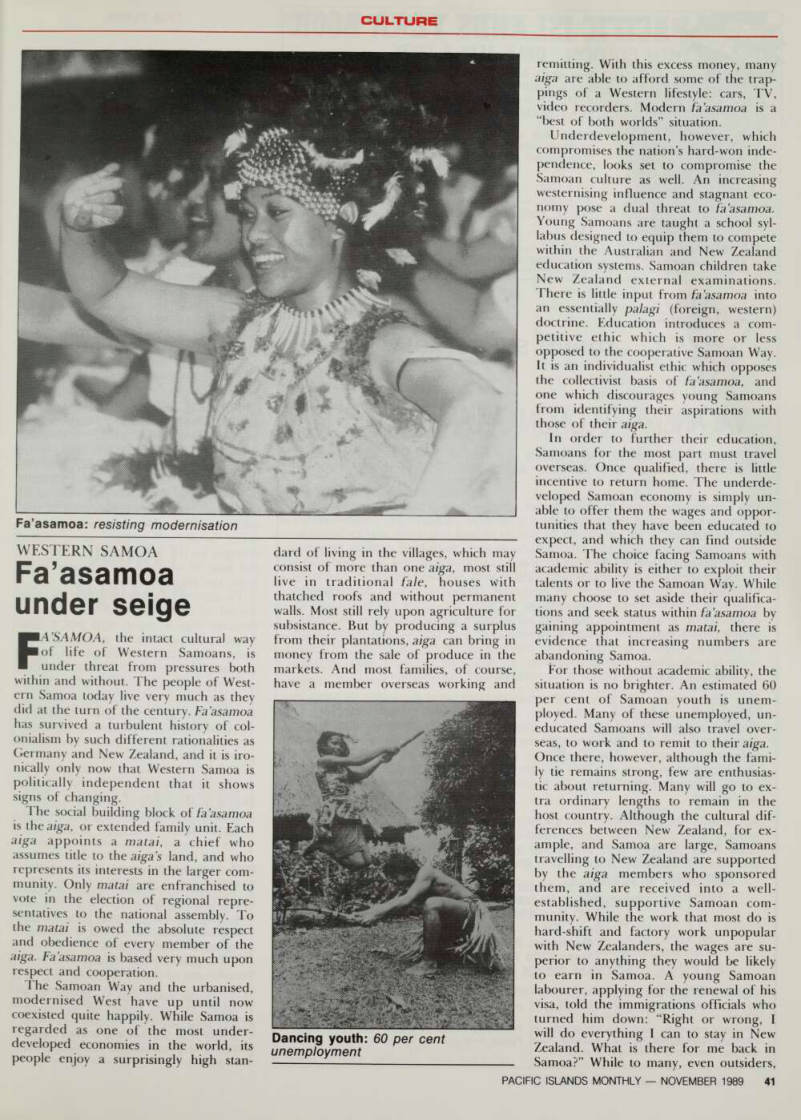
Fa’asamoa: resisting modernisation
Dancing youth: 60 per cent unemployment
the Samoan Way is attractive, it is doubt ful whether it will remain sufficiently attractive to draw back the young people who are emigrating.
Fa ’asamoa itself to some extent resists modernisation. Aiga which have tradi
tionally produced goods solely for their
own consumption do not appreciate the need to produce for an export market.
The combination of agricultural plenty and remittance money insulates most Sa moans from the dire economic position of the nation. Any attempt to gear Sa moan agriculture toward export produc tion will require modification of the tra ditional Samoan farmer’s goals, and this may prove difficult. Similarly, most Sa moans regard without enthusiasm the administration’s drive toward promoting tourism. It is difficult to infect such a contented people with a sense of the urgency of the need for such things.
Yet modernise Samoa must, to develop its economy in order to provide the opportunities which the young are cur rently seeking abroad. Fa’asamoa will otherwise lose much of the generation which must inherit it. This, then, is the dilemma which faces the Western Sa moan people. If they do not undertake to modernise the economy, then their young people will have to travel to find
opportunities. Development, on the
other hand, will require some radical changes to the Samoan way of life, not the least of which is an increased input from the Western culture.
To survive, fa’asamoa must be pre sented to Samoan youth as a cultural heritage that is more than just- a com fortable way of life in a stagnant eco nomy. They must be taught to regard education as the tool by which fa’asamoa can be brought up to date rather than as an alternative to it. Talented Samoans must be encouraged to use their gifts in the process of modernisation. The vital ity of the economy must be restored to provide opportunities, without which re maining in Samoa is unattractive to young Samoans. Only if they are con vinced of the value of fa’asamoa will the young, its future, work towards ensuring its survival. D
UTA stresses Noumea service UTA French Airlines has reaffirmed it intends to continue a twice-weekly ser vice between Sydney and New Caledo nia. The airline has issued a statement stressing its commitment to the route, and that public misconception had arisen because one of the twice-weekly flights is operated by a leased Air Caledonie In ternational 737. UTA considers that political stability has now been re established in the French territory and is
planning a promotional campaign early
next year.