called Hope
p. 42 · Read in the full issue
United Nations
A woman called Hope
By Ed Ram pell
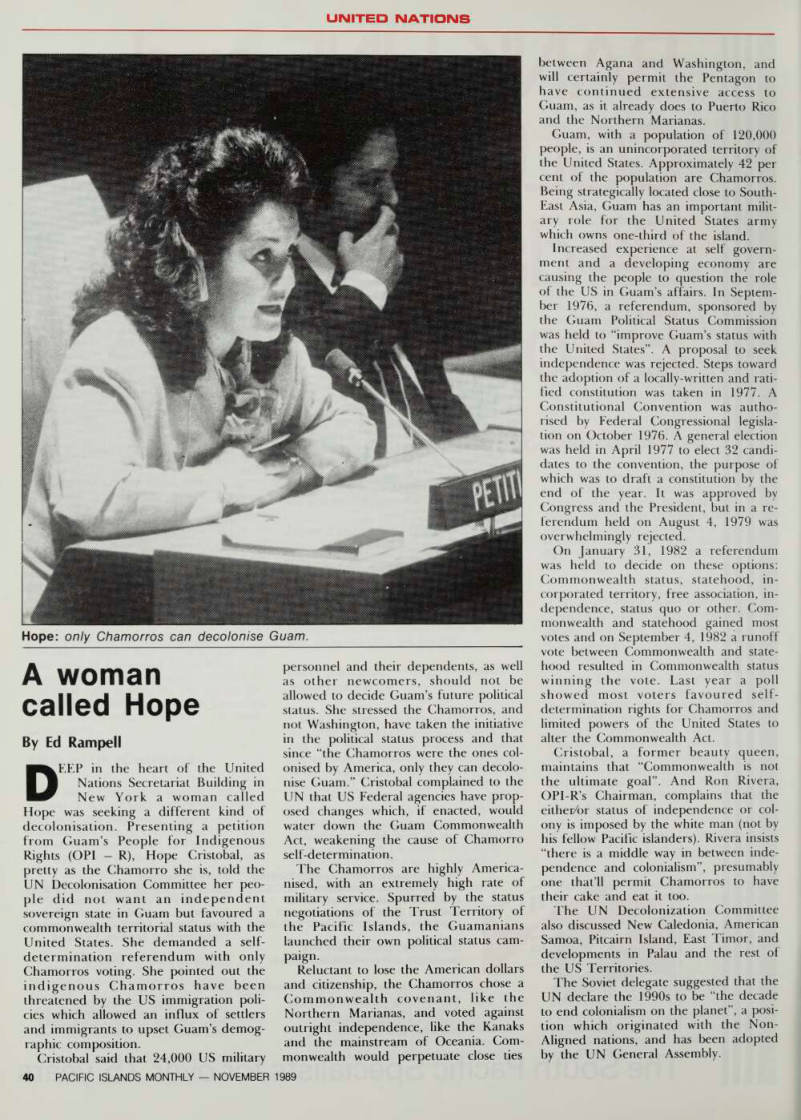
DEEP in the heart of the United Nations Secretariat Building in New York a woman called Hope was seeking a different kind of
decolonisation. Presenting a petition
from Guam’s People for Indigenous Rights (OPI — R), Hope Cristobal, as pretty as the Chamorro she is, told the UN Decolonisation Committee her peo ple did not want an independent sovereign state in Guam but favoured a commonwealth territorial status with the United States. She demanded a self determination referendum with only Chamorros voting. She pointed out the indigenous Chamorros have been threatened by the US immigration poli cies which allowed an influx of settlers and immigrants to upset Guam’s demog
raphic composition.
Cristobal said that 24,000 US military
personnel and their dependents, as well as other newcomers, should not be allowed to decide Guam’s future political status. She stressed the Chamorros, and not Washington, have taken the initiative in the political status process and that since “the Chamorros were the ones col onised by America, only they can decolo nise Guam.” Cristobal complained to the UN that US Federal agencies have prop osed changes which, if enacted, would water down the Guam Commonwealth Act, weakening the cause of Chamorro self-determination.
The Chamorros are highly America nised, with an extremely high rate of
military service. Spurred by the status
negotiations of the Trust Territory of the Pacific Islands, the Guamanians launched their own political status cam
paign.
Reluctant to lose the American dollars and citizenship, the Chamorros chose a Commonwealth covenant, like the Northern Marianas, and voted against outright independence, like the Kanaks and the mainstream of Oceania. Com monwealth would perpetuate close ties
between Agana and Washington, and will certainly permit the Pentagon to have continued extensive access to Guam, as it already does to Puerto Rico and the Northern Marianas.
Guam, with a population of 120,000
people, is an unincorporated territory of
the United States. Approximately 42 per cent of the population are Chamorros.
Being strategically located close to South- East Asia, Guam has an important milit ary role for the United States army which owns one-third of the island.
Increased experience at self govern ment and a developing economy are causing the people to question the role of the US in Guam’s affairs. In Septem ber 1976, a referendum, sponsored by the Guam Political Status Commission was held to “improve Guam’s status with the United States”. A proposal to seek
independence was rejected. Steps toward
the adoption of a locally-written and rati fied constitution was taken in 1977. A Constitutional Convention was autho
rised by Federal Congressional legisla
tion on October 1976. A general election was held in April 1977 to elect 32 candi dates to the convention, the purpose of which was to draft a constitution by the end of the year. It was approved by Congress and the President, but in a re ferendum held on August 4, 1979 was
overwhelmingly rejected.
On January 31, 1982 a referendum was held to decide on these options: Commonwealth status, statehood, in corporated territory, free association, in dependence, status quo or other. Com monwealth and statehood gained most votes and on September 4, 1982 a runoff vote between Commonwealth and state hood resulted in Commonwealth status winning the vote. Last year a poll showed most voters favoured self determination rights for Chamorros and limited powers of the United States to alter the Commonwealth Act.
Cristobal, a former beauty queen, maintains that “Commonwealth is not the ultimate goal”. And Ron Rivera, OPI-R’s Chairman, complains that the eithei/or status of independence or col ony is imposed by the white man (not by his fellow Pacific islanders). Rivera insists “there is a middle way in between inde
pendence and colonialism”, presumably
one that’ll permit Chamorros to have their cake and eat it too.
The UN Decolonization Committee also discussed New Caledonia, American Samoa, Pitcairn Island, East Timor, and developments in Palau and the rest of the US Territories.
The Soviet delegate suggested that the UN declare the 1990 s to be “the decade to end colonialism on the planet”, a posi tion which originated with the Non- Aligned nations, and has been adopted by the UN General Assembly.
Hope: only Chamorros can deco lonise Guam.