Diana Mcmanus
p. 26 · Read in the full issue
Tuvalu
A new leadership
By Diana McManus
THE election of Bikenibeu Paeniu as Tuvalu’s new prime minister has heralded in a new era of develop ment planning for the tiny Pacific Island nation. His Government intends to initi ate a number of policy changes, indi
cated by major reshuffling of portfolio
interests and allocations. The Prime Minister has also indicated that there will be a broadening of the Foreign Relations base, an emphasis on balanced develop ment of the outer islands and promotion of a national identity. Until now Govern ment has been faced with the difficulties of establishing the political infrastructure
and gaining administrative experience.
One of the great problems Govern ment members have had to face in con solidating the national government is the parochialism of their constituencies. Af ter 11 years of Independence many peo ple still think in terms of their home island identity first before thinking of themselves as Tuvaluans.
As a result the Tuvaluan electorates, in their political infancy, reveal many incon sistencies. Some members have been criticised because of too much attention to their island, or to their own welfare, or not enough attention to their island because they have had a broader national vision. The fourth administration will no doubt face the same problem of accom modating individual island politics within a national framework.
The new Cabinet, announced on Mon
day October 16, consists of newcomer Alesana Seluka who is Deputy Prime Minister and Minister of Finance and Commerce; former Opposition Leader lonatana lonatana, who is Minister of Works and Communications; Toomu Sione, Minister of Natural Resources and Home Affairs; and newcomer Naama Maheu Latasi, Minister of Health, Educa tion and Community Affairs. The Minis try of Foreign Affairs and Economic Planning has become the Prime Minis
ter’s portfolio.
The Speaker is Kokea Malua.
In an interview with Radio Tuvalu, former Prime Minister Dr. Tomasi Puapua, who was re-elected to parlia ment, said his government had achieved many good things for the country, and Tuvalu was stable in both politics and economy. Highlights of his eight years in office were Queen Elizabeth’s visit to Tuvalu in 1982, the South Pacific Forum meeting in 1984, and Tuvalu’s celebra tion of its 10th independence
anniversary last year.
There were a few surprises arising from the elections. Perhaps the biggest was the demise of Kitiseni Lopati, the former Deputy Prime Minister, and Minister of Finance, who was replaced by Naama Latasi, of Nanumea. Her election makes her the first woman parliamenta rian in Tuvalu’s brief history as a sovereign nation. She is not new to poli tics, being the daughter of former Gov ernment Minister and later MP, Maheu Naniseni, who died in office sometime around the previous elections. What is of interest is the fact that she is married to newly elected Funafuti member, Kamuta Latasi, making a rare case of husband and wife team together in politics. This is a particularly interesting situation as Mr Latasi represents the interests of the capital whereas his wife will no doubt be promoting more development for her is land, Nanumea.
Perhaps the most intriguing election campaign took place at Nui, with four members of the same family contesting the island’s one seat. Former Minister for Commerce and Natural Resurces, Lale Seluka, was displaced by his brother, Dr.
Alesana Seluka, who returned from a government position in Vanuatu to stand for office.
On the contrary, Nukulaelae had a very quiet time with Paeniu, facing no opposition. The small community was rocked last October with the sudden death of its representative, Minister for Social Services Telava Tevasa. Paeniu re turned from New Caledonia where he was working for the South Pacific Com mission, to contest the resulting by election. Directed by his electorate to support Puapua’s Government, he filled the office created by the unfortunate Minister’s death. Had he supported the Opposition at that time there would possibly have been a dissolution of Par liament and an early election called.
No-one is surprised that he now leads a Government made up largely from the former Opposition. With only 12 mem bers of Parliament Tuvalu does not have a party system. Instead individuals with like interests align themselves and Gov ernment is formed from the MPs’ secret ballot.
In the aftermath of the elections in evitable disgruntlement exists in some camps and rumours are bound to fly.
Foul play is always a popular accusation, particularly directed at the pre-election practise of candidates giving presents to their community. The Polynesian gener
osity and sharing ethic becomes particu
larly visible during occasions requiring a
high public profile.
Sometimes it’s hard to draw the line between what is culturally acceptable and what, to outsiders, constitutes bribery.
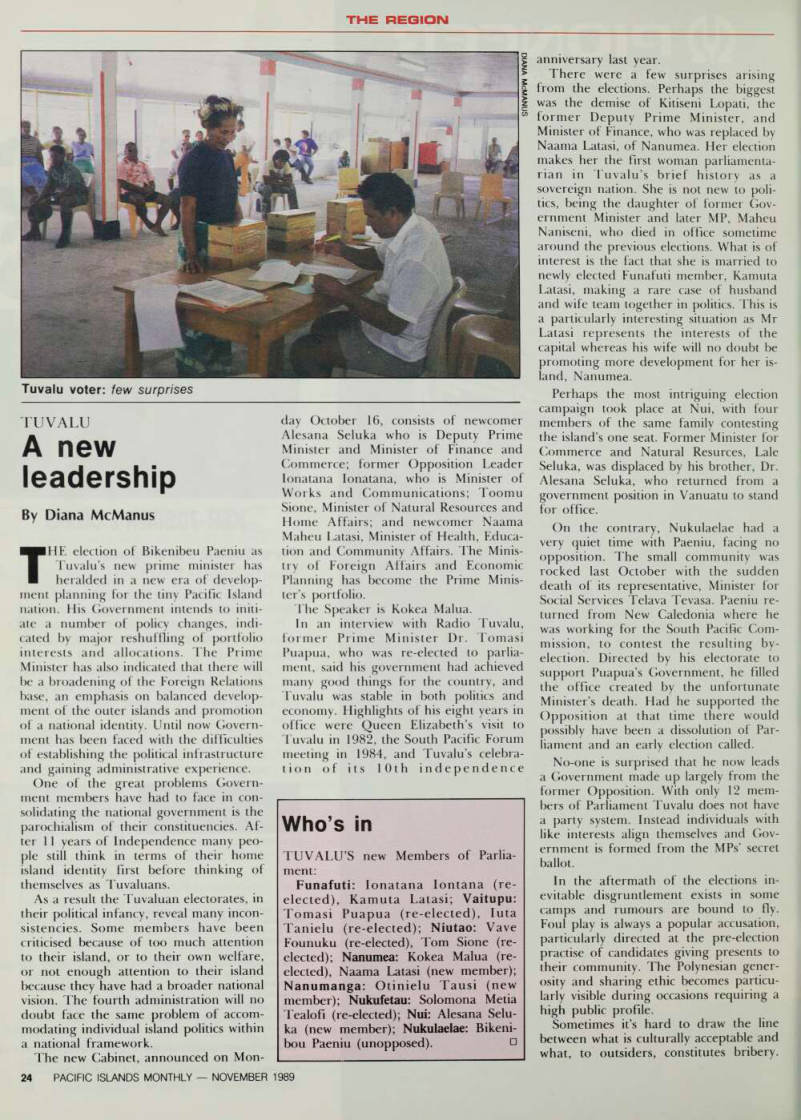
Tuvalu voter: few surprises