Coming
p. 24 · Read in the full issue
Sopac
Coming of age
By Josefa Nata
SOPAC has come of age. It has adopted a constitution to upgrade its status from a United Nation
Development Programme-sponsored
project to a fully fledged regional orga nisation. At its annual session in Canber ra last month it decided to change its name “to reflect its new status and also the type of work we do”.
“It also reflects the fact that we are an
independent, regional inter
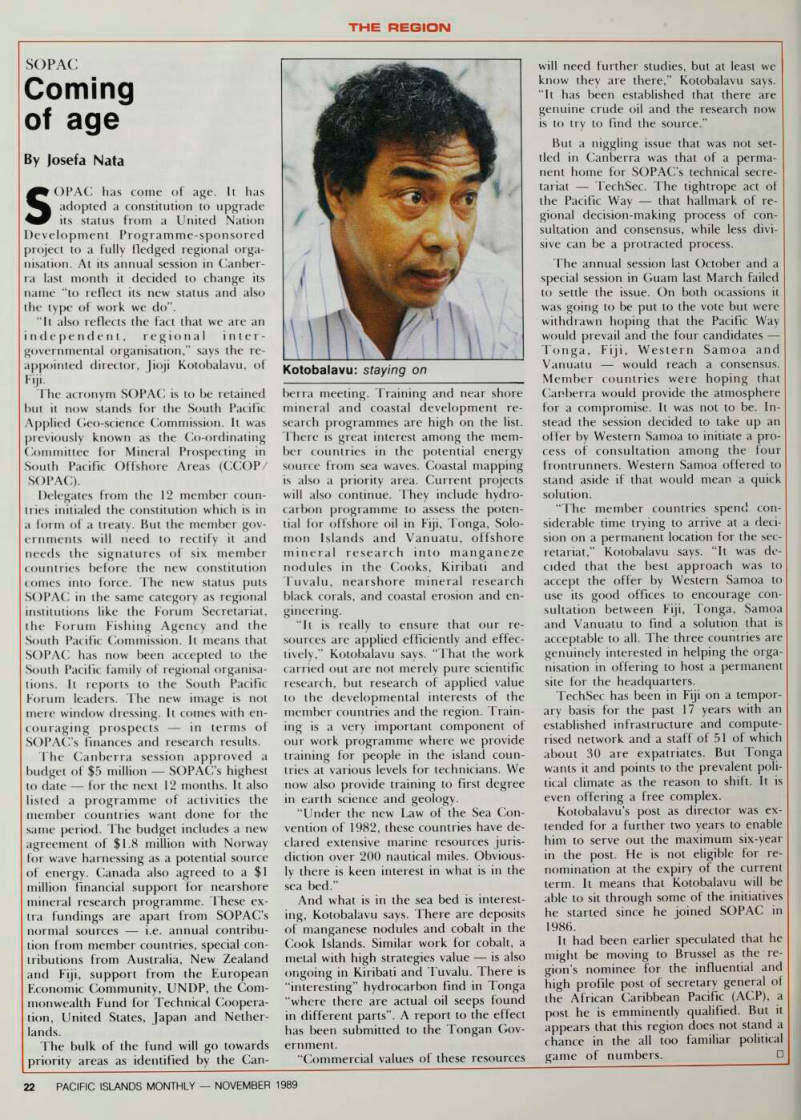
governmental organisation,” says the re appointed director, Jioji Kotobalavu, of
Fiji.
The acronym SOPAC is to be retained but it now stands for the South Pacific Applied Ceo-science Commission. It was previously known as the Co-ordinating Committee for Mineral Prospecting in South Pacific Offshore Areas (CCOP/
Sopac).
Delegates from the 12 member coun tries initialed the constitution which is in a form of a treaty. But the member gov ernments will need to rectify it and needs the signatures of six member countries before the new constitution comes into force. The new status puts SOPAC in the same category as regional institutions like the Forum Secretariat, the Forum Fishing Agency and the South Pacific Commission. It means that SOPAC has now been accepted to the
South Pacific family of regional organisa
tions. It reports to the South Pacific Forum leaders. The new image is not mere window dressing. It comes with en couraging prospects in terms of SOPAC’s finances and research results.
The Canberra session approved a budget of $5 million SOPAC’s highest to date for the next 12 months. It also listed a programme of activities the member countries want done for the same period. The budget includes a new agreement of $l.B million with Norway for wave harnessing as a potential source of energy. Canada also agreed to a $1 million financial support for nearshore mineral research programme. These ex tra fundings are apart from SOPAC’s normal sources i.e. annual contribu tion from member countries, special con tributions from Australia, New Zealand and Fiji, support from the European Economic Community, UNDP, the Com monwealth Fund for Technical Coopera tion, United States, Japan and Nether lands.
The bulk of the fund will go towards priority areas as identified by the Can-
berra meeting. Training and near shore mineral and coastal development re search programmes are high on the list.
There is great interest among the mem ber countries in the potential energy source from sea waves. Coastal mapping is also a priority area. Current projects will also continue. They include hydro carbon programme to assess the poten tial for offshore oil in Fiji, Tonga, Solo mon Islands and Vanuatu, offshore mineral research into manganeze nodules in the Cooks, Kiribati and Tuvalu, nearshore mineral research black corals, and coastal erosion and en
gineering.
“It is really to ensure that our re sources are applied efficiently and effec tively,” Kotobalavu says. “That the work carried out are not merely pure scientific research, but research of applied value to the developmental interests of the member countries and the region. Train ing is a very important component of our work programme where we provide training for people in the island coun tries at various levels for technicians. We now also provide training to first degree in earth science and geology.
“Under the new Law of the Sea Con vention of 1982, these countries have de clared extensive marine resources juris diction over 200 nautical miles. Obvious ly there is keen interest in what is in the sea bed.”
And what is in the sea bed is interest ing, Kotobalavu says. There are deposits of manganese nodules and cobalt in the Cook Islands. Similar work for cobalt, a metal with high strategies value is also ongoing in Kiribati and Tuvalu. There is
“interesting” hydrocarbon find in Tonga
“where there are actual oil seeps found in different parts”. A report to the effect has been submitted to the Tongan Gov ernment.
“Commercial values of these resources
will need further studies, but at least we know they are there,” Kotobalavu says.
“It has been established that there are genuine crude oil and the research now is to try to find the source.”
But a niggling issue that was not set tled in Canberra was that of a perma nent home for SOPAC’s technical secre tariat Tech Sec. The tightrope act of the Pacific Way that hallmark of re gional decision-making process of con sultation and consensus, while less divi sive can be a protracted process.
The annual session last October and a special session in Guam last March failed to settle the issue. On both ocassions it was going to be put to the vote but were withdrawn hoping that the Pacific Way would prevail and the four candidates Tonga, Fiji, Western Samoa and Vanuatu would reach a consensus.
Member countries were hoping that Canberra would provide the atmosphere for a compromise. It was not to be. In stead the session decided to take up an offer by Western Samoa to initiate a pro cess of consultation among the four frontrunners. Western Samoa offered to stand aside if that would mean a quick solution.
“The member countries spend con siderable time trying to arrive at a deci sion on a permanent location for the sec retariat,” Kotobalavu says. “It was de cided that the best approach was to accept the offer by Western Samoa to use its good offices to encourage con sultation between Fiji, Tonga, Samoa and Vanuatu to find a solution that is acceptable to all. The three countries are genuinely interested in helping the orga nisation in offering to host a permanent site for the headquarters.
Tech Sec has been in Fiji on a tempor ary basis for the past 17 years with an established infrastructure and compute rised network and a staff of 51 of which about 30 are expatriates. But Tonga wants it and points to the prevalent poli tical climate as the reason to shift. It is even offering a free complex.
Kotobalavu’s post as director was ex tended for a further two years to enable him to serve out the maximum six-year in the post. He is not eligible for re nomination at the expiry of the current term. It means that Kotobalavu will be able to sit through some of the initiatives he started since he joined SOPAC in 1986.
It had been earlier speculated that he might be moving to Brussel as the re gion’s nominee for the influential and high profile post of secretary general of the African Caribbean Pacific (AGP), a post he is emminently qualified. But it appears that this region does not stand a chance in the all too familiar political game of numbers. □
Kotobalavu: staying on