beautiful
p. 23 · Read in the full issue
Federated States
Of Micronesia
Small is beautiful
By Karen Mangnall
SMALL is beautiful and slow is best.
That’s the economic philosophy of Federated States of Micronesia’s
president John Haglelgam, which is
probably just as well considering the for midable hurdles facing the former Un ited Nations trust territory.
Haglelgam is openly critical of the 40 years of “inappropriate” American admi nistration which “was more interested in creating a big government and
bureaucracy and completely ignored eco
nomic development”.
“Our biggest challenge is to find a way to develop the economy so we can decide our own future and don’t have to de pend on the generosity of other coun tries,” Haglelgam says. Top of the agen da is cutting back the FSM’s bureaucracy
by making public service jobs “unattrac
tive”, as Haglelgam describes it, to en courage more people into the private sector. It’s been successful so far but the FSM now has to create more private sec tor jobs to take up the slack.
Haglelgam wants to encourage joint ventures with foreign investors to de velop the FSM’s agriculture, tourism and its vast fisheries. One hurdle is the FSM’s isolation from major regional markets.
But Haglelgam says the Compact of Free Association will provide a “strong mag net” for foreign investors once they real ise it provides a backdoor, duty-free en
try into the United States. As extra in centive, Haglelgam says the next session of the FSM Congress will be considering a package of tax breaks for foreign in vestors.
And although the FSM is upgrading its infrastructure with a major public works programme, Haglelgam says he’s not keen to match that with tourism de
velopment. The FSM lags just behind
Saipan and Guam as one of the major regional tourist destinations, but Haglel gam sees advantages in holding back.
“We have the opportunity and privilege to watch their development and learn from their mistakes so we can fashion our tourist development so it will not
disrupt our culture drastically,” he says.
Haglelgam says some aspects of the various Micronesian cultures have given way to four decades of American influ ence and his own administration is just beginning to assert a Micronesian fla vour. “Before it was more an American administration and American territory, so it has an American flavour to it but right now we can see Micronesian fea tures emerging,” he says. “We have tried as much as possible to incorporate our traditional way of doing things in run ning our country.”
The FSM is also asserting a new identity on the international stage, de
spite being handicapped by the fallout
from Palau’s constitutional row with the United States. The holdup means the United Nations Security Council hasn’t formally ended FSM’s Trust Territory status, even though the South Pacific Forum has recognised the FSM as a full
independent member. Haglelgam says
New Zealand and Australia have helped
by championing the FSM’s independent
status but many nations still refuse to
grant diplomatic recognition.
Palau’s debate over the boundaries of control over its foreign affairs and secur ity under the Compact of Free Associa tion with the Americans has also tar nished the FSM’s own image. “We have total control over foreign affairs but there is a fuzzy area dividing the bound ary between foreign affairs and secur ity,” Haglelgam says. “I can see in future heading on a collision course with the United States under the Compact. But it’s a remote possibility and it probably won’t come up at all during the life of
the Compact.”
Haglelgam gives as one example of the FSM’s foreign affairs independence its full support for the South Pacific Forum’s nuclear-free Treaty of Raroton ga, which the United States is still refus
ing to sign. Haglelgam’s government is
considering signing the treaty which would have to be amended to include the FSM’s territory. Haglelgam, says that after 40 years of Big Brothering from America, his country is keen to expand its links with the smaller countries in the region. New Zealand came in for special
praise during Haglelgam’s recent state
visit there, particularly for the way in which it administers aid.
“New Zealand aid is on a small scale.
If it comes in on a larger scale we have to bring in outsiders to administer it.
Small scale aid is better because we can handle it locally,” he says.
And despite the endless problems fac ing small Island nations, Haglelgam is confident the FSM can match its new political freedom with economic inde pendence. Says he; “I’m very optimistic that we will survive. If 1 were not opti mistic I wouldn’t be President.” □
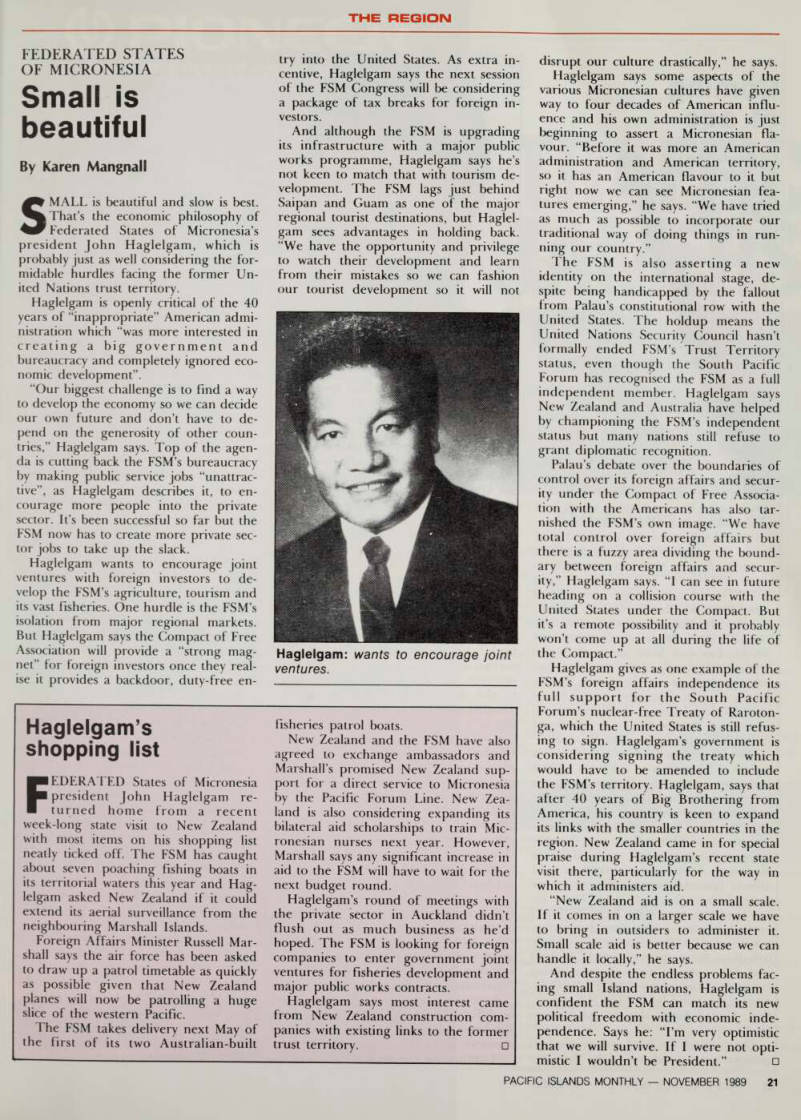
Haglelgam: wants to encourage joint ventures.