Finding a boss for Rabuka
pp. 20-22 · Read in the full issue
Fiji Finding a boss for Rabuka
By Jale Moala
ON a hill looking out over Suva Harbour bulldozers have cleared the ground for Fiji’s new Parliament House. Next door, to the west, the former official residence of the Prime Minister stays vacant waiting to be altered for parliamentary offices.
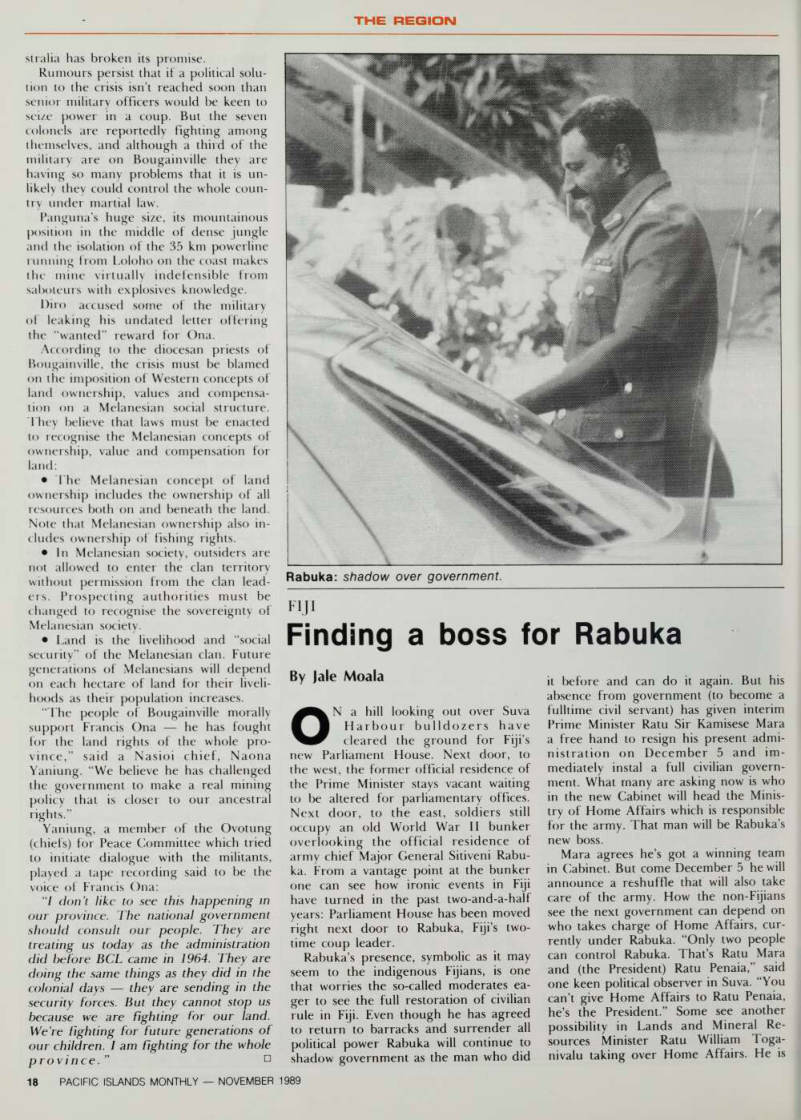
Next door, to the east, soldiers still occupy an old World War II bunker overlooking the official residence of army chief Major General Sitiveni Rabu ka. From a vantage point at the bunker one can see how ironic events in Fiji have turned in the past two-and-a-half years: Parliament House has been moved right next door to Rabuka, Fiji’s two time coup leader.
Rabuka’s presence, symbolic as it may seem to the indigenous Fijians, is one that worries the so-called moderates ea ger to see the full restoration of civilian rule in Fiji. Even though he has agreed to return to barracks and surrender all political power Rabuka will continue to shadow government as the man who did
it before and can do it again. But his absence from government (to become a fulltime civil servant) has given interim Prime Minister Ratu Sir Kamisese Mara a free hand to resign his present admi nistration on December 5 and im mediately instal a full civilian govern ment. What many are asking now is who in the new Cabinet will head the Minis try of Home Affairs which is responsible for the army. That man will be Rabuka’s new boss.
Mara agrees he’s got a winning team in Cabinet. But come December 5 he will announce a reshuffle that will also take care of the army. How the non-Fijians see the next government can depend on who takes charge of Home Affairs, cur
rently under Rabuka. “Only two people
can control Rabuka. That’s Ratu Mara and (the President) Ratu Penaia,’’ said one keen political observer in Suva. “You can’t give Home Affairs to Ratu Penaia, he’s the President.” Some see another possibility in Lands and Mineral Re sources Minister Ratu William Toga nivalu taking over Home Affairs. He is
of noble birth, a former soldier, and a former Minister for Home Affairs.
But Mara is the man who can keep the rein on Rabuka. He is undoubtedly the logical choice for Home Affairs. But this could mean giving away Foreign Affairs responsibilities to someone else. So perhaps the best alternative is for Mara to retain the Foreign Affairs portfolio
and bring Defence under the Prime Minister’s Office while Home Affairs
(police, prisons, immigration and
meteorological services) go to someone else. This will give Mara direct control of the army and it will elevate Rabuka to a position where he will be responsible only to the Prime Minister.
What of the rest of Cabinet? Rabuka’s
three colonels in Cabinet Youth and Sports Minister Ilaisa Kacisolomone, Fi jian Affairs Minister Vatiliai Navunisar avi and Rural Development and Rural
Housing Minister Apolosi Biuvakaloloma
must go if the new government is to be seen as being free of military influ ences. Without Rabuka and his three col onels, Cabinet strength will be down to 17, close to the pre-coup strength of 14 ministers and two ministers of state in Mara’s last government before losing the general elections in April 1987. Youth and Sports can be easily reunited with Education. Fijian Affairs is likely to go to Toganivalu whose Lands and Mineral Resources portfolio can go to Primary Industries Minister Viliame Gonelevu.
Primary Industries can be reunited with Forests.
Other reshuffles could see Informa tion Minister Ratu Inoke Kubuabola being moved to a position where his ex perience with the Bible Society of the South Pacific could be used for youth development. After the controversies surrounding the signing of a 12-year ex clusive television contract with Kerry Packer in 1986, Mara will be looking for a tougher negotiator to deal with Fiji’s new television interests. One of the two Indian members, businessman Ishwari
Bajpai (the Minister for Co-operatives) could be dropped. Some question his role in the ministry which will now need to step up its development programmes to match the new government policy of
promoting indigenous Fijians in com
merce.
With a salary package of F 530,000plus for each Cabinet Minister, Mara can go for fewer ministers as an indication of government intention to save money.
However, should he decide on the likely choice of maintaining emphasis on eco nomic recovery and development then Mara will replace the army colonels with a view of achieving a better distribution of duties. This could mean bringing in another Indian, although Mara will be cautious not to be seen by Fijians as en couraging the participation of Indians in decision-making. Two names have been mentioned as likely new candidates for
Cabinet: Fiji Development Bank general
manager Laisenia Qarase and trade un ionist Jim Smith. Qarase’s name is being linked to the Ministry of Finance, where he once worked as permanent secretary.
Some say he could take over from Kami kamica who could move to Lands. He is the general manager of Native Lands Trust Board.
Smith’s name is being linked with the
Ministry of Communications, Works and
Transport, currently being run by Apisai
Tora. Smith was a National Federation Party parliamentarian. But in recent months he has aligned himself close to Mara’s administration through pro government union initiatives. His role in Cabinet could be to quicken the comple tion of the new Marine Board Regula tions, a work overdue in Tora’s terms of office. fora, who has often been exhausted by the work involved in his large minis try, could move to Information where he could oversee the introduction of televi sion.
The reshuffle will help the introduc tion of a new constitution. While Fiji continues to attract vicious criticism for its biased draft constitution, New Zea land’s Foreign Affairs Minister Russell Marshall admits it “is probably the best we are going to get.” He was reported as saying that Fiji’s proposed new constitu tion was not as good as it should be, but the Commonwealth had to think whether it would ever get a better one.
Marshall, who was reported in the New Zealand Herald , was speaking in Kuala Lumpur after Papua New Guinea Prime Minister Rabbie Namaliu told journalists at the Heads of Commonwealth Meeting
there that the Commonwealth should consider Fiji’s re-admission “.at the appropriate time when she feels that she should re-apply.” The proposed new
constitution, published in September,
gives only 27 of the 69 seats in Parlia ment to the Indian community.
India’s External Affairs Minister, Nat
war Singh, overnight in Wellington in
early October to lobby New Zealand opposition to Fiji at the Commonwealth meeting. He met with Prime Minister Geoffrey Palmer and condemned Fiji’s draft constitution as a recipe for apar theid that would solve nothing. The In dian Ocean state of Mauritius, which attacked post-coup Fiji at the United Na tions, argued in Kuala Lumpur against re-admitting Fiji to the Commonwealth.
But Mauritius President Sir Anerood Jugnauth lost impact when he made the mistake of telling Commonwealth leaders Fiji had no indigenous people. “So I had a little conversation with them to give them a little information about the poli tical realities of Fiji,” Marshall told New Zealand Herald. On the other hand Fiji won sympathy from Papua New Guinea, the rest of the Melanesian countries and Malaysia for efforts to protect the aspira tions and rights of the indigenous peo
ple. n