the jungle
pp. 18-19 · Read in the full issue
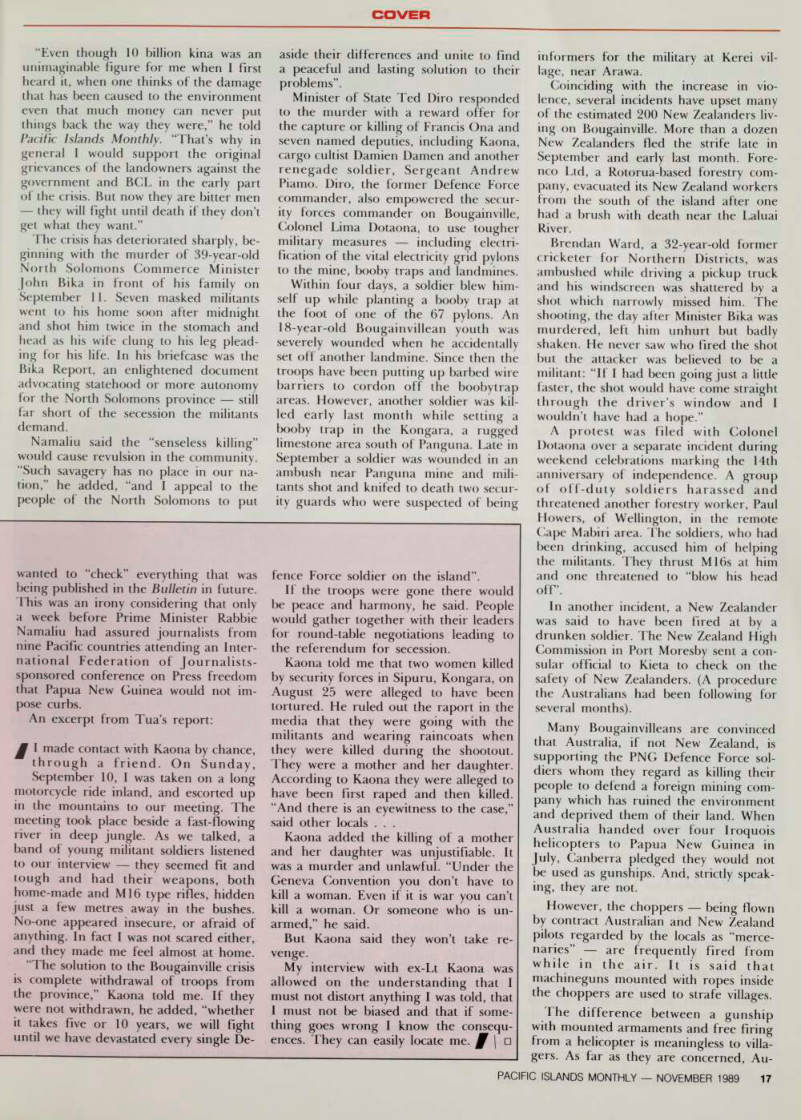
A scoop in the jungle
For 22-year-old Bougainvillean jour
nalist Moresi Tua, of the weekly Arawa Bulletin newspaper, it was an innocent scoop. But his deep-in-the jungle interview with Francis Ona’s right-hand man, former PNG Defence Force Lieutenant Sam Kaona, caused such an uproar that he was forced to go
into hiding.
Papua New Guinea security forces, negotiators and journalists had been trying to track down the militant lead ership for weeks when Tua got an inter view with Kaona “by chance”. His article, setting out the militant leadership’s con ditions for dialogue, was published in a “sanitised” version in the Post-Courier on September 14; the original account appeared in the Arawa Bulletin the fol
lowing day. Immediately the repercus
sions were dramatic. Soldiers burst into the Bulletin’s office, cleared out the handful of staff, baled up acting editor Carol Brett who thought “this is it for me” and demanded to be led to Tua who was on his day off.
Minister of State Ted Diro ordered restrictions on the movement of journal
ists on Bougainville, making it tougher
to gather information about events.
News media were barred from the joint forces headquarters in the commandeered Nafiq Club in Arawa.
According to one national government official, “unsubstantiated” reports by some local and foreign media organisations was the reason for the restrictions.
However, other sources indicated the real reason was the embarrassment of
military intelligence being caught flat-
footed over the Kaona interview.
On his first day back at work after the independence celebrations weekend break, Tua realised for the first time the reaction by authorities to his article. Tua voluntarily went to the joint forces headquarters and was interviewed by Colonel Lima Dotaona. The military wanted Tua to reveal where the interview took place.
But he refused to reveal his sources, or any information about where the inter
view happened.
“They asked me if I had actually had an interview with the lieutenant,” Tua told Pacific Islands Monthly. “What does he look like? What was he wearing? How did I actually know it was him? He is muscular, well built. He was dressed in white singlet, shorts and army boots.
The way he was talking, how he pre sented himself, how he introduced him self to me I had no doubt it was him.
I’ve seen his photo on TV.”
After a further interview by the milit ary that morning, Tua went home “sick” and then slipped off to his village until the fuss died down. But the military made it clear to deputy editor Brett they
wanted to “check” everything that was being published in the Bulletin in future.
This was an irony considering that only a week before Prime Minister Rabbie Namaliu had assured journalists from nine Pacific countries attending an Inter national Federation of Journalists sponsored conference on Press freedom that Papua New Guinea would not im pose curbs.
An excerpt from Tua’s report: £ I made contact with Kaona by chance, through a friend. On Sunday, September 10, I was taken on a long motorcycle ride inland, and escorted up in the mountains to our meeting. The meeting took place beside a fast-flowing river in deep jungle. As we talked, a band of young militant soldiers listened to our interview they seemed fit and tough and had their weapons, both home-made and Ml 6 type rifles, hidden just a few metres away in the bushes.
No-one appeared insecure, or afraid of anything. In fact I was not scared either, and they made me feel almost at home.
“The solution to the Bougainville crisis is complete withdrawal of troops from the province,” Kaona told me. If they were not withdrawn, he added, “whether it takes five or 10 years, we will fight until we have devastated every single De
fence Force soldier on the island”.
If the troops were gone there would be peace and harmony, he said. People would gather together with their leaders for round-table negotiations leading to the referendum for secession.
Kaona told me that two women killed by security forces in Sipuru, Kongara, on August 25 were alleged to have been tortured. He ruled out the raport in the media that they were going with the militants and wearing raincoats when they were killed during the shootout.
They were a mother and her daughter.
According to Kaona they were alleged to have been first raped and then killed.
“And there is an eyewitness to the case,” said other locals . . .
Kaona added the killing of a mother and her daughter was unjustifiable. It was a murder and unlawful. “Under the Geneva Convention you don’t have to kill a woman. Even if it is war you can’t kill a woman. Or someone who is un armed,” he said.
But Kaona said they won’t take re venge.
My interview with ex-Lt Kaona was allowed on the understanding that I must not distort anything I was told, that I must not be biased and that if some thing goes wrong I know the consequ ences. They can easily locate me. J \ □