Land rights
p. 13 · Read in the full issue
AS elsewhere in Papua New Guinea and the rest of the Pacific there is a powerful intimate rela tionship between people and land in Bougainville. In traditional culture, own ership or control over land was handed
down through innumerable generations,
but unlike the rest of Papua New Guinea it was normally through the female members of each tribe.
To Bougainvilleans, land has deep re ligious significance and has almost never
been transferred by sale. Primary rights
do not include the right to alienate tracts
of land by transferring freehold rights,
or by selling such rights, to a complete stranger. Although matrilineal kinship is important to the passing on of land
rights, such rights have normally been
used by men. This has sometimes led to disputes when men have wanted to plant cash crops on tracts of land where their wives have primary rights. Thus wives must approve of their husbands’ plans to use the land.
Under crown law introduced by the
Australian colonial administrators and adopted by the Papua New Guinea gov eminent at independence in 1975, things became very different, Bougainvilleans affected by the establishment of Panguna mine didn’t realise that the crown owned the rocks that lie beneath their land that they were entitled only to claim ownership of the first two metres of top soil.
“Australia had adopted the same law, which meant that the country’s Aborigin al inhabitants have become outcasts in their own land,” says Albert Toro, a playwright and National Cultural Board member who once worked for BCL’s media resources unit. “And it is the same law that colonial administrators apparently used to force the Rorovanas, on the coast of Bougainville, to surren der almost 100 ha of coconut plantation
to make way for the township of Loloho and for the mine’s port facilities.”
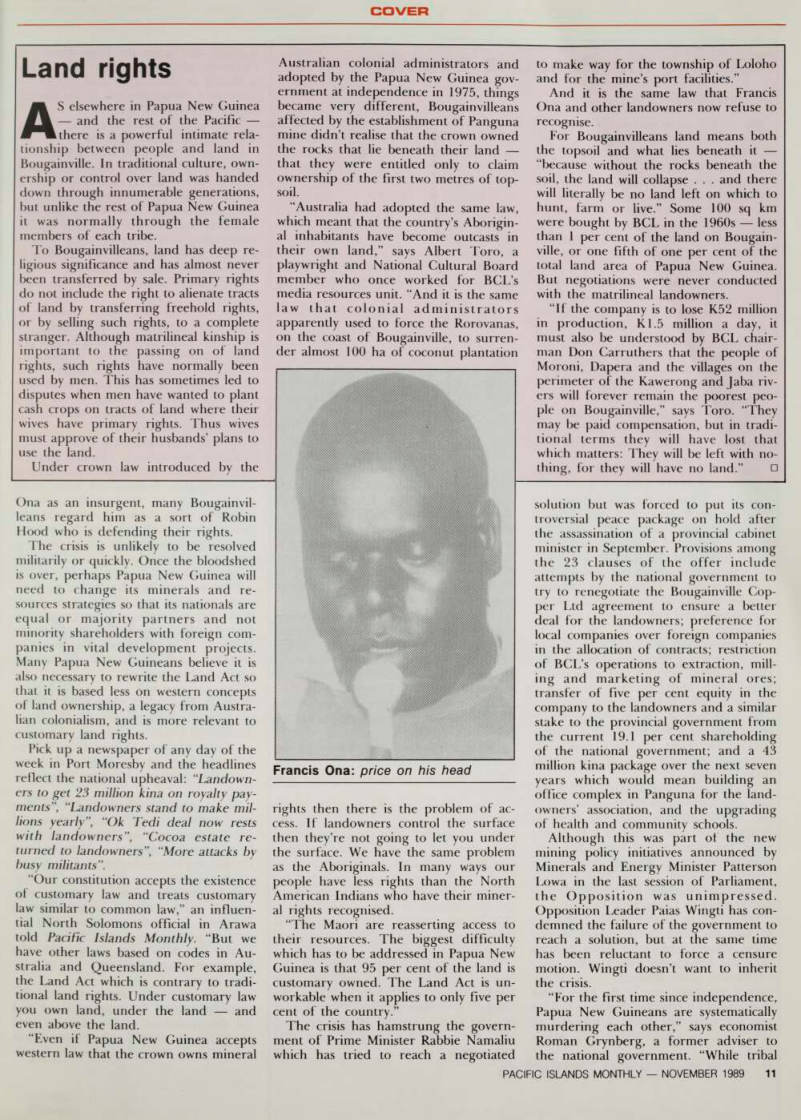
And it is the same law that Francis Ona and other landowners now refuse to recognise.
For Bougainvilleans land means both the topsoil and what lies beneath it “because without the rocks beneath the soil, the land will collapse . . . and there will literally be no land left on which to hunt, farm or live.” Some 100 sq km were bought by BCL in the 1960 s less than 1 per cent of the land on Bougain ville, or one fifth of one per cent of the total land area of Papua New Guinea.
But negotiations were never conducted with the matrilineal landowners.
“If the company is to lose K 52 million in production, K 1.5 million a day, it must also be understood by BCL chair man Don Carruthers that the people of Moroni, Dapera and the villages on the perimeter of the Kawerong and Jaba riv ers will forever remain the poorest peo
ple on Bougainville,” says Toro. “They
may be paid compensation, but in tradi tional terms they will have lost that which matters: They will be left with no thing, for they will have no land.” □
Francis Ona: price on his head