Bougainville
pp. 12-20 · Read in the full issue
Cover
Bougainville One year later
For a year, former surveyor Francis Ona and the tiny Bougainville Revolution ary Army have been holding an Australian mining company and the Papua New Guinea government to ransom. Port Moresby faces radical land and mineral policy reforms of risks disintegration.
By David Robie
PAPUA New Guinea has entered its 15th year of independence facing its most critical crossroads. The Bougainville crisis, which is a year old this month, cast a pall over the inde pendence celebrations in September and if it remains unresolved then national unity could slide into economic and poli
tical collapse.
The problems of Bougainville cannot be divorced from the rest of the country, or even from the rest of the Pacific. At stake are the crucial issues of a conflict between western concepts of land own ership and indigenous land values, the equity between the national government, provincial administration and the tradi tional landowners, and a choice between genuine sovereignty over resource de
velopment projects or dependence on
foreign control.
Bougainville’s key issues have parallels with New Zealand where the Maori peo ple are struggling for full recognition of the Treaty of Waitangi and partnership over the nation’s land, forests and fisher ies resources. They are also echoed in Australia where the Aboriginals are fighting for mineral and development rights. The same is now the demand by indigenous Fijians in post-coup Fiji.
Militants of the self-styled Bougainville
Revolutionary Army are holding one of the world’s biggest open-cut copper mines, a major Australian mining com pany, 2000 security forces and the national government to ransom. Rebel landowner leader Francis Ona and seven of his key lieutenants now have a 200,000 kina (US$200,000) “dead or alive” price tag on their heads.
But while the national government and foreign mining interests portray
David Robie
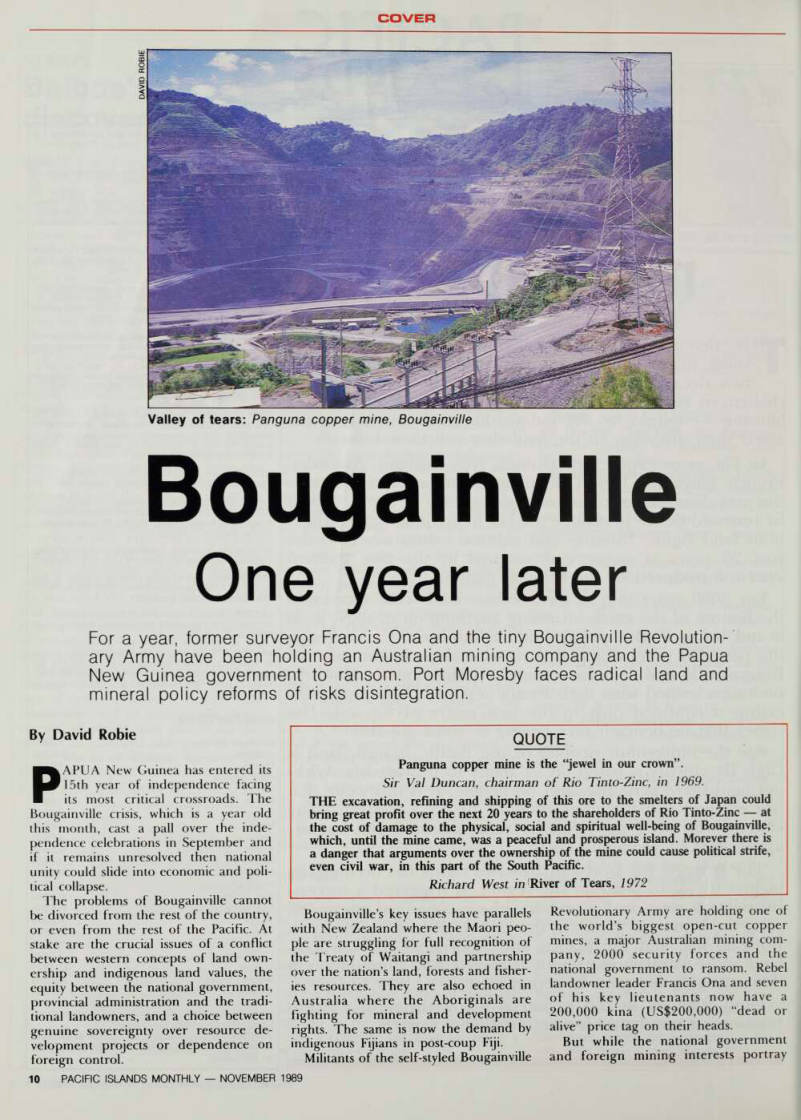
Valley of tears: Panguna copper mine, Bougainville
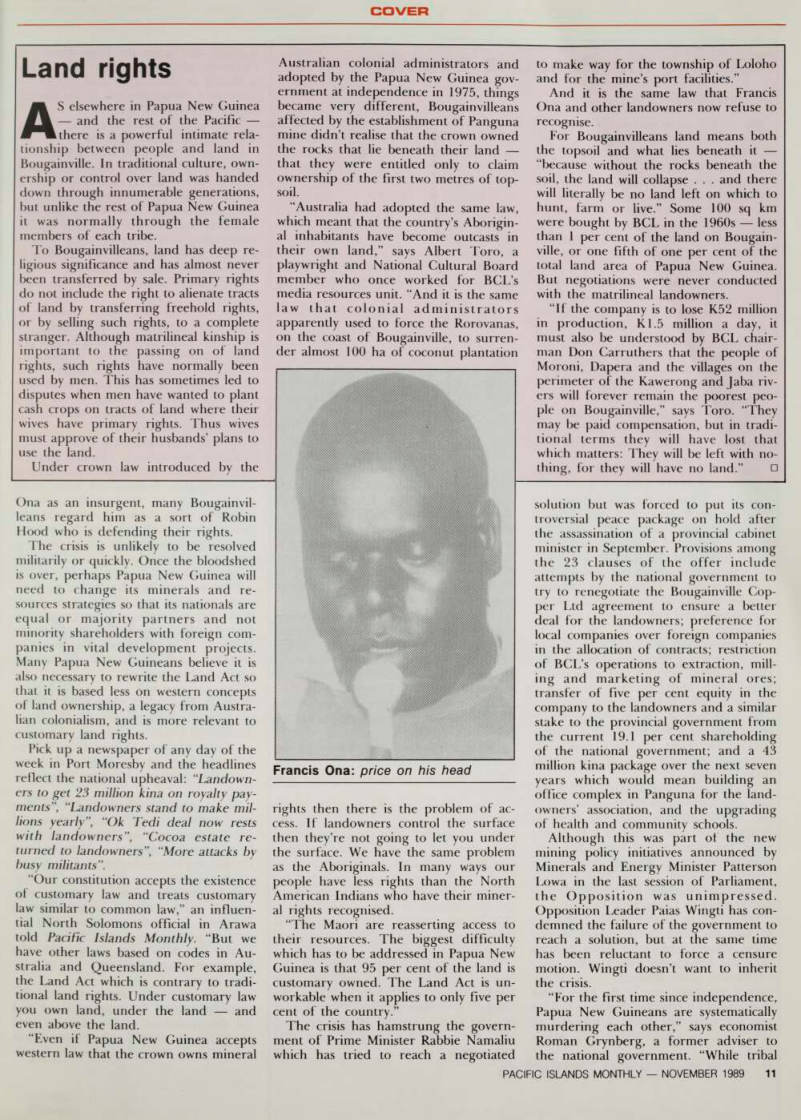
Ona as an insurgent, many Bougainvil leans regard him as a sort of Robin Hood who is defending their rights.
The crisis is unlikely to be resolved militarily or quickly. Once the bloodshed is over, perhaps Papua New Guinea will need to change its minerals and re sources strategies so that its nationals are equal or majority partners and not minority shareholders with foreign com
panies in vital development projects.
Many Papua New Guineans believe it is also necessary to rewrite the Land Act so that it is based less on western concepts of land ownership, a legacy from Austra lian colonialism, and is more relevant to customary land rights.
Pick up a newspaper of any day of the week in Port Moresby and the headlines reflect the national upheaval: “Landown ers to get 23 million kina on royalty pay ments”, “Landowners stand to make mil lions yearly ”, “Ok Tedi deal now rests with landowners ”, “Cocoa estate re turned to landowners ”, “More attacks by busy militants ”.
“Our constitution accepts the existence of customary law and treats customary law similar to common law,” an influen tial North Solomons official in Arawa told Pacific Islands Monthly. “But we have other laws based on codes in Au stralia and Queensland. For example, the Land Act which is contrary to tradi tional land rights. Under customary law you own land, under the land and even above the land.
“Even if Papua New Guinea accepts western law that the crown owns mineral
rights then there is the problem of ac cess. If landowners control the surface then they’re not going to let you under the surface. We have the same problem as the Aboriginals. In many ways our people have less rights than the North American Indians who have their miner
al rights recognised.
“The Maori are reasserting access to their resources. The biggest difficulty which has to be addressed in Papua New Guinea is that 95 per cent of the land is customary owned. The Land Act is un workable when it applies to only five per cent of the country.”
The crisis has hamstrung the govern ment of Prime Minister Rabbie Namaliu which has tried to reach a negotiated
solution but was forced to put its con troversial peace package on hold after the assassination of a provincial cabinet minister in September. Provisions among the 23 clauses of the offer include attempts by the national government to
try to renegotiate the Bougainville Cop
per Ltd agreement to ensure a better deal for the landowners; preference for
local companies over foreign companies
in the allocation of contracts; restriction of BCL’s operations to extraction, mill ing and marketing of mineral ores; transfer of five per cent equity in the company to the landowners and a similar stake to the provincial government from the current 19.1 per cent shareholding of the national government; and a 43 million kina package over the next seven years which would mean building an office complex in Panguna for the land owners’ association, and the upgrading of health and community schools.
Although this was part of the new
mining policy initiatives announced by
Minerals and Energy Minister Patterson Lowa in the last session of Parliament,
the Opposition was unimpressed.
Opposition Leader Paias Wingti has con demned the failure of the government to reach a solution, but at the same time has been reluctant to force a censure motion. Wingti doesn’t want to inherit the crisis.
“For the first time since independence, Papua New Guineans are systematically murdering each other,” says economist Roman Grynberg, a former adviser to the national government. “While tribal
warfare has gone on from time im memorial, what is new about this conflict is that it is about gold and copper
something quite foreign to traditional
Papua New Guinea society.
“For the first time, Papua New Guinea is writing its history in blood.”
In spite of the revolt which has left more than 40 people dead and triggered a minor New Zealand exodus in October big foreign investors such as Conzinc Riotinto Australia Ltd (CRA) and the American oil corporation, Chevron, are persevering with other projects. Howev er, such ventures as Chevron’s drilling in the Northern Highlands and the Hidden Valley gold mine were already well com mitted.
But will this confidence continue if CRA’s Bougainville Copper Ltd, the mainstay of the national economy, is put into “mothballs” for a year, as company executives threaten, or is shut down.
Since May 15 the mine has opened only once and then closed down eight hours later when militants ambushed a bus carrying workers.
Already belt-tightening is under way in Papua New Guinea. The first target is to restructure the huge, cumbersome
and expensive bureaucracy bequeathed
to the country by the Australian colonial administrators. Some government de partments may be axed in the govern ment’s new contingency plans aimed at coping with the huge financial losses from the crisis.
Namaliu may be also forced to drop some ministers and absorb their duties into other ministries at a cost-cutting de vice. An official announcement about the abolition of departments is expected to be made before the start of this month’s
parliamentary session.
Drastic cuts will be suggested by a “hatchet committee” chaired by Minister of State Ted Diro. His colleagues are Trade and Industry Minister John Gihe no, Police Minister Mathias Ijape, Justice Minister Bernard Narokobi and Admi nistrative Services Minister Theodore
Tuya.
Some optimistic observers believe that the hardship caused by a full closure of the Panguna mine on Bougainville could be a blessing in disguise it might force the country into reducing its dependence on mining and into developing its neg lected agriculture sector. Another sug gestion is that a new major gold mine at Porgera, in Enga province, and in creased production at the Ok Tedi mine in the Star Mountains could soften the loss from Bougainville in a not too dis tant future.
Apart from the environmental de vastation caused by Panguna mine and the disappearance of the ancestral land belonging to tribes like the Nasioi, a cru cial factor in the upheaval is the dispar
ity between tne 58 per cent of profit going to the national government which owns 19 per cent of BCL through dividends and taxation, com pared with 5 per cent for the provincial government and a mere 1 per cent in royalties and compensation for the land owners.
Under the agreement worked out be fore independence in 1975, the other shareholders mainly foreign with the biggest being Conzinc Riotinto Australia Ltd (CRA) with 53.6 per cent share the remaining 36 per cent of total earn
ings.
Since 1972, Panguna mine has pro vided 17 per cent of the national govern ment’s revenues and 45 per cent of its exports. Before it closed, the mine was pumping 1 million kina a day into the national government’s coffers and profits of 1.5 million kina a week to BCL.
When the crisis began, 3550 workers were employed at the mine including 610 expatriates, mostly Australian but also many New Zealanders. Of the 2950 Papua New Guinea citizens, two-thirds of them were from the rest of the country.
Now, following retrenchments, suspen sions and resignations, there are 2350 on the payroll with more retrenchments said to be imminent. In the last full year of operations the mine produced re venue of 480 million kina and after tax profits of 108.6 million kina.
The outside labour creates another
problem. The jet-black Bougainvilleans
consider themselves apart from the rest of the country’s ethnic groups whom they refer to disdainfully as “redskins”.
They resent the jobs |that have, gone to mainlanders and they resent the high salaries paid to expatriates along with the distortion of the local economy caused by the high proportion of fore igners living on the island, mainly Au stralians and New Zealanders.
The colonial experience on Bougain ville is rather different from on the mainland. Colonial powers arrived late, encountering an island which is moun tainous, covered in dense jungle, and criss-crossed by rivers and ravines. Dur ing the 1880 s, German traders and mis sionaries came to Bougainville and the north-east coast of the mainland.
Bougainville is geographically and cul turally part of the Solomon Islands. The island, swapped by Britain last century for German Samoa, was absorbed into Papua New Guinea during the First World War when Australia captured the German-ruled territories.
These factors help explain why the
idea of secession has found fertile ground on the island.
According to British author Richard West in his 1972 book, River of Tears; The Rise of the Rio Tinto-Zinc Mining Corporation, initial contact between the
company and the Nasioi villages in the area which is now the mine site was con fused by company and administration re liance on a single outspoken Nasioi who “had no right to commit the community to cooperation with CRA”. In fact, the women who were the traditional land owners under the matrilineal system were not negotiated with at all.
Opposition to the mine was overruled,
quite legally by the colonial administra
tion under Australian law, but it has led to growing feelings of intimidation and betrayal among the landowners since their original opposition in 1962. The arrival of the company fuelled secession ist sentiments in 1969 with the founding of Napidakoe Navitu which had its sights
on Bougainville independence.
Responding to an appeal by Prime Minister Namaliu for the establishment of dialogue to end the crisis, Ona’s right hand man, army deserter Lieutenant Sam Kaona, told Arawa Bulletin repor ter Moresi Tua in an exclusive interview (see box p!6) that any committee or indi vidual seeking negotiation must: • view the Bougainville crisis from the point of view of Francis Ona and his supporters • truly represent the wishes of the 140,000 people of Bougainville to the Prime Minister and cabinet and other countries. • have no interest in protecting any foreign company or business.
• be prepared to fight on behalf of Ona “and the Bougainvillieans” for a re ferendum and independence, or to can vas views on secession for Bougainville. • be ready to suffer even if it means death and many years of struggle When the smouldering resentment among customarylandowners which stretches back to the 19605, long before independence burst into open revolt last November with a raid on the Pangu na mine’s explosives magazine, the mili tants had very clear demands. They wanted a massive 10 billion kina com pensation for use of the land and the environmental devastation, closure of the mine and secession from Papua New Guinea. The latter demand was a revival
of a desire at independence which has continued to enjoy popular support among many Bougainvilleans.
Ironically, a catalyst in the struggle was an environmental and social impact report prepared by a PNG government appointed New Zealand company, Auck land-based Applied Geology Associates Ltd (AGA), which was regarded as any thing but independent by many of the landowners. Describing the report as being perceived as a “whitewash” by landowners, North Solomons Premier Joseph Kubui (See Pacific People, Page 51, for interview) told Pacific Islands Monthly it was a trigger for militant ac tion. “It wasn’t the right sort of report,” he says. “It was okay as far as the legal
framework was concerned. But the general feeling was that it didn’t ade
quately address environmental pollution.
“The people of Bougainville agree that it is necessary to take a more radical approach to avoid the catastrophe we have gone through now. This experience has opened the eyes of our politicans.
We believe the report was a failure. The investigating team didn’t have time to get to the bottom of questions. Three months was too short that’s what the owners wanted.”
Actually the report, completed earlier this year, does describe extensive en vironmental damage, and provincial gov ernment officials who have closely stu died it regard it as far more critical of BCL and the national government than the landowners realise.
Landowners regard logic and science as “white man’s trickery” an accusa tion they threw at the environmental re port. Notions of nationhood, investor confidence and BCL’s share price in Au stralia are irrelevant to them. And re gardless of what the report said, the landowners are convinced that the mine has driven away the island’s fruit bats, ruined banana crops and caused girls to begin menstruation earlier than they used to.
The report’s chief author, envrion mental consultant Martin Ward, says Panguna Landowners Association secret ary Francis Ona tried to intimidate him at a meeting in the Panguna chapel in September 1989. Ona was so wound up that he walked up to Ward thust his face menacingly in front of the consultant and pointed to the altar crucifix.
“Em ‘big fella ’ kilim i dai, Mipela nogat likem report bilong yu, yu kilim,” hissed Ona in Pidgin, and he drew his finger across his throat.
Two months later, discussing the pre liminary findings of the report in a meeting at the provincial government offices, the landowners became angry when they realised it wouldn’t be as damning as they wanted. When one con sultant said it couldn’t be proven scien tifically that fish were dying from the pollution of the Jaba River, a landowner sneered: “Have you drunk from it?”
Eventually Ona angrily stormed out declaring, “the only way is for us to shut the mine”. A former surveyor and truck driver at the mine, Ona and his suppor ters took to the jungle and launched a long war of attrition and sabotage against the mine.
The mine company, whose 1988 annual report has a misleading “environ mentally sound” cover depicting lush rainforest, was satisfied with the AGA report. “It showed there was no blame on us,” says commercial general manager Ken Perry. “The problem is that double the size of the population is now compet
ing for the same resources. What I said to the landowners was, ‘You have asked the wrong questions, You asked them (AGA consultants) to prove BCL did it.
You should have asked why is it happen
ing that’s why you’re unhappy’.”
The report describes • a mine pit occupying 400 hectares
and proposed pit extensions totalling
1210 hectares; 300 hectares of waste rock dumps, which could extend to 550 hectares if the mine is extended 15 years; 3000 hectares of mine tailings de vasting the Kawerong and Jaba river val leys and a 900 hectare delta of dis charged tailings in Princess Augusta Bay.
According to economist Grynberg, 90 per cent of the land loss at Panguna is a result of the manner in which BCL has disposed of its tailings. “BCL has opted for the environmentally sound method only when it is the least expensive solu tion”, he says. In its initial proposal, the company had argued that dumping the tailings into the river would cause broad-scale land loss. But later, because it was cheaper, it decided to dump the trailings in the Kawerong and Jaba rivers after all.
Among the AGA report’s recom mendations were that:
• the company and national government urgently needed to establish a quick and clear communications link with the landowners and the provincial government • lease documents, land ownership records and other information needed to be brought up to date and made freely available • information about the mine should
be provided in the Pidgin language;
senior mine management should learn
Pidjin.
• the present system of compensation payments needed urgent overhauling • improved housing needed to be provided for mine workers • a comprehensive health programme was needed, including the control of malaria; and • the company needs to undertake serious planning for mine closure covering rehabilitation of all mine-ravaged areas
and revegetation.
Landowner spokesman Lawrence
Daveona, secretary of the Panguna Road Mining Tailings Leases Trust Ltd., claims 39 Bougainvilleans have been kil led so far in the struggle. Although pro vincial government officials say this fi gure is too high, it is widely reported that at least 40 people overall have died, Also, human rights observers are trou bled by persistent but unconfirmed rumours that many Bougainvillean villa gers have been killed and their bodies left in free fire zones that are closed to journalists. More than 3000 villagers have been evacuated, or “relocated” under the official auphemism, to makeshift camps around Arawa. Any body left behind is regarded as a rebel.
“Everyone except the militants is fed up with the bloodshed and wants the crisis solved as soon as possible,” says
Catholic Bishop Gregory Singkai, who
trekked into the jungle in July for a four-hour talk with Ona the last direct contact by mediators with the mili tant leader.
Moresi Tua: contact with the rebels
“Even though 10 billion kina was an unimaginable figure for me when I first heard it, when one thinks of the damage that has been caused to the environment even that much money can never put things back the way they were,” he told Pacific Islands Monthly. “That’s why in general 1 would support the original grievances of the landowners against the government and BCL in the early part of the crisis. But now they are bitter men — they will fight until death if they don’t get what they want.”
The crisis has deteriorated sharply, be ginning with the murder of 39-year-old North Solomons Commerce Minister John Bika in front of his family on September 11. Seven masked militants went to his home soon after midnight and shot him twice in the stomach and head as his wife clung to his leg plead ing for his life. In his briefcase was the Bika Report, an enlightened document advocating statehood or more autonomy for the North Solomons province — still far short of the secession the militants demand.
Namaliu said the “senseless killing” would cause revulsion in the community.
“Such savagery has no place in our na tion,” he added, “and I appeal to the people of the North Solomons to put
aside their differences and unite to find a peaceful and lasting solution to their
problems”.
Minister of State Ted Diro responded to the murder with a reward offer for the capture or killing of Francis Ona and seven named deputies, including Kaona, cargo cultist Damien Damen and another
renegade soldier, Sergeant Andrew
Piamo. Diro, the former Defence Force commander, also empowered the secur ity forces commander on Bougainville, Colonel Lima Dotaona, to use tougher
military measures including electri
fication of the vital electricity grid pylons to the mine, booby traps and landmines.
Within four days, a soldier blew him self up while planting a booby trap at the foot of one of the 67 pylons. An
18-year-old Bougainvillean youth was
severely wounded when he accidentally set off another landmine. Since then the troops have been putting up barbed wire barriers to cordon off the boobytrap areas. However, another soldier was kil led early last month while setting a booby trap in the Kongara, a rugged limestone area south of Panguna. Late in September a soldier was wounded in an ambush near Panguna mine and mili tants shot and knifed to death two secur ity guards who were suspected of being
informers for the military at Kerei vil lage, near Arawa.
Coinciding with the increase in vio lence, several incidents have upset many of the estimated 200 New Zealanders liv ing on Bougainville. More than a dozen New Zealanders fled the strife late in September and early last month. Fore nco Ltd, a Rotorua-based forestry com pany, evacuated its New Zealand workers from the south of the island after one had a brush with death near the Laluai River.
Brendan Ward, a 32-year-old former cricketer for Northern Districts, was ambushed while driving a pickup truck and his windscreen was shattered by a shot which narrowly missed him. The shooting, the day after Minister Bika was murdered, left him unhurt but badly shaken. He never saw who fired the shot but the attacker was believed to be a militant: “If I had been going just a little faster, the shot would have come straight through the driver’s window and I wouldn’t have had a hope.”
A protest was filed with Colonel Dotaona over a separate incident during weekend celebrations marking the 14th anniversary of independence. A group of off-duty soldiers harassed and threatened another forestry worker, Paul Mowers, of Wellington, in the remote Cape Mabiri area. The soldiers, who had been drinking, accused him of helping the militants. They thrust Ml6s at him and one threatened to “blow his head off’.
In another incident, a New Zealander was said to have been fired at by a drunken soldier. The New Zealand High Commission in Port Moresby sent a con sular official to Kieta to check on the safety of New Zealanders. (A procedure the Australians had been following for several months).
Many Bougainvilleans are convinced that Australia, if not New Zealand, is supporting the PNG Defence Force sol diers whom they regard as killing their people to defend a foreign mining com pany which has ruined the environment and deprived them of their land. When Australia handed over four Iroquois helicopters to Papua New Guinea in
July, Canberra pledged they would not
be used as gunships. And, strictly speak
ing, they are not.
However, the choppers being flown by contract Australian and New Zealand pilots regarded by the locals as “merce naries” are frequently fired from while in the air. It is said that machineguns mounted with ropes inside the choppers are used to strafe villages.
The difference between a gunship with mounted armaments and free firing from a helicopter is meaningless to villa gers. As far as they are concerned, Au
stralia has broken its promise.
Rumours persist that if a political solu tion to the crisis isn’t reached soon than senior military officers would be keen to seize power in a coup. But the seven colonels are reportedly fighting among themselves, and although a third of the
military are on Bougainville they are
having so many problems that it is un likely they could control the whole coun try under martial law.
Panguna’s huge size, its mountainous position in the middle of dense jungle and the isolation of the 35 km powerline running from Loloho on the coast makes the mine virtually indefensible from
saboteurs with explosives knowledge.
Diro accused some of the military of leaking his undated letter offering the “wanted” reward for Ona.
According to the diocesan priests of Bougainville, the crisis must be blamed on the imposition of Western concepts of land ownership, values and compensa tion on a Melanesian social structure.
They believe that laws must be enacted to recognise the Melanesian concepts of ownership, value and compensation for land; • The Melanesian concept of land ownership includes the ownership of all resources both on and beneath the land.
Note that Melanesian ownership also in
cludes ownership of fishing rights.
• In Melanesian society, outsiders are not allowed to enter the clan territory without permission from the clan lead ers. Prospecting authorities must be
changed to recognise the sovereignty of
Melanesian society.
• Land is the livelihood and “social security” of the Melanesian clan. Future generations of Melanesians will depend on each hectare of land for their liveli hoods as their population increases.
“The people of Bougainville morally
support Francis Ona he has fought for the land rights of the whole pro vince,” said a Nasioi chief, Naona Yaniung. “We believe he has challenged the government to make a real mining policy that is closer to our ancestral
rights.”
Yaniung, a member of the Ovotung (chiefs) for Peace Committee which tried to initiate dialogue with the militants, played a tape recording said to be the voice of Francis Ona: “/ don’t like to see this happening in our province. The national government should consult our people. They are treating us today as the administration did before BCL came in 1964. They are doing the same things as they did in the colonial days they are sending in the security forces. But they cannot stop us because we are fighting for our land.
We’re fighting for future generations of our children. I am fighting for the whole
province.” D
Rabuka: shadow over government.