New horizon
pp. 51-52 · Read in the full issue
Pacific People
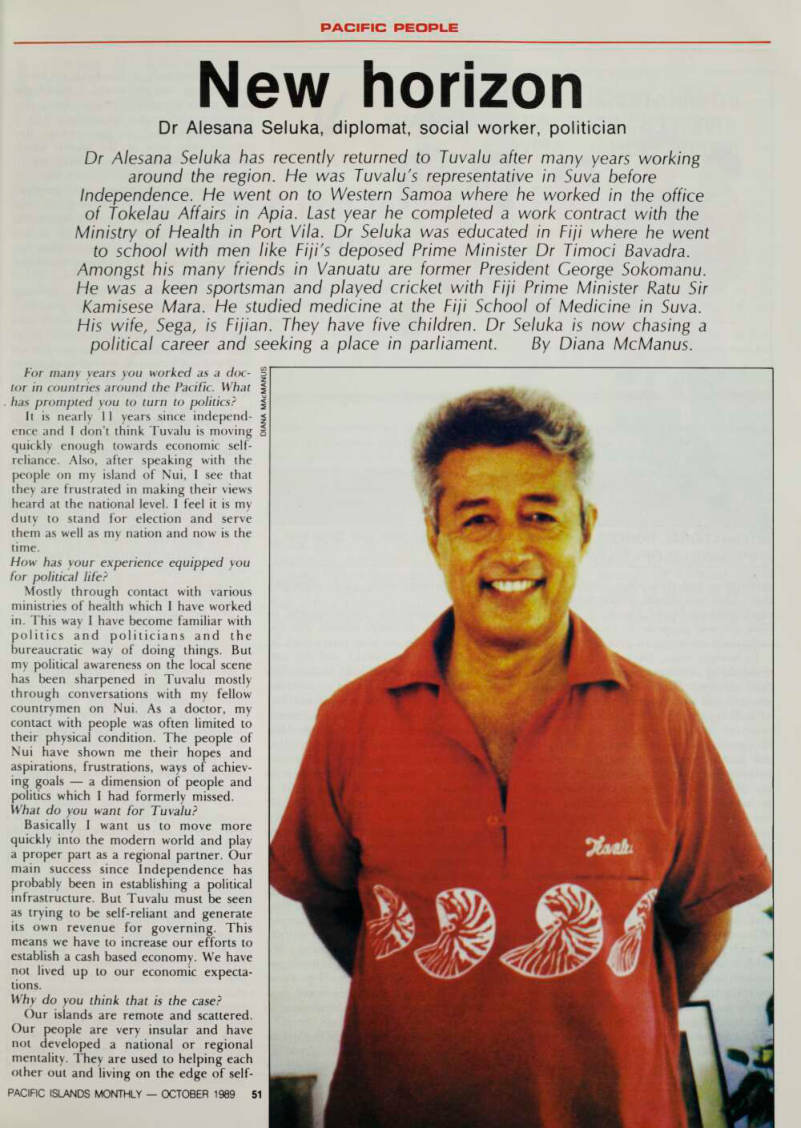
Dr Alesana Seluka, diplomat, social worker, politician
Dr Alesana Seluka has recently returned to Tuvalu after many years working around the region. He was Tuvalu's representative in Suva before Independence. He went on to Western Samoa where he worked in the office of Tokelau Affairs in Apia. Last year he completed a work contract with the Ministry of Health in Port Vila. Dr Seluka was educated in Fiji where he went to school with men like Fiji's deposed Prime Minister Dr Timoci Bavadra.
Amongst his many friends in Vanuatu are former President George Sokomanu.
He was a keen sportsman and played cricket with Fiji Prime Minister Ratu Sir Kamisese Mara. He studied medicine at the Fiji School of Medicine in Suva.
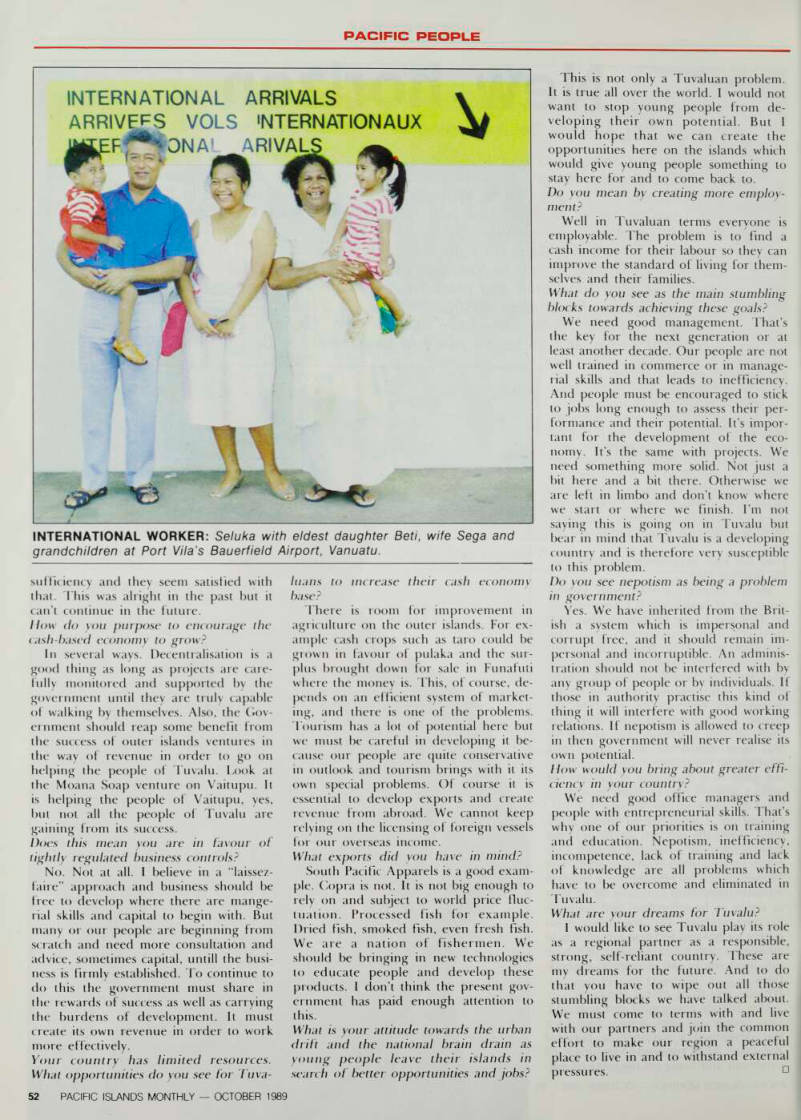
His wife , Sega, is Fijian. They have five children. Dr Seluka is now chasing a political career and seeking a place in parliament. By Diana McManus.
For many years you worked as a doc tor in countries around the Pacific. What has prompted you to turn to politics?
It is nearly 11 years since independ ence and I don’t think Tuvalu is moving quickly enough towards economic self reliance. Also, after speaking with the people on my island of Nui, I see that they are frustrated in making their views heard at the national level. I feel it is my duty to stand for election and serve them as well as my nation and now is the time.
How has your experience equipped you for political life?
Mostly through contact with various ministries of health which I have worked in. This way I have become familiar with politics and politicians and the bureaucratic way of doing things. But my political awareness on the local scene has been sharpened in Tuvalu mostly through conversations with my fellow countrymen on Nui. As a doctor, my contact with people was often limited to their physical condition. The people of Nui have shown me their hopes and aspirations, frustrations, ways of achiev ing goals a dimension of people and politics which I had formerly missed.
What do you want for Tuvalu?
Basically I want us to move more quickly into the modern world and play a proper part as a regional partner. Our main success since Independence has
probably been in establishing a political
infrastructure. But Tuvalu must be seen as trying to be self-reliant and generate its own revenue for governing. This means we have to increase our efforts to establish a cash based economy. We have not lived up to our economic expecta tions.
Why do you think that is the case?
Our islands are remote and scattered.
Our people are very insular and have not developed a national or regional mentality. They are used to helping each other out and living on the edge of self-
Diana Macmanus
sufficiency and they seem satisfied with that. This was alright in the past but it can’t continue in the future.
How do you purpose to encourage the cash-based economy to grow?
In several ways. Decentralisation is a good thing as long as projects are care
fully monitored and supported by the
government until they are truly capable
of walking by themselves. Also, the Gov ernment should reap some benefit from the success of outer islands ventures in the way of revenue in order to go on helping the people of Tuvalu. Look at the Moana Soap venture on Vaitupu. It is helping the people of Vaitupu, yes, hut not all the people of Tuvalu are gaining from its success.
Does this mean you are in favour of
tightly regulated business controls?
No. Not at all. 1 believe in a “laissez faire” approach and business should be free to develop where there are mange rial skills and capital to begin with. But many or our people are beginning from scratch and need more consultation and advice, sometimes capital, untill the busi ness is firmly established. To continue to do this the government must share in the rewards of success as well as carrying the burdens of development. It must create its own revenue in order to work
more effectively.
Your country has limited resources.
What opportunities do you see for Tuva-
I nans to increase their cash economy base?
There is room for improvement in agriculture on the outer islands. For ex ample cash crops such as taro could be grown in favour of pulaka and the sur plus brought down for sale in Funafuti where the money is. This, of course, de pends on an efficient system of market ing, and there is one of the problems.
Tourism has a lot of potential here but we must be careful in developing it be cause our people are quite conservative in outlook and tourism brings with it its own special problems. Of course it is essential to develop exports and create revenue from abroad. We cannot keep relying on the licensing of foreign vessels for our overseas income.
What exports did you have in mind?
South Pacific Apparels is a good exam ple. Copra is not. It is not big enough to rely on and subject to world price fluc tuation. Processed fish for example.
Dried fish, smoked fish, even fresh fish.
We are a nation of fishermen. We should be bringing in new technologies to educate people and develop these products. I don’t think the present gov ernment has paid enough attention to this.
What is your attitude towards the urban drift and the national brain drain as young people leave their islands in search of better opportunities and jobs?
This is not only a Tuvaluan problem.
It is true all over the world. I would not want to stop young people from de veloping their own potential. But I would hope that we can create the opportunities here on the islands which
would give young people something to
stay here for and to come back to.
Do you mean by creating more employ ment?
Well in Tuvaluan terms everyone is employable. The problem is to find a cash income for their labour so they can improve the standard of living for them selves and their families.
What do you see as the main stumbling blocks towards achieving these goals?
We need good management. That’s the key for the next generation or at least another decade. Our people are not well trained in commerce or in manage rial skills and that leads to inefficiency.
And people must be encouraged to stick to jobs long enough to assess their per formance and their potential. It’s impor tant for the development of the eco nomy. Ifs the same with projects. We need something more solid. Not just a bit here and a bit there. Otherwise we are left in limbo and don’t know where we start or where we finish. I’m not saying this is going on in Tuvalu but bear in mind that Tuvalu is a developing country and is therefore very susceptible to this problem.
Do you see nepotism as being a problem
in government?
Yes. We have inherited from the Brit ish a system which is impersonal and corrupt free, and it should remain im personal and incorruptible. An adminis tration should not be interfered with by any group of people or by individuals. It those in authority practise this kind of thing it will interfere with good working relations. If nepotism is allowed to creep in then government will never realise its
own potential.
How would you bring about greater effi
ciency in your country?
We need good office managers and people with entrepreneurial skills. That’s why one of our priorities is on training
and education. Nepotism, inefficiency,
incompetence, lack of training and lack of knowledge are all problems which have to be overcome and eliminated in Tuvalu.
What are your dreams for Tuvalu?
I would like to see Tuvalu play its role as a regional partner as a responsible, strong, self-reliant country. These are my dreams for the future. And to do that you have to wipe out all those stumbling blocks we have talked about.
We must come to terms with and live with our partners and join the common effort to make our region a peaceful place to live in and to withstand external pressures. D
INTERNATIONAL WORKER: Seluka with eldest daughter Beti, wife Sega and grandchildren at Port Vila's Bauerfield Airport, Vanuatu.