Reflections on
pp. 48-49 · Read in the full issue
Sports
Reflections on a mini event
EARLY reflections upon the 1989 [South Pacific Mini Games (brings to mind the old show business adage of “Everything will be right on the night”. For many months prior to its commencement, the Games appeared destined to be a fiasco. Con troversy over the funding of facilities built specifically for the 10-day festival, a dearth of publicity material available to the media, reports of the facilities con
struction programme being alarmingly
behind schedule and problems most in vited teams had in raising funds for the trip all augured badly for Tonga’s first attempt to host a major sporting event.
The death, just one day before the opening ceremony, of the wife of Brian Wightman who had worked like a Trojan in his capacity as Games Organis ing Committee Secretary not only cast a cloud over all eve of games functions, but was widely looked upon as yet another evil omen. Yet, from the joyous
opening ceremony right through to King
Taufa’ahau Tupou formally ending pro ceedings, the Games was; beyond all doubt, a huge success.
Although no world record was broken in Nuku’alofa, or even remotely threatened, an abundance of excellent performances which mirrored the overall
improvement in standards throughout
the region were witnessed by crowds of admirable size and enthusiasm.
As always, the athletics events deman ded most notice.
When the first day of competition had been completed with New Caledonia making a clean sweep of medals in both the hammer throw and men’s triple jump and the remarkable Alain Lazare blitzing the field to win the 10,000 metres, many feared that athletes from the French territory would monopolise the winners’ dais.
It transpired that the New Caledo nians did pick up more gold medals in athletics than any other team. But its haul of 13 (from the 40 awarded) hardly matched the total dominance expected and the widespread circulation of win ners’ laurels must be, with a view to South Pacific athletics’ overall welfare, be regarded as a healthy outcome.
Lazare went on to claim further gold medals in the 3000 metres steeplechase and 5000 metres. His must be acknow
ledged as the outstanding performance
of the Games and the heartwarming and spontaneous reception he received from the crowd; estimated as large as 8000 on some days, dispelled all apprehension over animosity towards the French at least at spectator level.
Yet, as with all sporting events, it is
the triumphs of the underdogs the totally unexpected results which will linger in the mind longest: Never to be forgotten will be 15-year old Gane Gardner of Norfolk Island’s emergence as the South Pacific’s own Nadia Comaneci, when displaying impish charm and exuberance while winning the women’s high jump. Just as surpris ing as Gardner’s success was the victory of Josef Manken, from Vanuatu, in the men’s 400 metres. Manken had never previously entered any international
event.
For fans at the Teufaiva Stadium, the highlight must surely have been Ikani Taliai’s gold medal winning effort in the
men’s long jump. Taliai jumped, literal
ly, from fifth to first place with his last leap. His gold made amends for Tongan disappointment over Siulolo Ikavuka’s inability to clinch wins in either the women’s shot put or discus, even though initially favoured for both disciplines.
The blue ribband event, the marathon, produced another unlikely winner in the
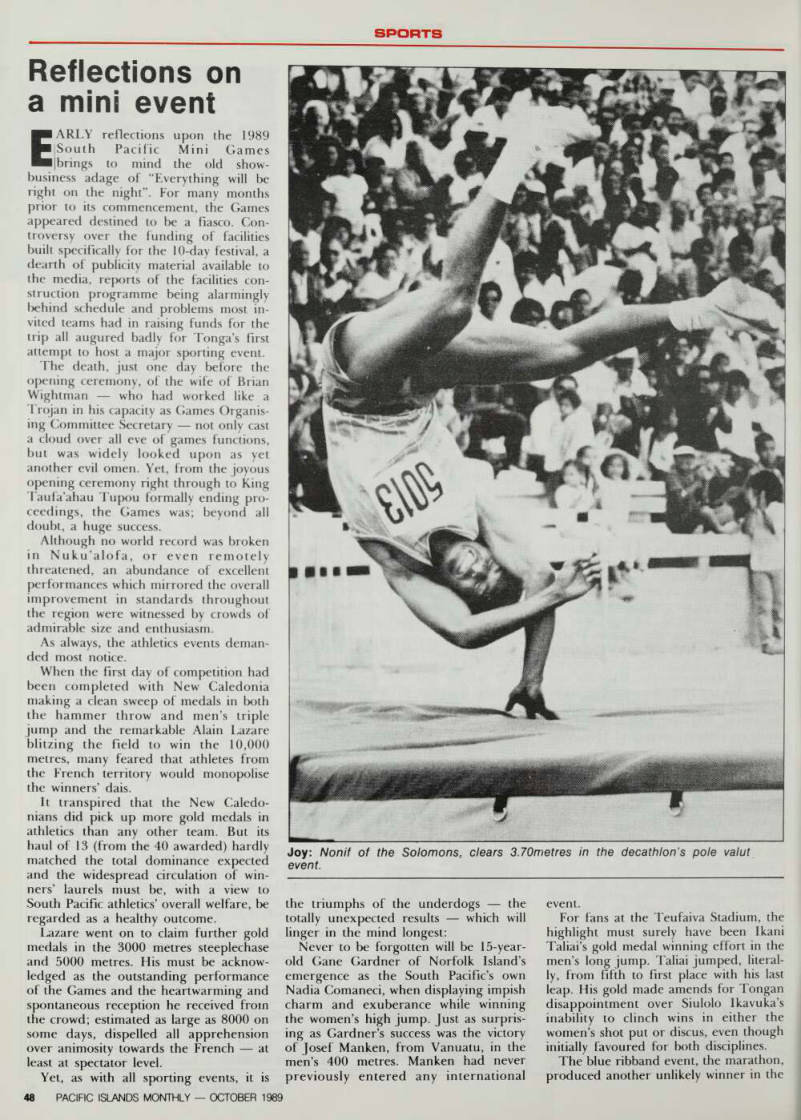
Joy: Nonif of the Solomons, clears 3.70metres in the decathlon’s pole valut event.
form of 38-year-old Shiri Chand. He was one of four gold medallists from Fiji on the final day of competition a day which salvaged Fiji pride, just when it appeared the meeting wouldn’t yield a single gold for one of the South Pacific’s traditional track and field powers.
Athletics may have gained more media attention, but it was the boxing tournament that captured the local people’s imagination. At times, it seemed half of Nuku’alofa was crammed into the indoor stadium. When, prior to leaving Apia,
Western Samoa boxing manager George Meredith, stated that his charges would return with six gold medals, most thought him to be merely exhibiting the bluster the sport is renown for. But, his boys fulfilled his prediction exactly a feat which enabled Western Samoa to surge to the top of the final overall med als table.
Unfortunately, the Mini Games did not escape the controversy which now seems obligatory at every international amateur boxing tournament. Of the
numerous doubtful judges’ decisions, the most crucial removed the very much in form Tommy Bauro from the mid dleweight division and robbed the Solo mon Islands (which had overcome im mense financial and logistical problems in getting to Nukualofa) of its best gold medal prospect.
Western Samoa also gained a golden harvest from weightlifting, with Papua New Guinea being the most successful of those grabbing the crumbs left by the Samoans. However, it was the 19-year old Nauruan Mark Stephens who pro duced the most impressive individual performance. While setting Games re cords for the snatch, jerk and combined in the 60kg class, Stephens gave warning that he is a contender for Common wealth Games honours next year.
With Fiji not competing, the netball gold medals’ destination looked to be a formality. Indeed, red hot favourites the Cook Islands did prevail but had to en dure many anxious moments before dis posing of a young and spirited Papua New Guinea combination 53-49 in the final.
What a shame it is that Australian aid to PNG does not extend to netball. If the Australian Institute of Sport in Canberra was able to take the Kumuls under its wing for a few weeks each year they would surely develop into a major world netball power. But, left to its own de vices, the team can probably anticipate nothing but stagnation a fate which befalls a tragically large amount of Paci fic islands young sporting talent.
French Polynesian expectations of cap turing all five tennis titles were shattered when Daniel Laine (New Caledonia) and fourth seeded Wendy Huynh (Guam) took the men’s and women’s singles fin als respectively. The doubles events were all won by Tahitian combinations though, so there remains little doubt where the greatest depth of talent lies in
the region.
More gold medals came French
Polynesia’s way in women’s golf; through
the efforts of its team and the individual tournament winner, Itari Poetai. Hon ours in the men’s section were shared.
Western Samoa’s Atapana Sanerive (19 with immense potential) won the indi vidual’s championship by a remarkable eight shot margin, only for Fiji’s strength in depth to tell in the teams’ contest.
Golf was just one of the sports in which host Tonga made disappointingly little impact. But the kingdom has inher ited some truly superb facilities from the Games and it can be expected to make a far greater impression at future regional events.
The prediction can be made, with a fair degree of confidence, that time will prove the next generation of Tongan athletes to be the 1989 South Pacific Mini Games’ biggest winners. □
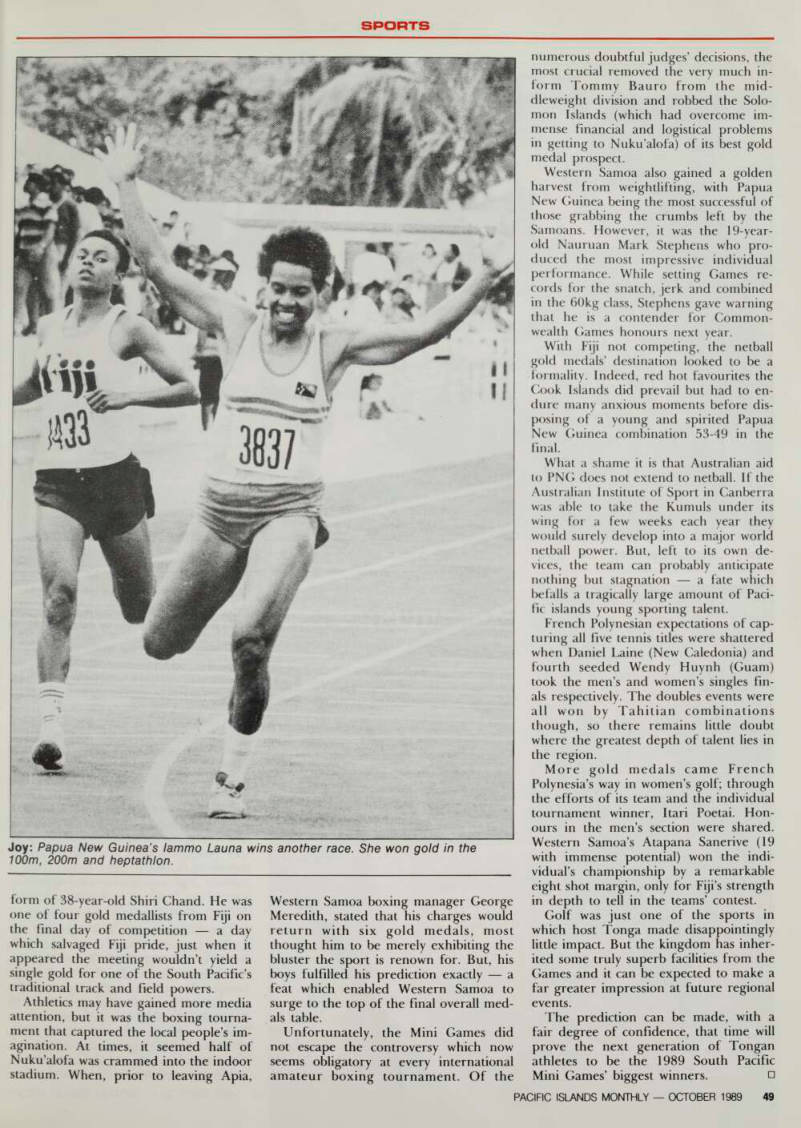
Joy: Papua New Guinea's lammo Launa wins another race. She won gold in the 100m, 200m and heptathlon.