patrol boat
p. 24 · Read in the full issue
Cook Islands
Finally, a
THE decision by the Cook Islands Government in March this year to defer acceptance of its Australian donated patrol boat has proved to be the right one, says Cook Islands Prime Minister Geoffrey Henry. After five months of discussions with the Austra lian Government, the Cook Islands has finally agreed to accept the patrol boat and the vessel is expected in Rarotonga this month.
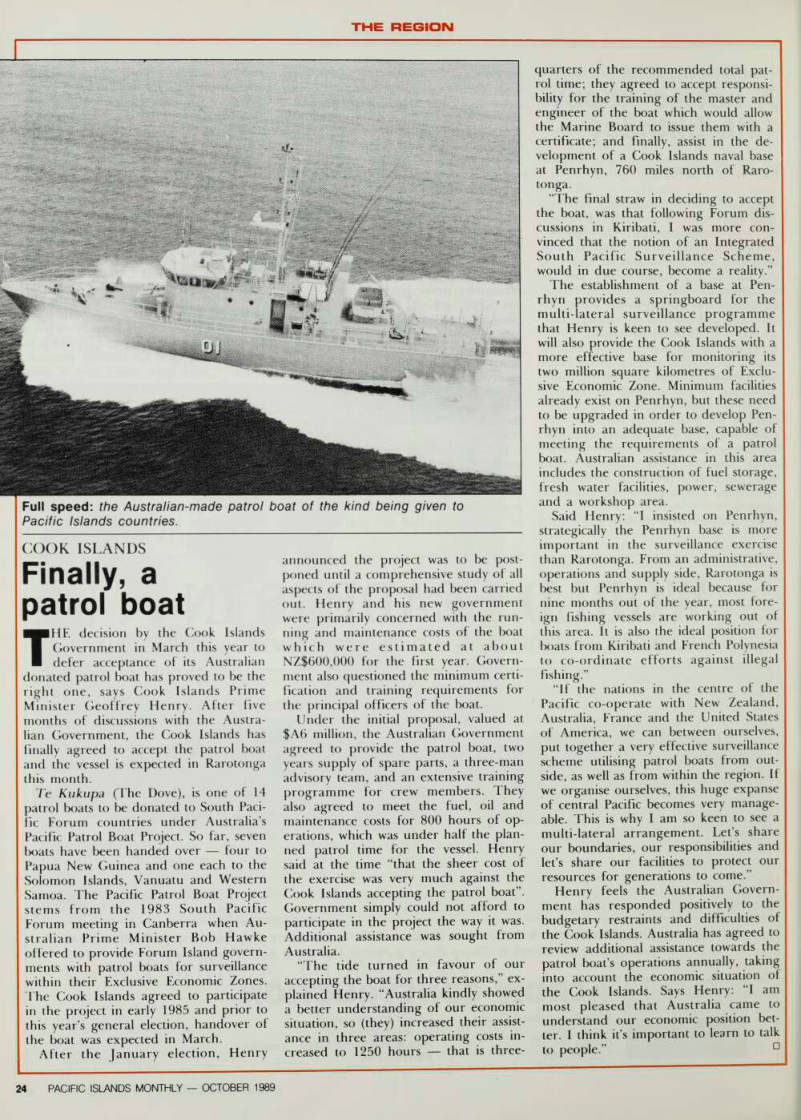
Te Kukupa (The Dove), is one of 14 patrol boats to be donated to South Paci fic Forum countries under Australia’s Pacific Patrol Boat Project. So far, seven boats have been handed over four to Papua New Guinea and one each to the Solomon Islands, Vanuatu and Western Samoa. The Pacific Patrol Boat Project stems from the 1983 South Pacific Forum meeting in Canberra when Au stralian Prime Minister Bob Hawke offered to provide Forum Island govern ments with patrol boats for surveillance within their Exclusive Economic Zones, 4 he Cook Islands agreed to participate in the project in early 1985 and prior to this year’s general election, handover of the boat was expected in March.
After the January election, Henry
announced the project was to be post poned until a comprehensive study of all aspects of the proposal had been carried out. Henry and his new government were primarily concerned with the run ning and maintenance costs of the boat which were estimated at about NZ$6OO,OOO for the first year. Govern ment also questioned the minimum certi fication and training requirements for the principal officers of the boat, Under the initial proposal, valued at SA6 million, the Australian Government agreed to provide the patrol boat, two years supply of spare parts, a three-man advisory team, and an extensive training programme for crew members. They also agreed to meet the fuel, oil and maintenance costs for 800 hours of op erations, which was under half the plan ned patrol time for the vessel. Henry said at the time “that the sheer cost of the exercise was very much against the Cook Islands accepting the patrol boat”, Government simply could not afford to participate in the project the way it was.
Additional assistance was sought from Australia.
“The tide turned in favour of our accepting the boat for three reasons,” ex plained Henry. “Australia kindly showed a better understanding of our economic situation, so (they) increased their assist ance in three areas: operating costs in creased to 1250 hours that is three
quarters of the recommended total pat rol time; they agreed to accept responsi bility for the training of the master and engineer of the boat which would allow the Marine Board to issue them with a certificate; and finally, assist in the de velopment of a Cook Islands naval base at Penrhyn, 760 miles north of Raro tonga.
“The final straw in deciding to accept the boat, was that following Forum dis cussions in Kiribati, I was more con vinced that the notion of an Integrated South Pacific Surveillance Scheme, would in due course, become a reality.”
The establishment of a base at Pen
rhyn provides a springboard for the
multi-lateral surveillance programme that Henry is keen to see developed. It will also provide the Cook Islands with a more effective base for monitoring its two million square kilometres of Exclu sive Economic Zone. Minimum facilities already exist on Penrhyn, but these need to be upgraded in order to develop Pen rhyn into an adequate base, capable of
meeting the requirements of a patrol
boat. Australian assistance in this area includes the construction of fuel storage, fresh water facilities, power, sewerage and a workshop area.
Said Henry: “I insisted on Penrhyn, strategically the Penrhyn base is more important in the surveillance exercise than Rarotonga. From an administrative, operations and supply side, Rarotonga is best but Penrhyn is ideal because for nine months out of the year, most fore ign fishing vessels are working out of this area. It is also the ideal position for boats from Kiribati and French Polynesia to co-ordinate efforts against illegal
fishing.”
“If the nations in the centre of the Pacific co-operate with New Zealand, Australia, France and the United States of America, we can between ourselves, put together a very effective surveillance scheme utilising patrol boats from out side, as well as from within the region. If we organise ourselves, this huge expanse of central Pacific becomes very manage able. This is why I am so keen to see a multi-lateral arrangement. Let’s share our boundaries, our responsibilities and let’s share our facilities to protect our resources for generations to come.”
Henry feels the Australian Govern ment has responded positively to the budgetary restraints and difficulties of the Cook Islands. Australia has agreed to review additional assistance towards the
patrol boat’s operations annually, taking
into account the economic situation of the Cook Islands. Says Henry: “I am most pleased that Australia came to understand our economic position bet ter. I think it’s important to learn to talk to people.” D
Full speed: the Australian-made patrol boat of the kind being given to Pacific Islands countries.