frigate deal
pp. 16-17 · Read in the full issue
Defence
Questions over frigate deal
NEW Zealand has decided to buy at least two ships under the
proposed joint frigate venture
with Australia. The concession from Wellington to its trans-Tasman ally in Canberra is more the result of political pressure from Canberra than the needs of the Royal New Zealand Navy.
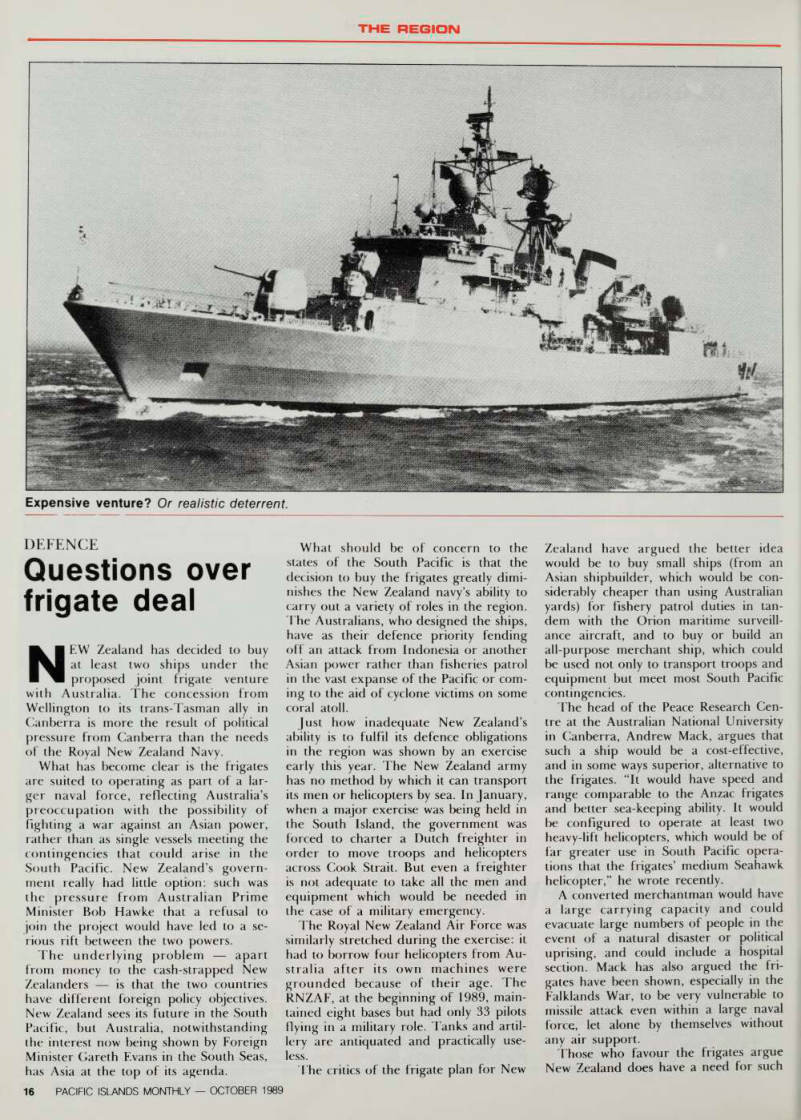
What has become clear is the frigates are suited to operating as part of a lar ger naval force, reflecting Australia’s preoccupation with the possibility of fighting a war against an Asian power, rather than as single vessels meeting the contingencies that could arise in the South Pacific. New Zealand’s govern ment really had little option: such was the pressure from Australian Prime Minister Bob Hawke that a refusal to join the project would have led to a se rious rift between the two powers.
The underlying problem apart
from money to the cash-strapped New Zealanders is that the two countries
have different foreign policy objectives.
New Zealand sees its future in the South Pacific, but Australia, notwithstanding the interest now being shown by Foreign Minister Gareth Evans in the South Seas, has Asia at the top of its agenda.
What should be of concern to the states of the South Pacific is that the decision to buy the frigates greatly dimi nishes the New Zealand navy’s ability to carry out a variety of roles in the region.
The Australians, who designed the ships, have as their defence priority fending off an attack from Indonesia or another Asian power rather than fisheries patrol in the vast expanse of the Pacific or com ing to the aid of cyclone victims on some coral atoll.
Just how inadequate New Zealand’s ability is to fulfil its defence obligations in the region was shown by an exercise early this year. The New Zealand army has no method by which it can transport its men or helicopters by sea. In January, when a major exercise was being held in the South Island, the government was forced to charter a Dutch freighter in order to move troops and helicopters across Cook Strait. But even a freighter is not adequate to take all the men and equipment which would be needed in the case of a military emergency.
The Royal New Zealand Air Force was similarly stretched during the exercise: it had to borrow four helicopters from Au stralia after its own machines were grounded because of their age. The RNZAF, at the beginning of 1989, main tained eight bases but had only 33 pilots Hying in a military role. Tanks and artil
lery are antiquated and practically use
less.
The critics of the frigate plan for New
Zealand have argued the better idea would be to buy small ships (from an Asian shipbuilder, which would be con
siderably cheaper than using Australian
yards) for fishery patrol duties in tan dem with the Orion maritime surveill ance aircraft, and to buy or build an all-purpose merchant ship, which could be used not only to transport troops and equipment but meet most South Pacific
contingencies.
The head of the Peace Research Cen tre at the Australian National University in Canberra, Andrew Mack, argues that such a ship would be a cost-effective, and in some ways superior, alternative to the frigates. “It would have speed and range comparable to the Anzac frigates and better sea-keeping ability. It would be configured to operate at least two heavy-lift helicopters, which would be of far greater use in South Pacific opera tions that the frigates’ medium Seahawk
helicopter,” he wrote recently.
A converted merchantman would have
a large carrying capacity and could
evacuate large numbers of people in the event of a natural disaster or political uprising, and could include a hospital section. Mack has also argued the fri gates have been shown, especially in the Falklands War, to be very vulnerable to missile attack even within a large naval force, let alone by themselves without any air support.
Those who favour the frigates argue New Zealand does have a need for such
Expensive venture? Or realistic deterrent.
ships. In a joint article published recent ly, a former Australian Secretary of De fence, Denis McLean, and Australian strategic expert Desmond Ball, pointed out that all the maritime and air links from the east coast of Australia and from New Zealand to northeast Asia go through or over the Solomon Islands and eastern Papua New Guinea 7O per cent of New Zealand’s trade went by that route or across the Pacific to the Panama Canal, while 60 per cent of Au stralian trade went by all Pacific routes.
The authors pointed out that New Zealand had defence obligations to the Cook Islands and Tokelau, and impor tant strategic interests in other Pacific states.
The article said there are two principal zones known as “choke points”: the sea route passing by way of the Coral Sea and the Solomon Islands, and the nar row channel across the north of Austra lia through the Torres Strait and Timor Sea. “Basic interests in both countries would be at risk should a hostile power become established in these areas with the capacity to interrupt trade and com munications,” the article added.
Another point is the division within the New Zealand defence establishment
of the frigate question. While sea-going
officers want the new vessels (it was feared many might leave the navy if smaller ships without a full wartime capability were bought), it is known that the opinion at the top of the Defence Department was that frigates could not be considered the nation’s top priority there was no point having a trained army if it could not be moved over wa ter. They also argued the frigates had no transport role; the ships carry only one small helicopter while the army needs helicopters which can transport sizable numbers of troops and a ship to carry
equipment.
What is clear is that Australian press ure has pushed New Zealand into a ma jor military decision unsuited to its role as a power in the South Pacific.
The NZSIOOO million deal threatened to split the New Zealand Labour Party only weeks after new Prime Minister
Geoffrey Palmer’s rejuvenated cabinet
had dramatically recovered in opinion
polls. It also provoked bitter opposition
from critics who accused the government of betraying the country’s sovereignty and undermining the nuclear-free stance.
A caucus vote confirming the decision came on September 7, just two days after allegations surfaced that a prominent Australian trade unionist who had been
regularly visiting New Zealand to lobby
in favour of the deal was actually work ing on behalf of the contractor. Labour
Party foreign policy officials arguing
against the deal claimed in a report con demning the government that ministers
justified the frigate purchase on the
grounds that Australia and the United States might no longer consult New Zea land about events in the Pacific.
Palmer admitted an overhaul of fore ign policy was needed with fresh initia tives in the Pacific showing some “vision” including economic and social policy, not just defence. The Prime Minister said New Zealand had not caught up with the increasing turmoil in the re
gion! “Look at Fiji, what happened
there, look at Bougainville, look at the difficulties in Vanuatu.”
However, opponents calling for a
genuine independent foreign policy in
the Pacific were bitter in their criticisms.
Kevin Hackwell, spokesman for the Just Defence coalition which waged a high profile campaign with a team of skilled researchers to an abortive bid to block the frigates deal, said the people of New Zealand had been betrayed: “It is a sad day for New Zealand when our foreign
policy is being dictated by Canberra.”
Disappointed Labour Party president
Ruth Dyson, another strong opponent,
said she hoped the frigate purchase
would become a springboard for other initiatives in the Pacific, such as aid and
development assistance. But, ignoring
the growing popularity of the rival “re born” New Labour Party which opposes the frigates, she claimed the deal would not lead to critics withdrawing support for the government because of their anti-nuclear beliefs. (According to opin ion polls, more than seven out of 10 New Zealanders support the nuclear-free
policy).
Dyson warned that if the opposition National Party regained power it would mean the return of nuclear-powered and nuclear-armed warships in New Zealand ports. “This will never happen under a Labour government,” she added.
A leak of a document by Labour Par ty’s influential foreign affairs and secur ity policy committee embarrassed the government by citing a claim from Fore ign Affairs Minister Russell Marshall that
New Zealand’s foreign policy was being
made on “an ad hoc and piecemeal basis”. Accusing the New Zealand armed forces of an “outright political role”, the document also said the frigate policy appeared to be “based on a historical need to associate with more powerful Western allies in order to preserve poli
tical patronage”.
Popular opposition MP Winstor Peters
upstaged his party leader Jim Bolger’s
muted criticism by launching a blistering
attack in a snap parliamentary debate.
Peters branded the decision “economic and social lunacy”, saying that while Labour had created a growing number of poor people in the country, it had decided to spend $lOOO million on fri gates. He also criticised the hypocrisy of the Palmer government which was taking the first step back to a nuclear policy with the deal while claiming it was nuc lear-free.
However, former Prime Minister David Lange denied the purchase meant “any deviation at all” in New Zealand
foreign policy. Bolger described the fri
gates as the world’s most expensive fisheries patrol craft. □