What do the Fijians want?
pp. 12-14 · Read in the full issue
IN announcing his intention to continue as Fiji's interim Prime Minister , Ratu Sir Kamisese Mara will now be judged by indigenous Fijians on how best he is able to safeguard their interests. But the Fijians have a problem, as Mara told /ope Balawanilotu last month:
• Mara on the indigenous Fijians and what they want: I’m quite happy with what has been done. To say that I have caused the de gradation of the Fijians is really trying to avoid the real issue. The Fijians them selves have got to pick themselves up from the bootstraps that they now wear.
I don’t think anyone can help the Fi jian people as a whole, entirely. They are crying about the achievements of the In dians. Why can’t they achieve the achie vents of the Indians? It is very difficult to explain to them that you’ve got to change what you hold dear to you your customs and traditions in order to be like the Indians. I think what can be done is for Fijians to strive as Yavusa (communal divisions) or provinces, if possible, to get ahead. And there ought to be a friendly rivalry.
I have been accused by (Fijian Nationalist Party leader Sakeasi) Butad roka and the nationalists that I’ve let the Fijians down. It’s not as if the Fijians were puppets and I just pull the strings and they work. No one can do that. The Fijians themselves have got to realise and find out what they can do.
I was one of the first five (Fijians) to own cars when I first came back (from overseas studies) in 1950. Look at the number of Fijians who own cars today.
Look at the phone books from the 1950 s onwards. You’ll find a few Fijians who had telephone at the time compared to the large number of today. Yet people are still complaining that we have not progressed, that we have gone downhill. • On the draft constitution: The draft constitution may not be the ideal constitution but what would be the ideal constitution? There are over 150 nations in the United Nations (and) they all pronounce to the world that they are democratic governments and we all know that they are not the same. We have now a draft. From my own perusal of the draft, I have no quarrels over it at all. I must say they’ve done a very, very good job. The very fact that they came out unanimous in their report is an achieve ment. There are actually six Indians, supposed to have been seven Fijians but one, Rakoto, left half way through to become the Consul General in Sydney, one Chinese and three other general
electors (in the Constitutional Inquiry and Advisory Committee).
I found from the report that they had reasons for the decisions they’ve made and I learned afterwards that they’re prepared to stand up in any meeting to
explain the reasons why they’ve made
them. I commend each and everyone of the those members of the committee, especially the leader because it must be his leadership that kept the group together and came out as one in the end.
As I’ve said I have no quarrels with their recommendations.
I really think that in the previous Con stitution, if the Fijians were united there wouldn’t be any trouble. There was di vision then, and if there is going to be division even with a majority there will be a problem.
With the assumption that the draft constitution is approved as ammended by the committee, it will take a year for an election to take place. And my wish and hope is that we agree to that and have a 10-year period in which we practise the constitution and we have another review
at the end of 10 years and that perhaps every 10 years we should have a review.
No constitution in itself is perfect. If it is the will of the people to live together and work out a constitution for the be nefit of all, that will be beneficial to the
people.
• Mara on the constitutional summit:
These people have already spent eight
months receiving individual’s oral and written submissions. They’ve gone around and looked at groups. Haven’t they combed Fiji? What else can we get out of a summit? I thought they’ve done their work so well to eliminate the need of a summit and all it has to do is from Cabinet to the President to the Council of Chiefs, and promulgate it. • Mara on his involvement in post-coup governments: When I lost the election in ’B7 I stated that I supported the process of democra cy then. I vacated my office and I moved in to the Opposition and I had thought that my period in the Opposition is a
period of preparation to actually retire
from politics. I think I’ve had a good
innings.
The coup took place and I was alleged to be the mastermind. I didn’t know any thing about it. I came because what I had built up over the 17 years was at risk of being destroyed. I wanted to come and keep it together.
After, there was a long period of great uncertainty the period in which the (Governor-General) took over as leader and we were advisors, but we didn’t quite know where we stood at the time.
My advice was not taken up as I would have expected. It was a disappointing
period.
And when Rabuka took over (again) it was quite a relief. At least someone knew what he was going to do because we were all uncertain. We thought we were going to be in the Commonwealth and I took a trip to the UK to find out whether it was still possible or not and I found out it wasn’t. So 1 said to myself; thank God for that, someone is going to map out the future of Fiji, good luck to them.
I then, quite frankly, didn’t quite
know where I stood at the time. I still had security around the house I was given. No one told me that I was com pletely out. I didn’t know whether 1 was actually restricted, so to speak, to my residence and for two months I didn’t quite know where 1 stood. Then after two months the period of the military government came to an end, suddenly, and the President took over. The Presi dent asked me to lead a government. I was in Lau when the announcement was made. I then took it up as a challenge. 1 had a number of Cabinet Ministers who were there and I didn’t want to
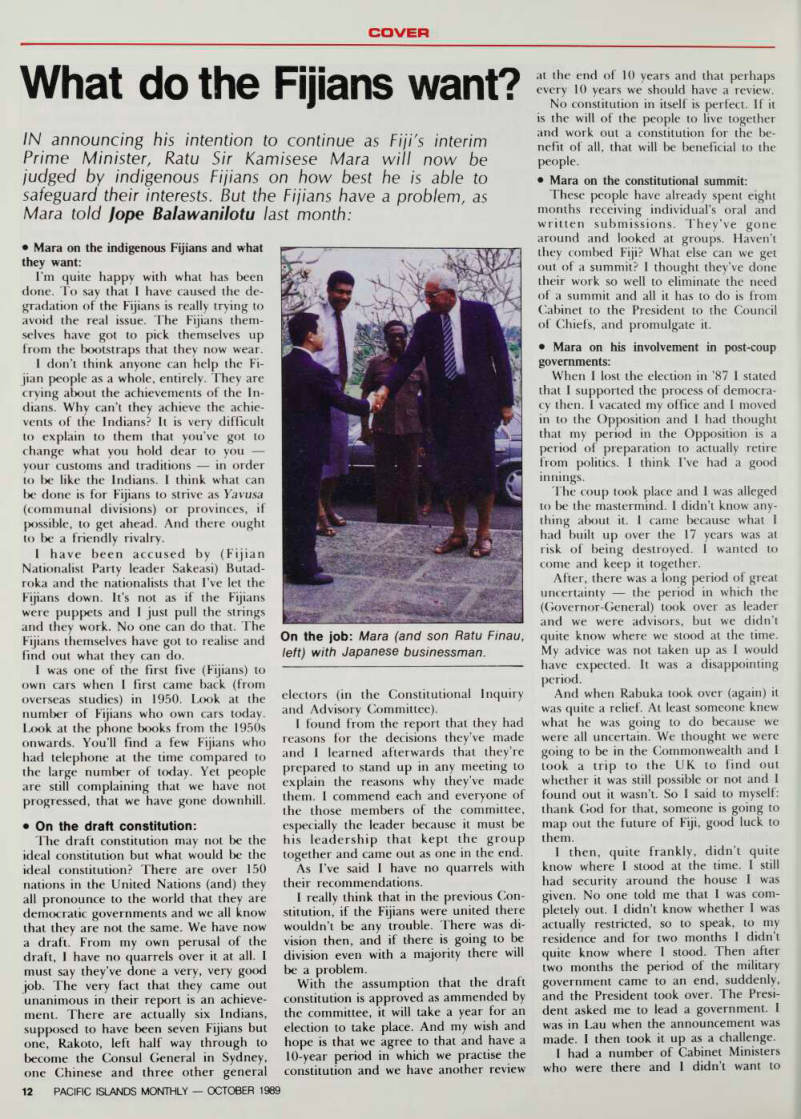
On the job: Mara (and son Ratu Finau, left) with Japanese businessman.
create animosity right from the very be ginning. I thought I could make do with all who were there accept some who were openly hostile to me (Sakeasi) Butadroka for one and (Ratu Meli) Vesi kula for the other. They said openly
during their short period how incapable
I was and I was to be blamed for all that has caused the dissatisfaction of the Fi jians. But I took on the Cabinet that I (have) now and decided at the time that unless we have a clear objective we wouldn’t get anywhere.
The greatest priority as I saw then was the recovery of the economy not only for the sake of the people who had lost their jobs and the people who aspire to get jobs, but one of the greatest causes of dissastisfaction that caused the coup was the fact the Fijians didn’t think that they have a fair share of the cake. And now the thing to do is to increase that cake, even though the period is very short. And the other, of course, is get a constitution a draft constitution.
Under the circumstances it looked very difficult and looked almost impossible.
During those two years I actually had three heart attacks. Fortunately 1 had treatment in Australia and I found as the tension began to resolve I was able to survive. The doctor told me, and I be lieve that it was the tension that caused the heart attack. And I was told at the time if you want to work you work for two months you take 10 days, two months take 10 days. I was very happy with that sort of timetable, but it was impossible. You can’t control events for up to two months and then you let go.
So that was how the heart attacks came on.
But because of the sense of emergency that was instilled into the Cabinet, they did do their job. Everyone must be com mended for what they’ve done. Some of them also had health problems in en deavouring to carry out their duties, but I think we’ve all been very satisfied now that the economy has shown to be not only recovered but even better than it was in 1986, and there is a draft con stitution. • Mara on the Fiji Military Forces: I would like to see them go back to barracks, modify their system of training in order to develop national youth train ing so that instead of our people going to the army to go to Lebanon or to be in the barracks, they have a system where people can serve for a year or two years then back to their villages. At least you can instil discipline into them, some form of training and then they can go back for the benefit of their people.
They can’t train every Fijian to get into the army because at the end of it they will just look for pension and they’re not going to be productive units in the economy of Fiji. But with a little
army discipline in the early parts of your lives you can be a very useful unit.
I wish that they concentrate on de
veloping a national youth training
scheme. They have the facilities, they have the manpower and people like to be in uniform.
I know that practically all the Afri can countries with the exception of Tanzania, Zambia and Malawi and, of course, the smaller ones Bohtswana and Swaziland have been led by the milit ary. What the military did was to try and destroy the custom and tradition that structure which doesn’t allow them to be the leaders. The influence of the military out there was to go against customs and traditions because they want the loyalty and support of the people, and their chiefs are not usually the ones who sup port them.
I’m surprised at the great difference here in Fiji. The military said they sup port the chiefly system. Yet there are two divisive things which they’ve sup ported. One is the secession in the Methodist Church and the other is the fourth confederacy. If they want the uni ty of the people of Fiji those two issues could be left over till we’ve returned to
normalcy, then tackle them. To tackle them now when we are not united, it makes fun of the 37-27 (Fijian-Indian ratio in a new parliament). You’re actual ly dividing 37 by two on the Methodist issue, you’re dividing 37 by four over the
fourth confederacy.
On what influence can make me change my mind and carry on lead ership: those two issues will never, never attract me to the leadership.
I pity the man who is going to take over because the army who brought all these about is now supporting those divi sive issues. • If there is no return to barrack?
God help Fiji.
• Mara on whether Cabinet was worried about Major-General Sitiveni Rabuka’s role in the Methodist Church crisis: It has always been a questioning of his role after he has done something. No discussion before he did anything. • Mara on the Fourth Confederacy and talk of secession: They seem to think that they have the upper hand by holding us to ransom: if you don’t do this we’ll get away. Well, every part of Fiji can do that. So it’s an empty threat really. • Mara on an offer from the East-West Centre in Honolulu: There was an offer to spend a sabatical year at the centre where you can do your own research. My objective of spending a year is to gather all my papers and books and try and sort them out for future use, if I can put them into a book. I’m sure I can find people there who could help me to do it, that my experience could be translated into paper for the benefit of the world. I don’t know if the offer is still in extent.
Meantime my hopes have been bouyed by the fact that I’ve been invited in my next trip to Europe to visit my college, Wad ham, in Oxford, because there’s also an opportunity there for a similar thing.
I prefer the Hawaiian one because it is nearer home, the climate is better and there are, already, people there who have done research in the Pacific who will be of great help. • Mara on Fiji’s move to set up an oil company and buy oil from Indonesia: What we thought could be done through the friendly attitude of Indone sia, was to get us the oil from Indonesia like Mobil, Shell and others. We re fine it either in Australia or Whangarei, in Auckland, or in Hawaii and then we bring it here and sell it to them. The margin they make here, they say, is six cents a litre and the Australians and New Zealanders will be very, very happy to make three cents a litre.
If we can get a bit of that margin, we thought a Fijian shareholder could come from that margin, if half of that margin could be freed.
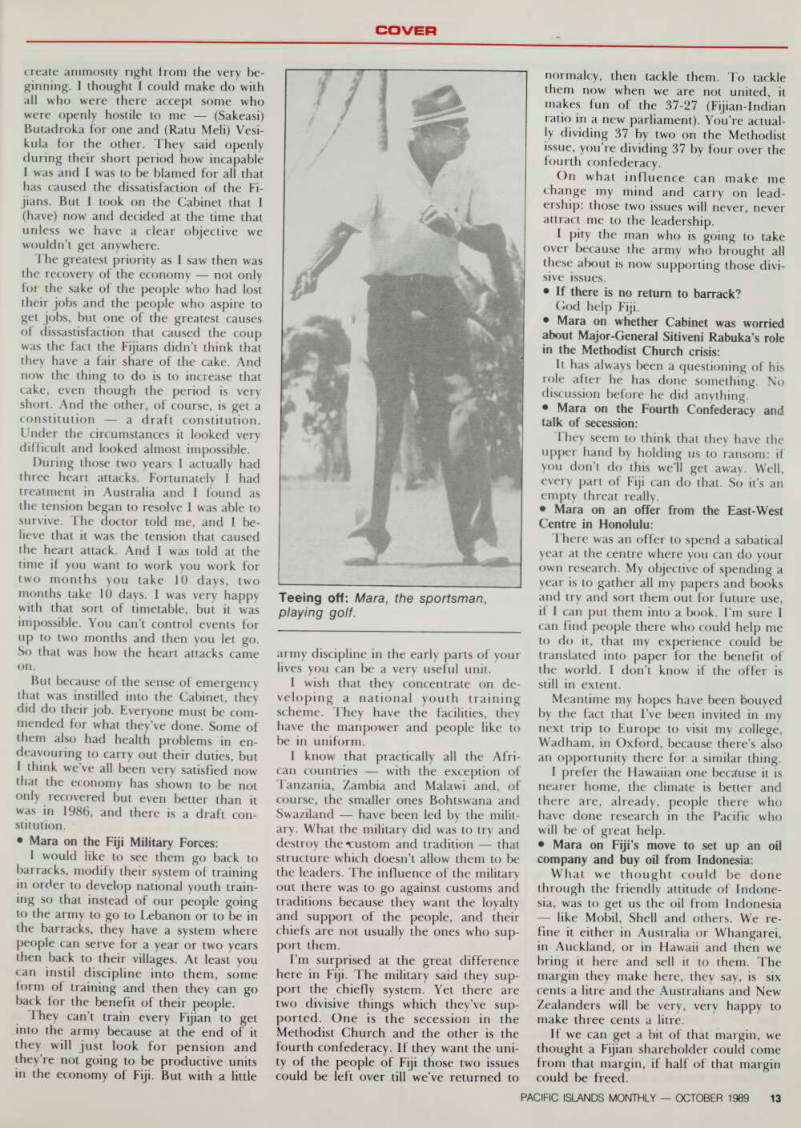
Teeing off: Mara, the sportsman, playing golf.
We have more control over the price of oil. The oil companies are fighting very hard, they’ve got the money, they can put out disinformation about this and about that.
They’ve got Dr Fesharaki who we have been trying to get to make a statement about how he has been encouraging us all along, but now he is saying that it is no good. Well, he must have got some good reason to change his mind sudden ly like that.
But all we ask is the oil companies should give us a tender and how much could they buy the oil for if we bring it to Vuda. None of them has been able to do that. We know the price. We know what they ought to pay.
I had one man from the university who was investigating for me but unfor tunately he is an Indian from Malaysia, I think, and he took off at the coup. He told me there was money in it and he was sent over here by Dr Fesharaki and I’m surprised that Dr Fesharaki has now publicly changed his mind, whether he has said so himself or it’s some man ipulation of his statement because it was his number two or number three who came here and talked about it.
What we want is a steady price of oil.
They’re now blaming government for putting tax on it. Well, that tax could come down. But development now is on wheel particularly for the Fijians in the more remote area outboard motors, trucks. And their margin can go
up and down and repayments to the bank or wherever they got their trucks from can be snuffed out very quickly unless they know what the price is going to be for the next six months or year.
But when it goes up and down like that they are the ones we want to help. • Mara on why Mobil, Shell and British Petroleum will not decentralise their opera tions by building storage facilities in the outlying islands: They say their business here is not big enough to warrant such a big capital out lay and that we are lucky to get their services. Then why is it that they’re trying to oppose our endeavours to try and buy our own oil? Because they are making good money. Gas Coral Gas comes from Melbourne and we’re paying the price as if we are importing it from Singapore. Similarly with oil. Most of our oil comes from Australia and we’re paying the transport cost from Singa
pore. And they’re making good money
because we’re paying transport money from Singapore. They’re not transport ing it from Singapore. That’s the sort of money that we know they’re making. All we want is to control from source to Vuda. Let them take it from Vuda to the consumer. D
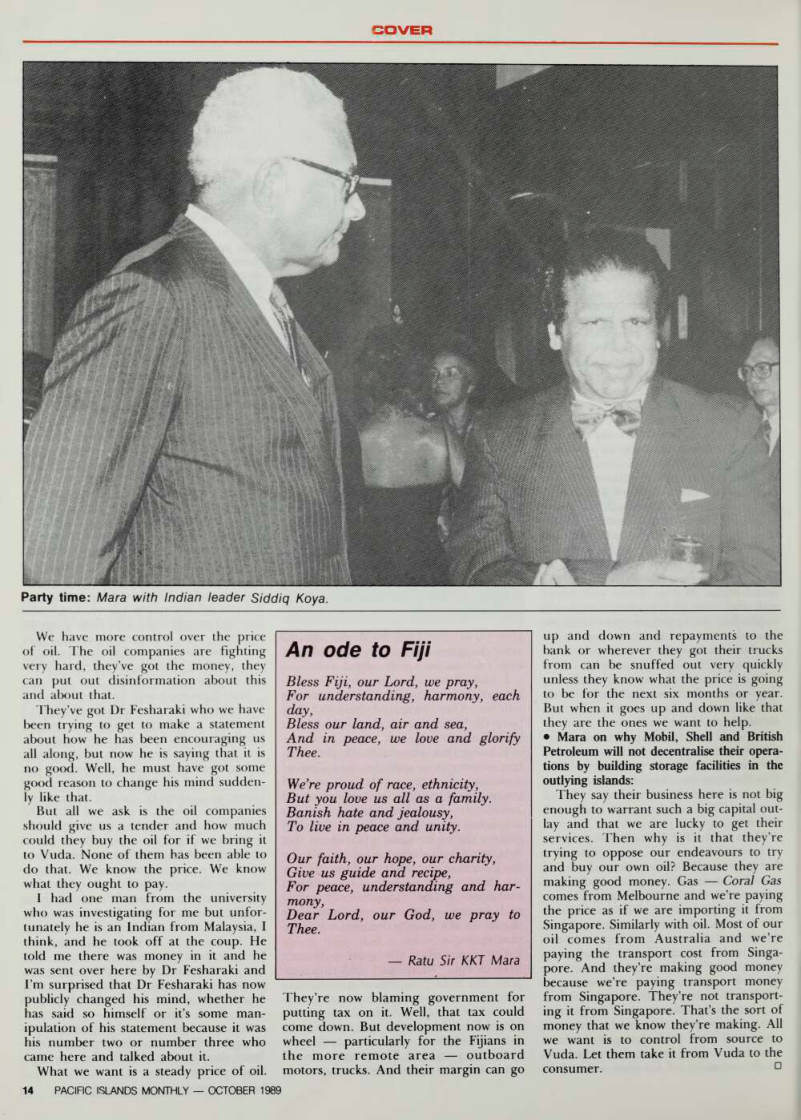
Party time; Mara with Indian leader Siddiq Koya.