Who’s on Mara’s side
pp. 10-11 · Read in the full issue
Cover
Fiji continues to rebuild from the military coups of 1987. The economy is growing. The only major worry is the new constitution. With Ratu Sir Kamisese Mara staying as leader , there seems to be hope.
By Jale Moala
Rabuka and the President, Ratu Sir Penaia Ganilau, met in Suva on Septem ber 28. A statement from Government House that evening said the President “had prevailed” over Mara to continue as head of government after his two-year term expires on December 5. Mara told AAP he accepted with conditions based on the trimming of Rabuka’s power both as a military leader and as a Cabinet minister. It was an about-turn for Mara who announced last May his desire to retire from politics and go home to his people in the Lau Group of islands.
Even when Pacific Islands Monthly asked him on September 18 if there was any thing that could change his mind, Mara said: “I have no wish to continue ... No thing can change my mind. I’ve had
enough.”
After falling to the precipice of disas ter in 1987, Fiji’s economy picked up growth during Mara’s term of office.
RATU Sir Kamisese Mara’s decision to stay on as Fiji’s interim Prime Minister was just as soothing to Fiji’s million-dollar investors as it was to many Indians. Both communities, fear ing the radicalism of the military strong men, see the 69-year-old Mara as the stabilising force in a country still uncer tain about its political future. The fear that coup leader Major-General Sitiveni Rabuka would march back into control was always in danger of causing the eco nomy to overheat. For the Indians, the army was always a threat and the pub lication of a report late last month in which the army called for radical
changes favouring the indigenous Fijians
seemed to justify their suspicion of the
military.
Mara’s decision was announced by Au stralian Associated Press after Mara,
The Asian Development Bank predicts a growth of at least two to three per cent this year and next year. The growth rate in 1987, the year of Rabuka’s two milit ary coups, had dropped to a negative eight per cent. But a significant turn around in 1988, when Mara was back in office, saw the economy growing by two per cent.
Mara must be basking in the comfort
ing thought that the economic security
he seems to provide will bring him the friends he needs for an extended term in office. Obviously the business com
munity have been overjoyed, particularly
that Mara made his announcement three days after the publication of the army report which said some multinationals like Burns Philp was having it “too good for too long at our expenses”. That army report, presented by Rabuka to Mara and Ganilau in May, was a billboard of anxiety for the Indian community. Politi
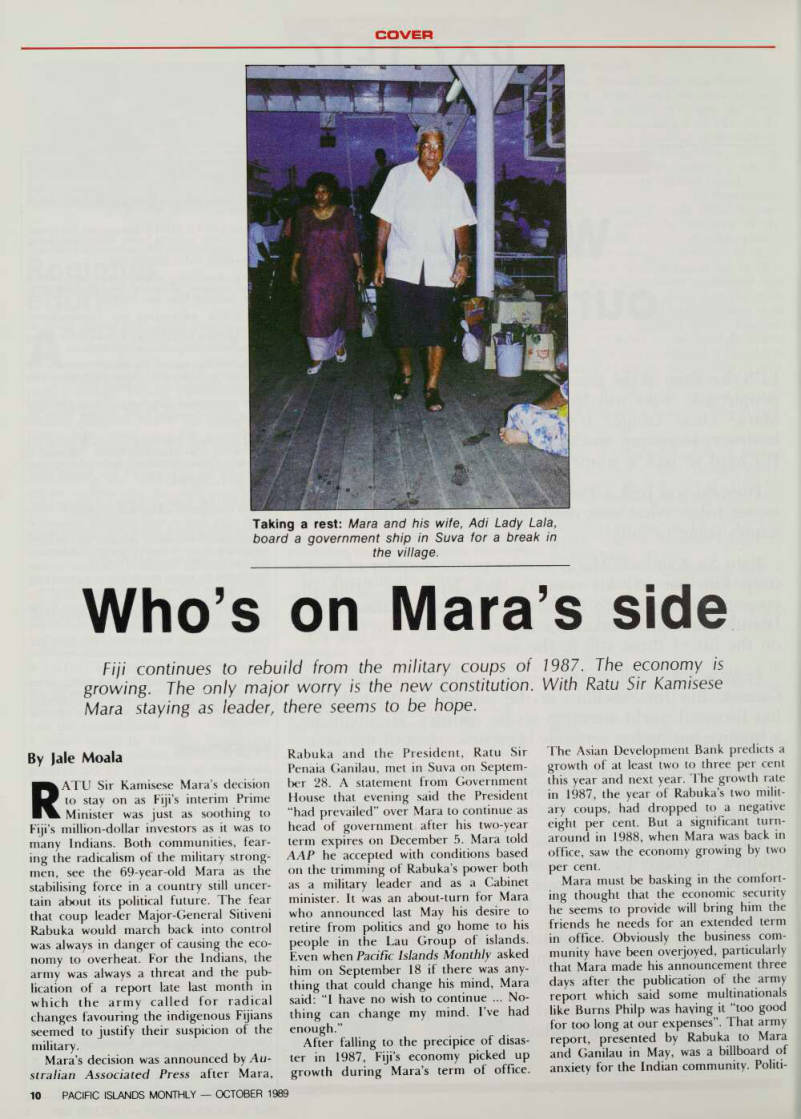
Taking a rest: Mara and his wife, Adi Lady Lala, board a government ship in Suva for a break in the village.
cians and diplomats were alarmed by the report which called for the expulsion of the Indian ambassador and the Austra lian defence attache and a shift in de fence agreement to Asian countries.
It was clearly evident that given the choice on who to choose, most people would pick Mara, even if many would not agree with his politics. An example was the Indian businessman who met his board of directors on September 25 to discuss an expansion programme in
Suva. During the meeting, they received
a faxed copy of the army report which was published by the Australian Finan cial Review that day. The businessman said the arrival of the report immediate ly changed their attitude towards invest ing a large sum of money in Fiji. Sus pecting that the army would be back in power in December, the group retired from their meeting without making any firm decision. Mara’s announcement three days later relieved the pressure.
While Mara is undoubtedly winning friends because of his economic policies, he will continue to be wary of his politic al foes. The National Federation Party/ Labour Coalition has refused to accept his role, calling instead for direct parti cipation in the formulation of the new constitution. President Dr Balwant Singh Rakka, speaking in the absence of Dr Timoci Bavadra, rejected Mara’s con tinued leadership and said it was Mara’s endorsement of a racially-biased draft constitution. Rakka’s praises were directed at deposed Prime Minister Dr Timoci Bavadra who during the time of writing was being treated in Auckland for cancer of the spine which one source said was probably malignant. Mara, too, has big health problems. He said he had three heart attacks in the past two years and his doctor advised him to rest reg
ularly.
When Mara took office on December 5, 1987, he did so with caution. He knew the coup had made him unpopular among Indians, and to some extent among Fijians. He therefore did not make too many changes to the 20member Cabinet he inherited from Rabuka’s military government. Notable was his dismissal of Fijian Nationalist Party leader Sakeasi Butadroka and Taukei Movement strongman Ratu Meli Vesikula whom he said “were openly hostile” to him. This December he is ex pected to cut the size of Cabinet. Who will go is a guessing game. But men like Deputy Prime Minister Josevata Kamika mica, Trade Minister Berenado Vunibo bo, Tourism Minister David Pickering, Works and Communications Minister Apisai Tora and Education Minister Filipe Bole will form the core of the new government. They will be the men Mara will rely on as he continually takes those
holidays prescribed by his doctor. □