Farewell from
p. 53 · Read in the full issue
a white ship
By Diana McManus
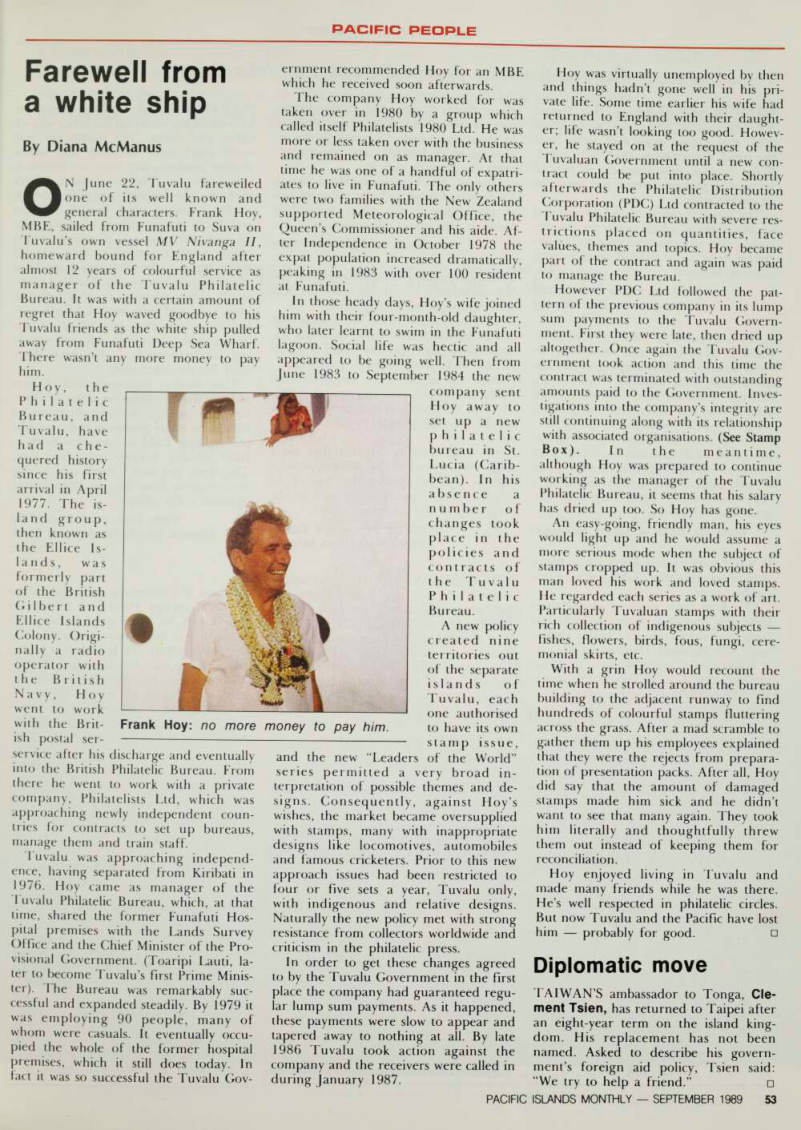
ON June 22, Tuvalu fareweiled one of its well known and general characters. Frank Hoy, MBE, sailed from Funafuti to Suva on Tuvalu’s own vessel MV Nivanga //, homeward bound for England after almost 12 years of colourful service as manager of the Tuvalu Philatelic Bureau. It was with a certain amount of regret that Hoy waved goodbye to his Tuvalu friends as the white ship pulled away from Funafuti Deep Sea Wharf.
There wasn’t any more money to pay him.
Hoy, the Philatelic Bureau, and Tuvalu, have had a che
quered history
since his first arrival in April 1977. The is land group, then known as the Ellice Is lands, was
formerly part
of the British Gilbert and Ellice Islands
Colony. Origi
nally a radio operator with the British Na vy, Hoy went to work with the Brit ish postal ser
service after his discharge and eventually into the British Philatelic Bureau. From there he went to work with a private company, Philatelists Ltd, which was
approaching newly independent coun-
tries for contracts to set up bureaus, manage them and train staff.
I uvalu was approaching independence, having separated from Kiribati in 1976. Hoy came as manager of the I uvalu Philatelic Bureau, which, at that time, shared the former Funafuti Hospital premises with the Lands Survey Of fice and the Chief Minister of the Provisional Government. (Toaripi Lauti, later to become Tuvalu’s first Prime Minister). Ihe Bureau was remarkably suecessful and expanded steadily. By 1979 it was employing 90 people, many of whom were casuals. It eventually occupied the whole of the former hospital premises, which it still does today. In fact it was so successful the Tuvalu Gov-
ernment recommended Hoy for an MBE which he received soon afterwards.
The company Hoy worked for was taken over in 1980 by a group which called itself Philatelists 1980 Ltd. He was more or less taken over with the business and remained on as manager. At that time he was one of a handful of expatri ates to live in Funafuti. The only others were two families with the New Zealand supported Meteorological Office, the Queen’s Commissioner and his aide. Af ter Independence in October 1978 the
expat population increased dramatically,
peaking in 1983 with over 100 resident at Funafuti.
In those heady days, Hoy’s wife joined him with their four-month-old daughter, who later learnt to swim in the Funafuti lagoon. Social life was hectic and all appeared to be going well. Then from June 1983 to September 1984 the new
company sent Hoy away to set up a new philatelic bureau in St.
Lucia (Carib bean). In his absence a number of
changes took
place in the policies and contracts of the Tuvalu Philatelic Bureau.
A new policy created nine territories out of the separate islands of Tuvalu, each one authorised to have its own stamp issue,
and the new “Leaders of the World” series permitted a very broad in terpretation of possible themes and de
signs. Consequently, against Hoy’s
wishes, the market became oversupplied with stamps, many with inappropriate designs like locomotives, automobiles and famous cricketers. Prior to this new approach issues had been restricted to four or five sets a year, Tuvalu only, with indigenous and relative designs.
Naturally the new policy met with strong resistance from collectors worldwide and criticism in the philatelic press.
In order to get these changes agreed to by the Tuvalu Government in the first place the company had guaranteed regu lar lump sum payments. As it happened, these payments were slow to appear and tapered away to nothing at all. By late 1986 Tuvalu took action against the company and the receivers were called in during January 1987.
Hoy was virtually unemployed by then
and things hadn’t gone well in his pri vate life. Some time earlier his wife had returned to England with their daught er; life wasn’t looking too good. Howev er, he stayed on at the request of the Tuvaluan Government until a new con tract could be put into place. Shortly afterwards the Philatelic Distribution Corporation (PDC) Ltd contracted to the I uvalu Philatelic Bureau with severe res trictions placed on quantities, face values, themes and topics. Hoy became part of the contract and again was paid to manage the Bureau.
However PDC Ltd followed the pat tern of the previous company in its lump sum payments to the Tuvalu Govern ment. First they were late, then dried up altogether. Once again the Tuvalu Gov ernment took action and this time the contract was terminated with outstanding amounts paid to the Government. Inves tigations into the company’s integrity are
still continuing along with its relationship
with associated organisations. (See Stamp Box). In the meantime,
although Hoy was prepared to continue
working as the manager of the Tuvalu Philatelic Bureau, it seems that his salary has dried up too. So Hoy has gone.
An easy-going, friendly man, his eyes would light up and he would assume a more serious mode when the subject of stamps cropped up. It was obvious this man loved his work and loved stamps.
He regarded each series as a work of art.
Particularly Tuvaluan stamps with their rich collection of indigenous subjects fishes, flowers, birds, fous, fungi, cere monial skirts, etc.
With a grin Hoy would recount the time when he strolled around the bureau building to the adjacent runway to find hundreds of colourful stamps fluttering across the grass. After a mad scramble to gather them up his employees explained that they were the rejects from prepara tion of presentation packs. After all, Hoy did say that the amount of damaged stamps made him sick and he didn’t want to see that many again. They took him literally and thoughtfully threw them out instead of keeping them for reconciliation.
Hoy enjoyed living in Tuvalu and made many friends while he was there.
He’s well respected in philatelic circles.
But now Tuvalu and the Pacific have lost him probably for good. □
Diplomatic move
TAIWAN’S ambassador to Tonga, Cle ment Tslen, has returned to Taipei after an eight-year term on the island king dom. His replacement has not been named. Asked to describe his govern ment’s foreign aid policy, Tsien said: “We try to help a friend.” □
Frank Hoy: no more money to pay him.