better place
p. 30 · Read in the full issue
Better life, better place
LIFE expectancy rates in the Pacific are up, and most population growth rates have slowed, accord ing to new statistics released by the World Bank. These and other measures of the quality of life are called “social indicators” by the lending institution.
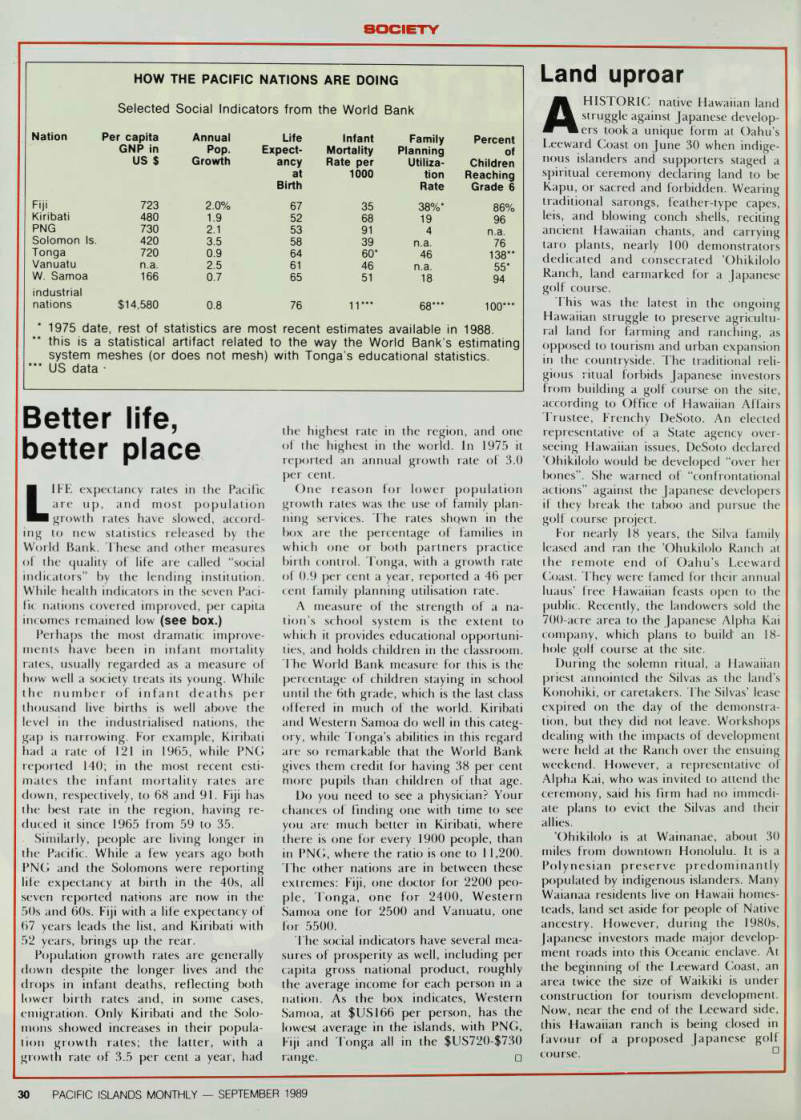
While health indicators in the seven Paci fic nations covered improved, per capita incomes remained low (see box.) Perhaps the most dramatic improve ments have been in infant mortality rates, usually regarded as a measure of how well a society treats its young. While the number of infant deaths per thousand live births is well above the level in the industrialised nations, the gap is narrowing. For example, Kiribati had a rate of 121 in 1965, while PNG reported 140; in the most recent esti mates the infant mortality rates are down, respectively, to 68 and 91. Fiji has the best rate in the region, having re duced it since 1965 from 59 to 35.
Similarly, people are living longer in
the Pacific. While a few years ago both PNG and the Solomons were reporting life expectancy at birth in the 40s, all seven reported nations are now in the 50s and 60s. Fiji with a life expectancy of 67 years leads the list, and Kiribati with 52 years, brings up the rear.
Population growth rates are generally
down despite the longer lives and the drops in infant deaths, reflecting both lower birth rates and, in some cases, emigration. Only Kiribati and the Solo mons showed increases in their popula tion growth rates; the latter, with a growth rate of 3.5 per cent a year, had
the highest rate in the region, and one of the highest in the world. In 1975 it reported an annual growth rate of 3.0 per cent.
One reason for lower population growth rates was the use of family plan ning services. The rates shqwn in the box are the percentage of families in which one or both partners practice birth control. Tonga, with a growth rate of 0.9 per cent a year, reported a 46 per cent family planning utilisation rate.
A measure of the strength of a na tion’s school system is the extent to which it provides educational opportuni ties, and holds children in the classroom.
The World Bank measure for this is the percentage of children staying in school until the 6th grade, which is the last class offered in much of the world. Kiribati and Western Samoa do well in this categ ory, while Tonga’s abilities in this regard are so remarkable that the World Bank gives them credit for having 38 per cent more pupils than children of that age.
Do you need to see a physician? Your chances of finding one with time to see you are much better in Kiribati, where there is one for every 1900 people, than in PNG, where the ratio is one to 11,200.
The other nations are in between these extremes: Fiji, one doctor for 2200 peo ple, Tonga, one for 2400, Western Samoa one for 2500 and Vanuatu, one for 5500.
The social indicators have several mea sures of prosperity as well, including per
capita gross national product, roughly
the average income for each person in a nation. As the box indicates, Western Samoa, at SUSI 66 per person, has the lowest average in the islands, with PNG, Fiji and Tonga all in the SUS72O-$730 range. □