adventures
p. 23 · Read in the full issue
American Samoa
Washington
By David North
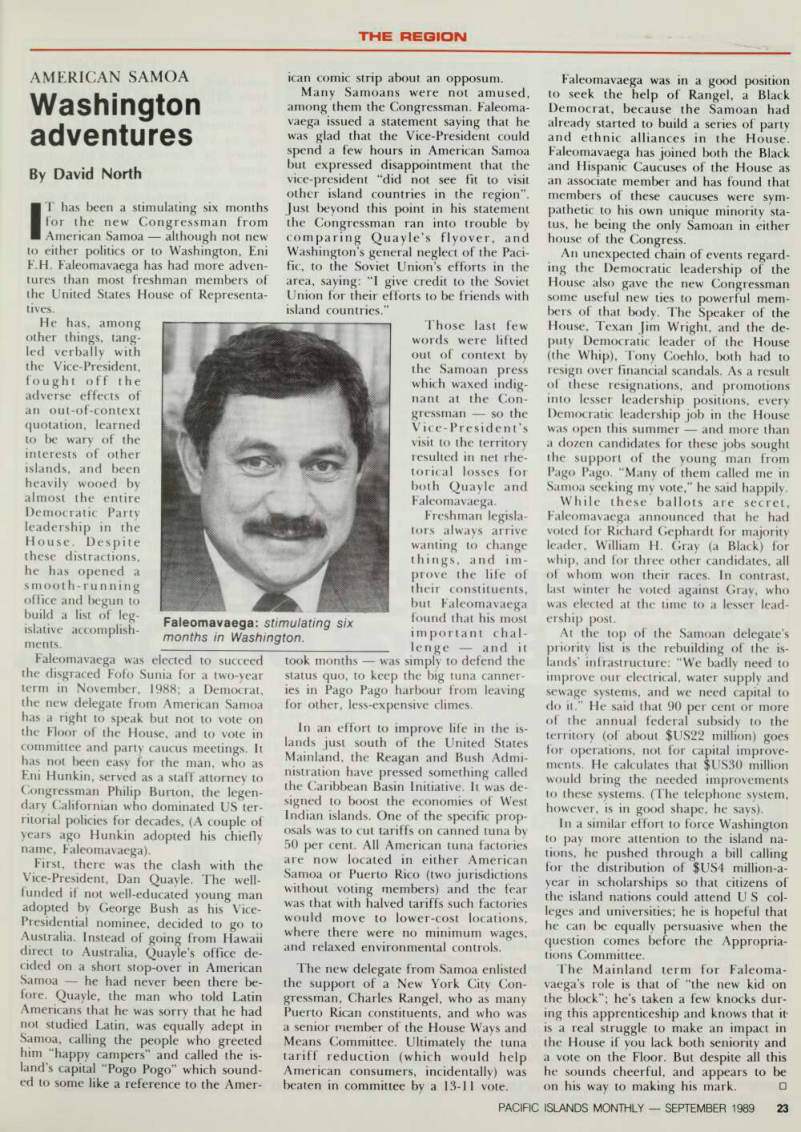
IT has been a stimulating six months for the new Congressman from American Samoa although not new to either politics or to Washington, Eni F.H. Faleomavaega has had more adven tures than most freshman members of the United States House of Representa tives.
He has, among other things, tang led verbally with the Vice-President, fought off the adverse effects of an out-of-context quotation, learned to be wary of the interests of other islands, and been heavily wooed by almost the entire Democratic Party leadership in the
House. Despite
these distractions, he has opened a
smooth-running
office and begun to build a list of leg
islative accomplish
ments.
Faleomavaega was elected to succeed the disgraced Fofo Sunia for a two-year term in November, 1988; a Democrat, the new delegate from American Samoa has a right to speak but not to vote on the Floor of the House, and to vote in committee and party caucus meetings. It has not been easy for the man, who as Fni Hunkin, served as a staff attorney to Congressman Philip Burton, the legen dary Californian who dominated US ter ritorial policies for decades, (A couple of years ago Hunkin adopted his chiefly
name, Faleomavaega).
First, there was the clash with the Vice-President, Dan Quayle. The well funded if not well-educated young man adopted by George Bush as his Vice- Presidential nominee, decided to go to Australia. Instead of going from Hawaii direct to Australia, Quayle’s office de cided on a short stop-over in American Samoa he had never been there be fore. Quayle, the man who told Latin Americans that he was sorry that he had not studied Latin, was equally adept in Samoa, calling the people who greeted him “happy campers” and called the is land’s capital “Pogo Pogo” which sound ed to some like a reference to the Amer-
ican comic strip about an opposum.
Many Samoans were not amused, among them the Congressman. Faleoma vaega issued a statement saying that he was glad that the Vice-President could spend a few hours in American Samoa but expressed disappointment that the vice-president “did not see fit to visit other island countries in the region”.
Just beyond this point in his statement the Congressman ran into trouble by
comparing Quayle’s flyover, and
Washington’s general neglect of the Paci fic, to the Soviet Union’s efforts in the area, saying: “I give credit to the Soviet Union for their efforts to be friends with island countries.”
Those last few words were lifted out of context by the Samoan press which waxed indig nant at the Con gressman so the Vice-President’s visit to the territory resulted in net rhe torical losses for both Quayle and
Faleomavaega.
Freshman legisla
tors always arrive
wanting to change
things, and im prove the life of their constituents,
but Faleomavaega
found that his most
important chal
lenge and it
took months was simply to defend the status quo, to keep the big tuna canner ies in Pago Pago harbour from leaving for other, less-expensive climes.
In an effort to improve life in the is lands just south of the United States Mainland, the Reagan and Bush Admi nistration have pressed something called the Caribbean Basin Initiative. It was de signed to boost the economies of West Indian islands. One of the specific prop osals was to cut tariffs on canned tuna by 50 per cent. All American tuna factories are now located in either American Samoa or Puerto Rico (two jurisdictions without voting members) and the fear was that with halved tariffs such factories would move to lower-cost locations, where there were no minimum wages, and relaxed environmental controls.
The new delegate from Samoa enlisted the support of a New York City Con gressman, Charles Rangel, who as many Puerto Rican constituents, and who was a senior member of the House Ways and Means Committee. Ultimately the tuna tariff reduction (which would help American consumers, incidentally) was beaten in committee by a 13-11 vote.
Faleomavaega was in a good position
to seek the help of Rangel, a Black Democrat, because the Samoan had already started to build a series of party and ethnic alliances in the House.
Faleomavaega has joined both the Black and Hispanic Caucuses of the House as an associate member and has found that members of these caucuses were sym pathetic to his own unique minority sta tus, he being the only Samoan in either house of the Congress.
An unexpected chain of events regard ing the Democratic leadership of the House also gave the new Congressman some useful new ties to powerful mem bers of that body. The Speaker of the House, Texan Jim Wright, and the de puty Democratic leader of the House (the Whip), Tony Coehlo, both had to resign over financial scandals. As a result of these resignations, and promotions into lesser leadership positions, every Democratic leadership job in the House was open this summer and more than a dozen candidates for these jobs sought the support of the young man from Pago Pago. “Many of them called me in Samoa seeking my vote,” he said happily.
While these ballots are secret, faleomavaega announced that he had voted for Richard Gephardt for majority leader, William H. Gray (a Black) for whip, and for three other candidates, all of whom won their races. In contrast, last winter he voted against Gray, who was elected at the time to a lesser lead
ership post.
At the top of the Samoan delegate’s priority list is the rebuilding of the is lands’ infrastructure: “We badly need to improve our electrical, water supply and sewage systems, and we need capital to do it.” He said that 90 per cent or more of the annual federal subsidy to the territory (of about SUS 22 million) goes
for operations, not for capital improve
ments. He calculates that SUS3O million would bring the needed improvements to these systems. (The telephone system, however, is in good shape, he says).
In a similar effort to force Washington to pay more attention to the island na tions, he pushed through a bill calling for the distribution of SUS 4 million-a year in scholarships so that citizens of the island nations could attend U S col leges and universities; he is hopeful that he can be equally persuasive when the question comes before the Appropria tions Committee.
The Mainland term for Faleoma vaega’s role is that of “the new kid on the block”; he’s taken a few knocks dur ing this apprenticeship and knows that it* is a real struggle to make an impact in the House if you lack both seniority and a vote on the Floor. But despite all this he sounds cheerful, and appears to be on his way to making his mark. □
Faleomavaega: stimulating six months in Washington.