Pacific Way
pp. 21-22 · Read in the full issue
Ccop/Sopac
A test for the Pacific Way
By Jope Balawanilotu
THE Pacific Way faces another test when the governing body of the Co-ordinating Committee for Mineral Prospecting in South Pacific Offshore Areas (CCOP/SOPAC) meets for its annual session in Canberra from September 2 to 13. The session is ear marked to appoint a director and decide on a permanent location for its technical secretariat (Techsec) which has been based in Suva for 17 years.
A decision will end a prolonged race by four member countries Fiji, Vanuatu, Tonga and Western Samoa to host the headquarters. To make a de cision, the annual session might resort to democracy and put to vote on an issue the much vaunted Pacific Way has so far failed to resolve. “This was considered at our annual session last October (where) we were ready to put it to the vote (but) we decided to do it the Pacific Way,” says Jioji Kotobalavu, the director of Techsec. “We thought, why can’t we do this the Pacific Way. Why don’t we think it over. We were then to have a special session in Guam in March this year.
“So we held our March meeting in Guam (where) we were ready to put it to the vote, but again, we decided, let’s do this the Pacific Way because if we put this to the vote we will end up with one winner out of the four and the other three will consider themselves losers and create bad feelings. The meeting in Guam decided to let the four countries talk amongst themselves, don’t involve the rest of the membership between now and October when we will have our annual session, and try to resolve this themselves.”
Kotobalavu, a 46-year-old Fijian tech-
nocrat of exceptional qualities and potential, has done his bit to keep the highly technical CCOP/SOPAC free of politics. In an effort to help member countries decide on a location merely on its merits, he commissioned an indepen dent study team early last year to visit each of the contending countries and re port on their “comparative advantage” and suitability. To ensure impartiality, the team was not commissioned to make any recommendation.
Fiji, with existing infrastructure, clear ly had the edge. But Tonga, Fiji’s closest ally in terms of blood ties between their leaders, pointed to Fiji’s unsolved politic al problems as a major drawback. The island kingdom is wooing Techsec with the promise it will provide the headquar ters complex free. Western Samoa has in the past marketed itself as a better place for tourists to visit. It drew attention to the many devastating cyclones that con tinually hit Fiji in the past. The battle goes on for CCOP/SOPAC Techsec which has a 1989 expenditure budget of $3,990,870. The rapid growth of the agency since Kotobalavu became its first regional director four years ago dictates
that it requires bigger and better premis es within the next two years. It means that the Canberra session must come to a decision one way or another.
What the non-contending countries will like to do is decide the issue, not on a political basis of give and take but simply on the merits of location and advantage. “In other words we must be cost efficient and (effective) in terms of delivery of the work programme,” Koto balavu says. “When I came in (in 1986) this organisation was funded mainly by one source, the United Nations (through its United Nations Development Prog ramme) and it is a United Nations policy to start an activity, support it and try to encourage that activity to stand on its own and become self reliant. So one of my first roles was to try and diversify, increase and broaden the range of financing available to this organisation so that we are not dependent on one source.” And so Kotobalavu has: • marshalled member countries Au stralia, the Cooks, Fiji, Guam, New Zea land, Papua New Guinea, the Solomons, Tonga, Vanuatu and Western Samoa to each pay an annual contribution of
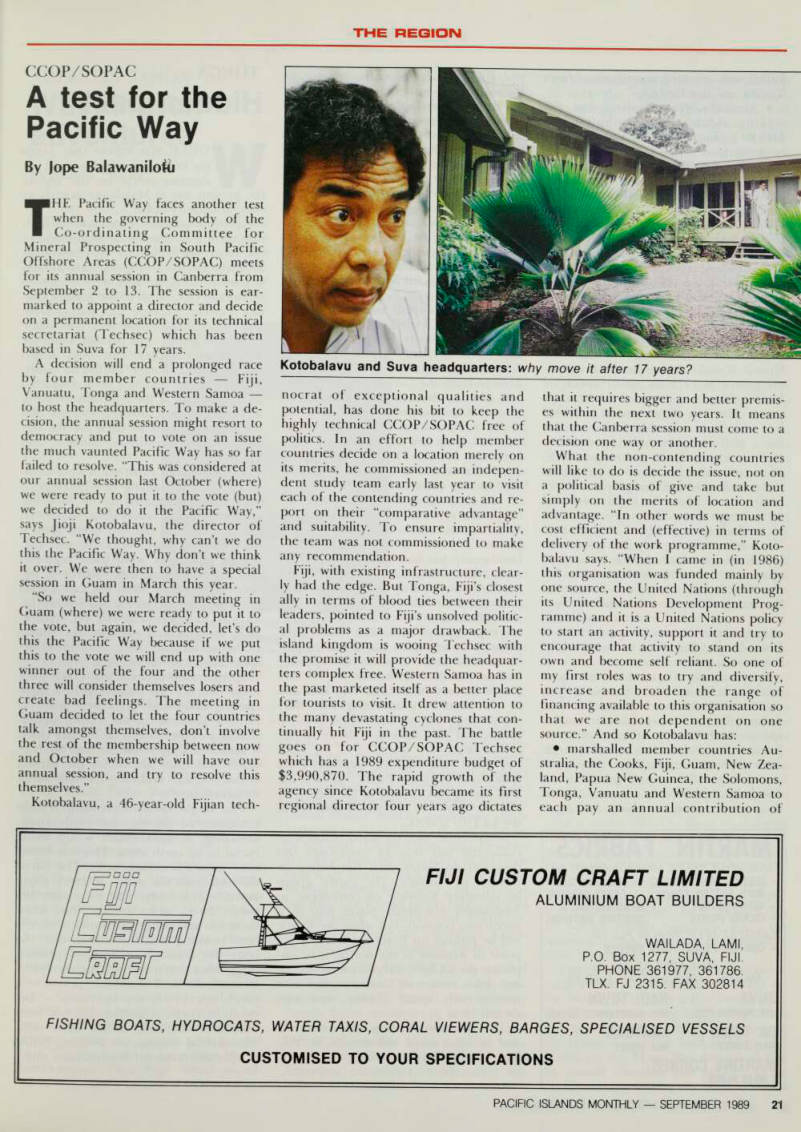
Kotobalavu and Suva headquarters: why move it after 17 years?
$9750 with adjusted contributions from Tuvalu and the Kiribati; • Australia, New Zealand and Fiji
making voluntarily contributions of
$402,015 plus, $359,820, and $145,000
respectively.
• won donations from Canada
($1,131,405), the European Community
($885,050), France ($295,145), the Un
ited Nations Development Programme
($75,350), and the Commonwealth Fund for Technical Co-operation ($52,800); and • attracted from other donor coun tries, including the Netherlands and
other agencies, expertise, equipment,
shiptime and other technical services all worth $8 million.
Kotobalavu has brought CCOP/ SOPAC Techsec a long way since the
United Nations Development Program
me gave it in 1972 an initial funding of $0.75 million and provided the manage ment. The Fiji Government provided free office space. Techsec in Suva today has a staff component that resembles a mini world community, where world ex perts pass on knowhow to regional understudies, with a computerised nerve centre to facilitate its highly technical work programme. The secrecy of most of its findings has helped Techsec turn into a low profile agency. But good news like finds of cobalt (which is used in spacecraft) in commercial quantities off the Cooks do get out. Over the Creenouse Effect phenomenon, Techsec is not over reacting, which it could do to attract research money for its scientists.
Instead it is going about its own sea level
monitoring programme.
Kotobalavu’s efforts, have not gone unnoticed. Forum 20 in Tarawa in July commended the work programme he presented in a 60-page dossier. In re sponse to the expiry of his contract in January, Kotobalavu says potential candi dates from the region have telephoned to say they will not apply for the job if Kotobalavu decides to stay on. “I find their gesture very touching and again
you find this (prevalent) amongst we islanders and I will not be surprised that the few who have applied are not Pacific Islanders,” he says.
What Kotobalavu does not know is that when applications closed in July, 15 had applied for his job. The annual six
figure package associated with regional
agency secretariat executives is an irre sistable attraction. Some contenders say Kotobalavu is not available for the direc torship because he has been selected for nomination by the Pacific caucus of ministers in the African Caribbean Paci fic (AGP) group for secretary general in Brussels.
The AGP group of ministers meet in two sessions (October 2-5 and October 10-13) in Brussels where it will also appoint its secretary general (currently Edwin Carrington, of Trinidad and Tobago from the Caribbean). In a num bers game in Brussels, the Pacific has no chance. The 66-member AGP comprises of 44 nations from the African conti nent, 14 from the Caribbean and eight from the Pacific. There is, however, a small chance for the Pacific depen dent on the understanding that the post of secretary general should rotate be tween the regional groups of the AGP.
The African nations have had two con secutive five-year terms and the Carib bean group has had Carrington for five years. The Caribbeans are eligible for another term. But all groups have nominated candidates.
Kotobalavu says the most the Pacific can expect out of Brussels is “making the point that the region has a role to play in the AGP and that it has the capability and preparedness to handle it”. He says Pacific leaders “have been very nice and it has been very touching that they should approach me because obviously it means that they have confidence in me.
It has been very touching in the same way that I find touching messages from senior officials from Pacific island coun tries saying that so long as I’m here they will not apply for the job of director of
The Ccop/Sopac.”
Sentimental. But the hard realities in clude the fact that 15 candidates feel they can do better than Kotobalavu as director of Techsec. The Pacific group of ministers’ showing of confidence in Kotobalavu effectively places him in a precarious position. For while the Pacific will be putting up Kotobalavu to make a point in Brussels in the northern hemis phere, the CCOP/SOPAC will be decid ing down under in Canberra where to permanently locate Techsec and who should head it.
The questions arising are what role and in what shape will the Pacific Way have in the derision making. □