End of an era
pp. 10-15 · Read in the full issue
Cover
For five years , David Lange presided over some of the most dramatic reforms in New Zealand for half a century. Last month he suddenly stepped aside and fellow lawyer Geoffrey Palmer took over the reins. David Robie reports.
ONE night last month an earth quake gripped central New Zealand, shaking all the way from Gisborne in the north to the south ern city of Christchurch. Although there were no reports of serious damage, the tremors were symbolic of a dramatic
political upheaval taking place.
Delivering his budget speech that
night, Tuesday, August 8, Opposition Leader Jim Bolger stopped for a mo ment during the tremors and looked around the chamber. “It isn’t shaking half as much as the Labour govern ment,” he jibed. But Geoffrey Palmer, New Zealand’s new Prime Minister of just a few hours, snorted back that the quake was far more interesting than any
thing Bolger had said.
Certainly the tremors couldn’t match the seismic shock that for the previous 36 hours had followed former Prime Minister David Lange’s dramatic resigna tion. Just as Lange had presided over a roller-coaster five years in office in which New Zealand experienced some of the most far-reaching reforms for half a century, he bowed out in a charismatic
and jocular style.
Lange will be remembered interna tionally as the prime minister that chal lenged the superpowers to keep nuclear weapons out of the South Pacific, and opened the door to a free market eco nomy. Yet at home his dream or reshap ing the social welfare state that had once
led the world with improvements that fitted the overhauled economy had bare
ly begun to become a reality.
For many New Zealanders who sup ported his nuclear-free stance the econo
mic reality and growing polarisation be
tween the country’s wealthy and the poor had turned their hopes sour, Lange’s astute sense of timing and courage to bow out, however have apparently ensured that his successors are now totally committed to his goal he has halted the “New Right jugger naut”, as he put it. Less than a week after taking office, Prime Minister Palmer de clared to a standing ovation at a rally of ruling party faithful he would honour
Lange’s vision.
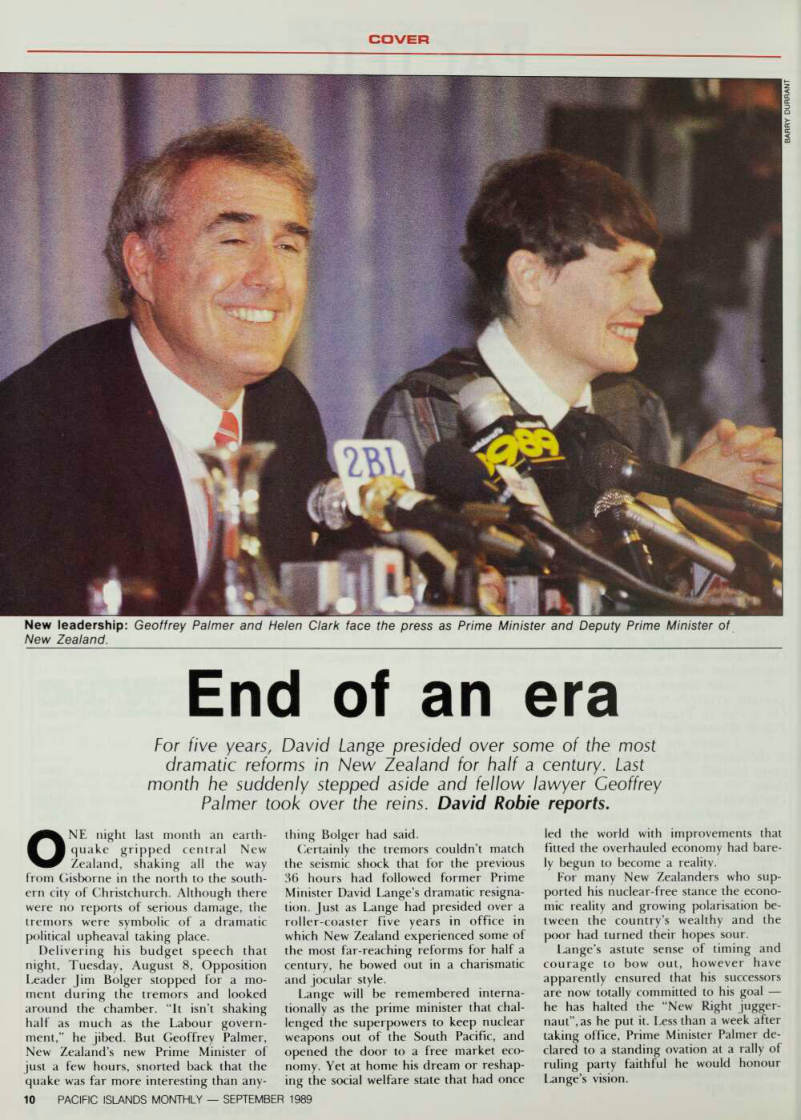
New leadership: Geoffrey Palmer and Helen Clark face the press as Prime Minister and Deputy Prime Minister of New Zealand.
The rejuvenation and new-found popularity of the government has boosted its morale as it tries to regain credibility for next year’s general elec tion after a bitter 18 months of feuding.
But the revival poses problems for both the opposition National Party, and the fledgling New Labour Party, led by re negade left-wing Labour MP Jim Ander ton, which has been gaining fast-growing support.
Although Palmer lacks the charisma and witty sparkle of Lange “boring”, perhaps, as many commentators and newspapers brand him he has reshuf fled a highly gifted cabinet and packed his front benches with social reformers.
Deputy Prime Minister Helen Clark, the first woman to hold such high political office, is flag-bearer of the left-wing of the party and has quickly demonstrated skills as a tough minister.
Reported at first as a victory for the
Right, within two days Lange’s resigna
tion had become a triumph for the Left.
“Clearly it was neither”, remarked Sun day Times commentator Robert Mann ion. “The Right could hardly be pleased with a Palmer-Clark leadership; the Left had not wanted to see Lange go in the
first place.”
Lange’s rehabilitated arch-rival Roger Douglas, architect of the so-called “Rogernomics” economic strategy which he steered as Finance Minister, was given 12th ranking in the new cabinet with the portfolios of police, im migration and “special projects” safely out of the economic limelight. Clark had comfortably defeated Douglas in the bal lot for the deputy’s job and she added the labour portfolio to her controversial role as Health Minister.
The chief Douglas lieutenant, Richard Prebble, was successfully kept out of cabinet when Lange accepted the post of Attorney-General (outside cabinet) and prevented the need for the election of a 20th minister. Prebble, former Pacific Affairs Minister whose wife Nancy is Fi jian, wields formidable political mana among Pacific Islands communities, par ticularly in Auckland.
Nancy Prebble accused the new lead
ership of being dominated by “university
politics” and too much “backscratching”.
Declaring her husband and Douglas had been caught like “chooks without their
heads” by Lange’s resignation, she
added; “If he was a big man he would have wanted the best team to carry us through to the election.”
Both Palmer and Clark, a former
chairperson of the parliamentary foreign
affairs select committee, have a broad view of the Pacific and New Zealand’s role in the region. But their administra tion is unlikely to be marked by the flamboyant style of Lange who made a stunning visit to Noumea to talk with
pro and anti-independence parties shortly after being elected to office in 1984, and who made a savage attack on Ratu Sir Kamisese Mara in post-coup Fiji.
One of the first major tasks of the new Palmer administration was to make a decision on whether New Zealand would participate in the proposed ANZAC warship pact an issue that has bitterly divided New Zealanders for months. A week after Palmer took office, the Australian government showed its hand, putting pressure on New Zealand.
Pacific and Foreign Affairs Minister Russell Marshall declared on national television that “several Pacific nations are counting on our decision” to ensure
their security.
Announcing the selection of the Amecon consortium to build up to 12 West
German-designed Mako frigates, Austra
lian Defence Minister Kim Beazley said he expected New Zealand to make a de cision in a few weeks. Beazley added that regional defence cooperation would be come run down if New Zealand aban
doned the proposed joint project, but
Palmer refused to be rushed into a deci sion.
Opinion polls show more than 70 per cent of New Zealanders are opposed to the frigate proposal in which New Zea land could buy up to four ships at more than $3OO million each. (Australia has agreed to contract for 10 ships with a let-out clause that would allow only eight to be built or up to 12 if New Zealand joins the project). The majority of gov ernment MPs are also opposed, Peace campaigners and researchers
claim that by entering such an agree ment, New Zealand would be effectively forced into a “back door” accommoda tion with the ANZUS regional nuclear umbrella. Many critics condemn the New Zealand government for not seriously considering an alternative proposal for a Danish frigate design which is a fraction of the cost and arguably more suited to South Pacific regional patrol and fisher ies work.
Palmer plans to take centre stage on the “wall of death” driftnet fishing issue with an address at the United Nations General Assembly next month. He will plead for international action against the
ecological disaster.
Lange put up a brave face with his resignation, declaring there would be no labour market deregulation, and mini mum wage rates would remain. The so cial “caring and compassion”, a tradition al cornerstone of previous Labour gov ernments, would return.
He was even back to his wittiest self: “Can I tell you, Geoffrey I have changed my mind!”, he chortled at Pal mer during a joint press conference marking the handover of power. But in a television interview with the Australian Channel Nine network’s 60 Minutes which he didn’t want broadcast in New Zealand Lange was far more candid.
He warned he would remain a thorn in the side of the government MPs who had betrayed him.
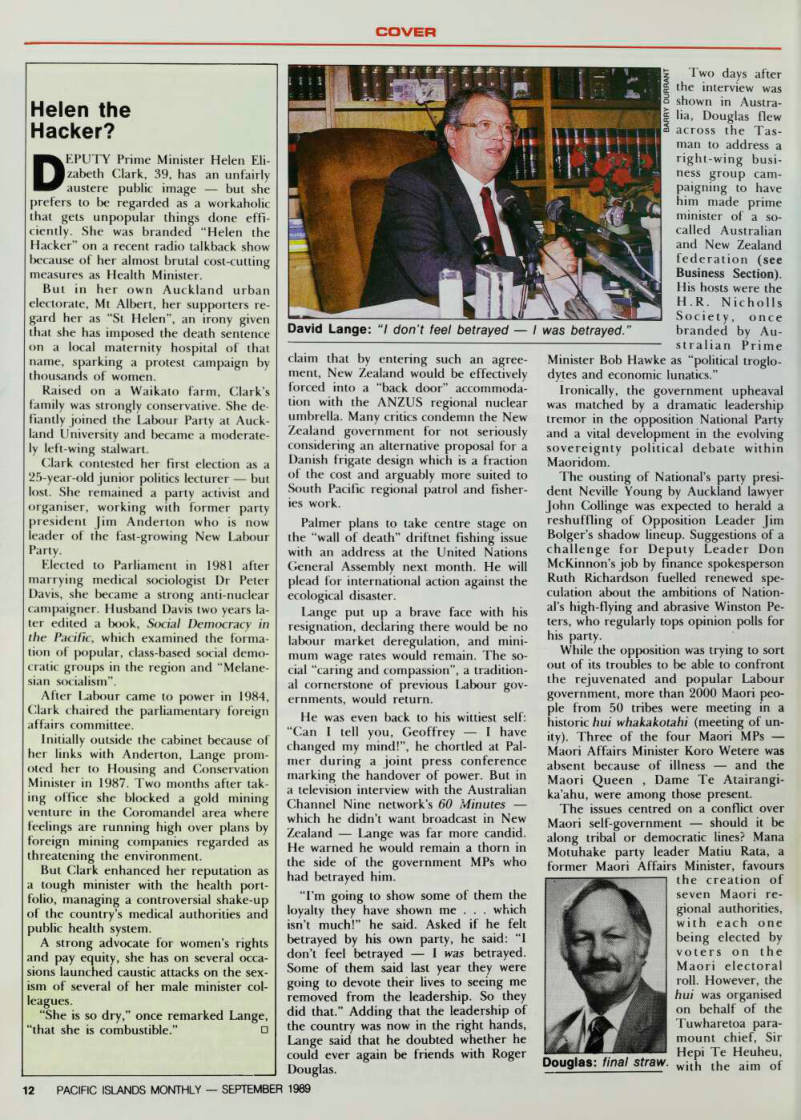
“I’m going to show some of them the loyalty they have shown me . . . which isn’t much!” he said. Asked if he felt betrayed by his own party, he said: “I don’t feel betrayed I was betrayed.
Some of them said last year they were going to devote their lives to seeing me removed from the leadership. So they did that.” Adding that the leadership of the country was now in the right hands, Lange said that he doubted whether he could ever again be friends with Roger Douglas.
Two days after the interview was shown in Austra lia, Douglas flew across the Tas man to address a
right-wing busi
ness group cam paigning to have him made prime minister of a so called Australian and New Zealand federation (see Business Section).
His hosts were the HR. Nicholls
Society, once
branded by Au stralian Prime
Minister Bob Hawke as “political troglo dytes and economic lunatics.”
Ironically, the government upheaval
was matched by a dramatic leadership tremor in the opposition National Party and a vital development in the evolving
sovereignty political debate within
Maoridom.
The ousting of National’s party presi dent Neville Young by Auckland lawyer John Collinge was expected to herald a
reshuffling of Opposition Leader Jim
Bolger’s shadow lineup. Suggestions of a challenge for Deputy Leader Don McKinnon’s job by finance spokesperson Ruth Richardson fuelled renewed spe culation about the ambitions of Nation al’s high-flying and abrasive Winston Pe ters, who regularly tops opinion polls for his party.
While the opposition was trying to sort out of its troubles to be able to confront the rejuvenated and popular Labour government, more than 2000 Maori peo ple from 50 tribes were meeting in a historic hui whakakotahi (meeting of un ity). Three of the four Maori MPs Maori Affairs Minister Koro Wetere was absent because of illness and the Maori Queen , Dame Te Atairangi ka’ahu, were among those present.
The issues centred on a conflict over Maori self-government should it be along tribal or democratic lines? Mana Motuhake party leader Matiu Rata, a former Maori Affairs Minister, favours
the creation of seven Maori re
gional authorities,
with each one
being elected by
voters on the Maori electoral roll. However, the hui was organised on behalf of the Tuwharetoa para mount chief, Sir Hepi Te Heuheu, with the aim of
Barry Durrant
David Lange: “I don't feel betrayed - I was betrayed."
Douglas: final straw.
forming an iwi (tribal) based structure.
Although the hui gave the go ahead for a unified congress, it left decisions on the details of whether it should be regional or tribal to a group of tribal elders. They are expected to report back to another hui later in the year.
Organisers have been campaigning to prevent the congress plan being com
promised by any state-funded help. The
state-funded Iwi Transition Agency was blocked from holding seminars linked with the hui, and the issue of how the congress would relate to long-established groups such as the Maori Council and the Maori Women’s Welfare League both being funded by the government has yet to be decided.
Newspaper and public reaction to Lange’s resignation, once they had re
gained their breath, was generally posi
tive. Describing it as an “honourable act”, the influential New Zealand Herald said Lange’s final gesture was an “hon ourable one, all too rare in New Zealand politics ... Mr Lange had sought a
pledge of personal loyalty from those
standing for the cabinet vacancies. He did not get it from Mr Douglas. The tragedy of the long struggle between Mr Lange and Mr Douglas is that both are motivated by a sense of the country’s best interests. Neither seems consumed by personal ambition or the exercise of power for its own sake.”
The Auckland Star, the country’s ma jor afternoon daily, noted that the eco nomic and social strengths of the recent budget, and Palmer’s early reaffirmation of David Caygill as Finance Minister de monstrated that the new leader realised that above all New Zealanders wanted
continuity.
“The new prime minister has been criticised for not being a populist,” the Star said. “In a half-hearted sort of way the proverbial Kiwi clobbering machine has risen on its knee to throw away epithets like ‘intellectual’ and ‘austere’ as if academic qualifications and the ability to pronounce words of more than two
syllables, plus know their meanings, is
somehow a liability for a prime minister.”
Palmer is an advocate of rationality in
politics. “It is a refreshing concept,”
added the Star, “and given the choice between rational politics and populism, the electorate at large is unlikely to be
seduced by baby-kissing.”
David Russell Lange, the son of a local doctor and a former nurse from Tasma nia, was born in Auckland in 1942. He became a Methodist lay preacher and joined the Labour Party in 1961 while studying law part-time and working for a law firm representing trade unions.
After marrying his English-born wife Naomi at a Methodist mission in London during a working holiday in 1967, he
took up liberal legal practice in New Zea land and became active for the party, then in opposition.
Elected to Parliament in a 1977 by election, he immediately gained national attention because of his bulk (176 kilos) and his oratory skills. Forging an alliance with Roger Douglas and other members of the so-called “fish and chip” club (in cluding Prebble), he was eventually elected Opposition Leader to replace Bill (later Sir Wallace) Rowling.
When the then Prime Minister Sir Robert Muldoon called a snap election in June 1984, Lange led Labour to a land slide victory. Treasury officials advised a post-election devaluation to restore con fidence in the economy. Douglas, as the new Finance Minister, did that and also removed interest rate controls and im port licensing in his first moves of
Rogernomics.
Elected on a nuclear-free platform, Lange addressed the United Nations over the need for a nuclear-free zone in the South Pacific. A few months later, in February 1985, the Lange government barred entry to a United States warship, the USS Buchanan, which could poten tially carry nuclear weapons.
Washington retaliated by calling off
military exercises with New Zealand and blocking access to intelligence. But it took until June 1986 before the final ANZUS break came when US Secretary of State George Shultz told Lange that the American security guarantee for New Zealand had been withdrawn.
In the meantime, the new economic direction was in full swing with the intro duction of a 10 per cent comprehensive goods and services tax (GST, which was increased to 12.5 per cent this year), abolition of several tax deductions and higher “user pays” charges for govern ment services.
When French secret service agents sabotaged the Greenpeace anti-nuclear flagship Rainbow Warrior in Auckland harbour on July 10, 1985, killing Portu
guese-born photographer Fernando
Pereira, the Lange government acted de cisively. In spite of the later release of two French agents who were jailed for 10 years for their role in the bombing, Lange was regarded as a national leader defending New Zealand’s honour.
In September 1986, he was nominated for the Nobel peace prize.
The same year, Rogernomics was tak ing force with NZ$BOO million being slashed from government spending in
May 1986, and again two months later.
Government departments began to be dismantled or corporatised the Post Office and Forest Service being among the first to be carved up.
Feuding finally began in public be
tween Lange and Douglas in January 1987 after the Finance Minister announced a flat rate on all incomes and a privatisation programme aimed at cut ting the national debt by one third.
Lange overturned the tax package.
Eventually, as tension mounted, Lange sacked State-Owned Enterprises Minister Richard Prebble in November 1988, and succeeded in forcing Douglas to resign two months later.
Lange is credited with changing New Zealand at least as much as two previous major periods of reforms under the John Balance-Richard Seddon adminis tration in the 1890 s and under Michael Joseph Savage’s first Labour government in the 19305.
Although Lange cited health reasons (after surgery last year to unblock a vein) as the major factor for his resignation, it was the re-election of Douglas to the cabinet last month after months of pub lic sniping and attacks on the Prime Minister that became the final straw. □