sees growing
p. 32 · Read in the full issue
Business
Bank survey sees growing Fiji economy
FIJI’S economy has picked up growth
momentum after performing poorly in 1987, according to a new outlook survey from the Asian Develop ment Bank. As the political situation has stabilised, the tourism industry has reco vered and earnings from sugar, gold and garments have risen following the cur rency’s devaluation. The Asian Develop ment Bank (ADB) report predicts growth of between two and three per cent for 1989 and 1990 provided export markets stay buoyant, and political stabil ity and investor confidence are restored.
“The maintenance of economic growth in the longer term will require attention to a number of . . . basic issues, includ ing further diversification of the econo mic base, growing unemployment, and the effects of the emigration of Fiji Indian professionals on the supply of skilled labour,” said the report. “Above all, there is a need for continued political stability, without which the projected course of the economy could be drasti
cally affected.”
The Fiji economy showed a significant turn-around in 1988, with two per cent growth after a negative growth rate of nearly eight per cent in 1987. Sugar pro duction (which accounts for half the
country’s export commodity earnings)
rose nine per cent, with prices up 14 per cent. The ADB draws attention to what it calls the increasingly serious problem of unemployment in Fiji. The low rate of growth throughout the 1980 s had meant the economy was unable to generate a sufficient number of jobs to cope with an annual two per cent growth in the labour force. In 1987 and 1988, the for mal jobs sector was able to employ only a quarter of the new entrants into the labour force.
Inflation was up from six per cent in 1987 to 13 per cent in 1988 as a con sequence of marked growth in the
money supply, rising economic activity,
and the depreciation of the Fiji dollar against that of its largest trading partner, Australia. The rate of growth of Fiji’s money supply (M 2) accelerated from an annual rate of four per cent in 1987 to 20.6 per cent in 1988, and the Reserve Bank of Fiji in order to stimulate eco nomic recovery had to abandon its
tight money supply policy.
Reflecting that economic recovery, im ports were up 20 per cent in 1988, with the main increases being in manufac tured goods and fuel. On the other hand, export earnings rose 30 per cent,
so that the SF27 million trade deficit in 1987 was narrowed to SF2 million in 1988.
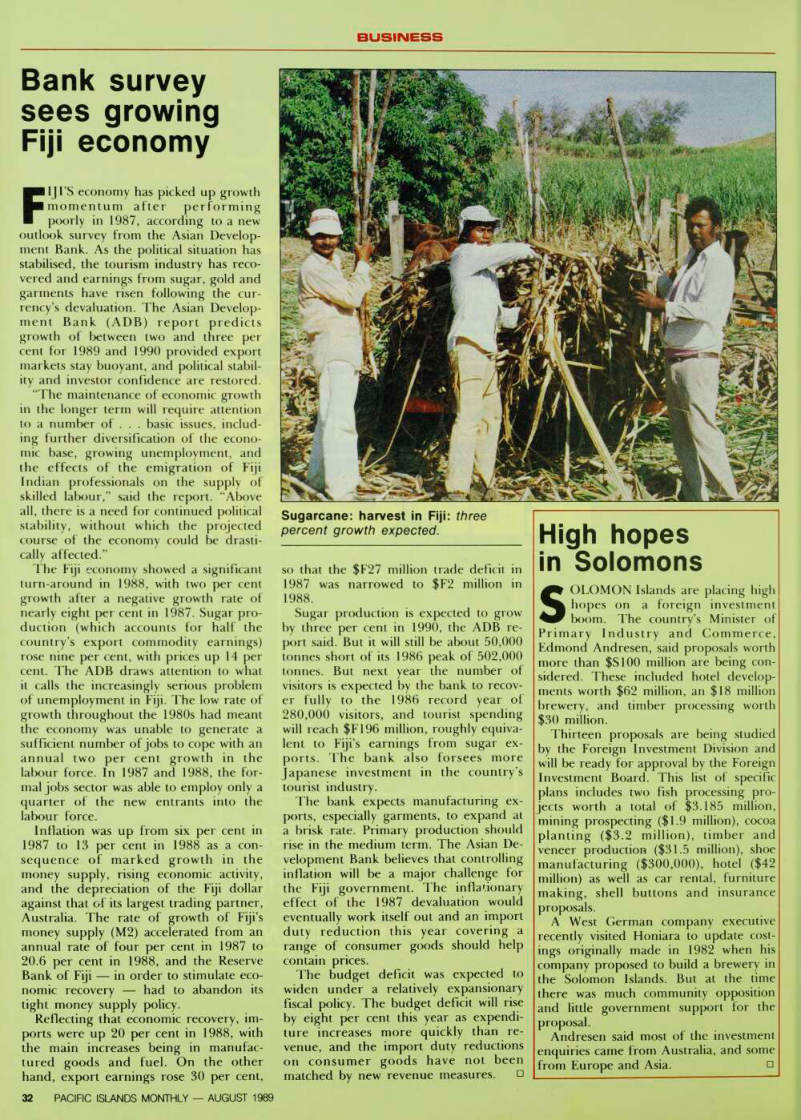
Sugar production is expected to grow
by three per cent in 1990, the ADB re port said. But it will still be about 50,000 tonnes short of its 1986 peak of 502,000 tonnes. But next year the number of visitors is expected by the bank to recov er fully to the 1986 record year of 280,000 visitors, and tourist spending will reach SFI96 million, roughly equiva lent to Fiji’s earnings from sugar ex ports. The bank also forsees more Japanese investment in the country’s
tourist industry.
The bank expects manufacturing ex ports, especially garments, to expand at a brisk rate. Primary production should rise in the medium term. The Asian De velopment Bank believes that controlling inflation will be a major challenge for the Fiji government. The inflationary effect of the 1987 devaluation would eventually work itself out and an import duty reduction this year covering a range of consumer goods should help
contain prices.
The budget deficit was expected to widen under a relatively expansionary fiscal policy. The budget deficit will rise by eight per cent this year as expendi ture increases more quickly than re venue, and the import duty reductions on consumer goods have not been matched by new revenue measures. □
Sugarcane: harvest in Fiji: three percent growth expected.