Remembering
a disaster
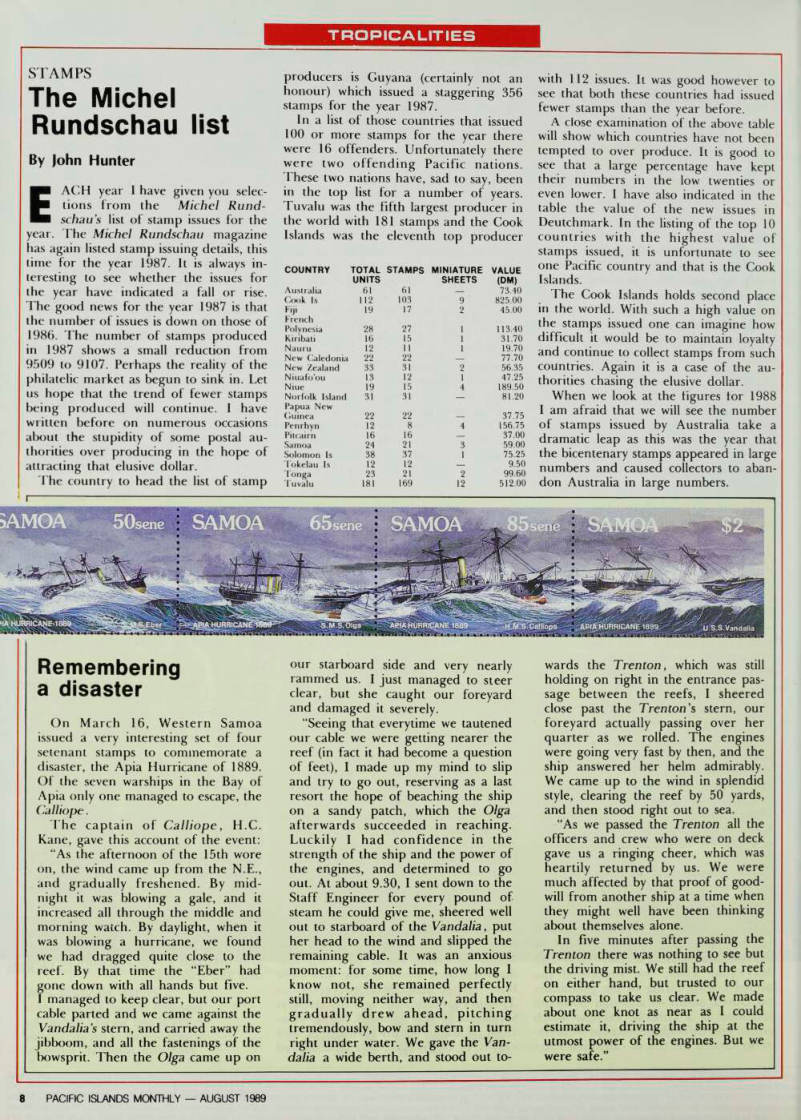
On March 16, Western Samoa issued a very interesting set of four setenant stamps to commemorate a disaster, the Apia Hurricane of 1889.
Of the seven warships in the Bay of Apia only one managed to escape, the
Calliope.
The captain of Calliope, H.C.
Kane, gave this account of the event: “As the afternoon of the 15th wore on, the wind came up from the N.E., and gradually freshened. By mid night it was blowing a gale, and it increased all through the middle and morning watch. By daylight, when it was blowing a hurricane, we found we had dragged quite close to the reef. By that time the “Eber” had gone down with all hands but five.
I managed to keep clear, but our port cable parted and we came against the Vandalia’s stern, and carried away the jibboom, and all the fastenings of the bowsprit. Then the Olga came up on
our star b° arc l side and very nearly rammed us. 1 just managed to steer clear, but she caught our foreyard
and damaged it severely.
“Seeing that everytime we tautened our cable we were getting nearer the reef (in fact it had become a question of feet), I made up my mind to slip and try to go out, reserving as a last resort the hope of beaching the ship on a sandy patch, which the Olga afterwards succeeded in reaching.
Luckily I had confidence in the strength of the ship and the power of the engines, and determined to go out. At about 9.30, I sent down to the Staff Engineer for every pound of steam he could give me, sheered well out to starboard of the Vandalia, put her head to the wind and slipped the remaining cable. It was an anxious moment: for some time, how long I know not, she remained perfectly still, moving neither way, and then
gradually drew ahead, pitching
tremendously, bow and stern in turn right under water. We gave the Vandalia a wide berth, and stood out to-
wards the Trenton, which was still holding on right in the entrance pas sage between the reefs, I sheered close past the Trenton's stern, our
foreyard actually passing over her
quarter as we rolled. The engines were going very fast by then, and the ship answered her helm admirably.
We came up to the wind in splendid style, clearing the reef by 50 yards, and then stood right out to sea.
“As we passed the Trenton all the officers and crew who were on deck gave us a ringing cheer, which was heartily returned by us. We were much affected by that proof of good will from another ship at a time when they might well have been thinking about themselves alone.
In five minutes after passing the Trenton there was nothing to see but the driving mist. We still had the reef on either hand, but trusted to our compass to take us clear. We made about one knot as near as I could estimate it, driving the ship at the utmost power of the engines. But we were safe.”