Foreign press faces backlash
pp. 45-46 · Read in the full issue
Media
News media coverage of the South Pacific has upset several nations because of alleged cultural insensitivity and distortions. Some leaders have called for press curbs; some resorted to lawsuits.
FOREIGN journalists are hardly the
flavour of the moment in South
Pacific countries. Although they
have been unpopular at times in the past, criticisms in recent months have reached a new intensity and the issue of alleged media distortion is likely to be raised at the South Pacific Forum in Kiribati this month.
Papua New Guinea Foreign Minister Michael Somare recently accused Austra lian and New Zealand journalists of “ra cist” and “colonialist” attitudes in their coverage of the Pacific. Some Vanuatu leaders are also upset at what they see as
“destructive” reporting by mainly Au
stralian news media of the unsuccessful constitutional coup last December.
Fiji makes no bones about its dis
trust of foreign jour
nalists. It screens journalists and is selective about who is welcome. But the in terim government continues to argue that the policy “is
merely to bring Fiji’s
regulations in con formity with those of New Zealand, Au stralia and many other countries of the world” which re quire Fiji journalists to have visas to enter those countries.
Deportations and talk of stringent con trols on foreign re porters are becoming
increasingly com
mon. Papua New Guinea barred over seas journalists from entering the troubled Bougainville island to cover the landown ers’ violent dispute with the Bougainville Copper Mine. So mare, a former radio journalist, is advocat ing that the Austra lian and New Zea
land governments cooperate in setting up a code of conduct with penalties paid by media organisations whose journalists breach the rules. But many Pacific jour nalists caution against this sort of approach, saying it would effectively gag the Press and prevent it reporting un palatable truths.
While visiting New Zealand recently, senior Vanuatu government official Grace Molisa quietly crusaded against the foreign media, claiming that repor ters had seriously misunderstood and maligned her country. She also accused some journalists of becoming partisan and supporting rebel politician Barak
Sope during the power struggle with
Prime Minister Father Walter Lini. Sope,
former President Ati George Sokomanu, former Opposition Leader Maxime Car lot and rebel ex-MP Willie Jimmy were acquitted and freed by the Vanuatu Court of Appeal in April after having been earlier found guilty by a judge on charges of mutiny and sedition.
“For the whole of Vanuatu’s indepen dent life, since 1980 when we struggled through a rebellion to achieve independ ence, Vanuatu has been subjected to a bashing by the overseas media,” said Mrs Molisa, private secretary to the Prime Minister and wife of Finance Minister Sela Molisa.
Mrs Molisa was referring to television and newspaper reports that over the years have focused on alleged Cuban, Soviet and eventually Libyan connections in Vanuatu. One major Australian news paper report in 1983 claimed there were Cuban soldiers in Vanuatu and a Cuban adviser to the Prime Minister: (There were no soldiers and the “Cuban advis er” was a Jamaican on a Commonwealth loan programme).
The same year, Mrs Molisa bared her
distaste for foreign journalists who “ram freedom of the Press down our throats”
while misrepresent
ing Vanuatu. In a poem entitled News paper Media in her Black Stone collec tion, Mrs Molisa wrote:
Metropolitan
journalists
flock to Port Vila crawling the bars sniffing the farts of other transient scaven gers and go away experts on Vanuatu poli tics.
“We have had bad treatment by Austra lian journalists who
are portraying
Vanuatu as a bad joke,” she said.
“They come here, make a few cursory interviews and then go ahead and write
their preconceived
stories. It seems that their only purpose in life is to obliterate Vanuatu.”
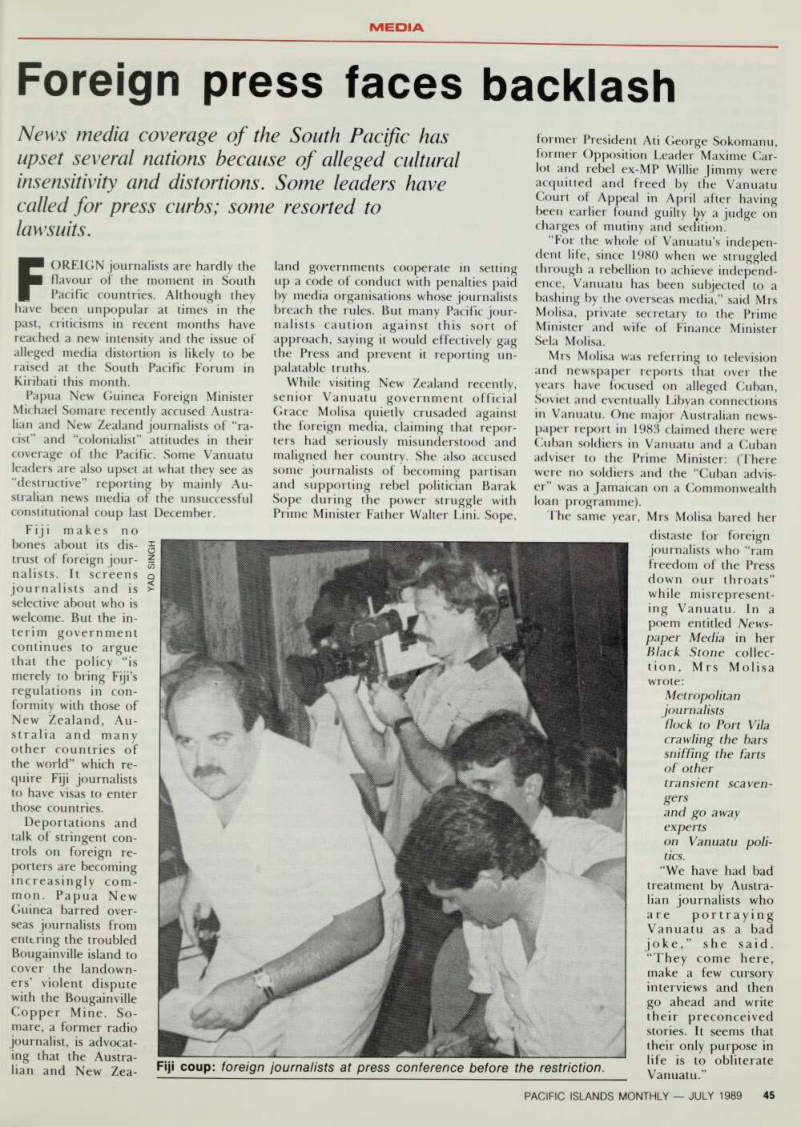
Fiji coup: foreign journalists at press conference before the restriction.
Mrs Molisa accused some foreign jour nalist of blowing events out of propor
tion, sensationalising and manipulating
political events. She believes Vanuatu’s constitutional crisis got out of hand last year because foreign journalists encour aged Sope with “false hopes of power”.
Asked about criticisms by Pacific jour nalists that Vanuatu government minis ters and officials are frequently difficult to interview or unavailable for state ments, Mrs Molisa replied: “Journalists often arrogantly think they are in Au stralia, or somewhere, where a minister has up to 20 staff to deal with the news media. Vanuatu is a developing country with extremely limited resources and hard-pressed staff. The government doesn’t even have a fax machine. Deal ing with journalists is the least of our
priorities.”
“Let’s face it,” Mrs Molisa said. “How free is a free press really? Why should we have the free press rammed down our throats when all it matters to them are the profits at the end of the year?
Why should we allow our economy to be sabotaged? When the Australian media wants blood it makes sure it gets it.” But Mrs Molisa stresses that not all foreign journalists are in her bad books. Some, she says, try to report issues with sensi
tivity and understanding.
Would Vanuatu consider curbs on
foreign journalists, as Fiji has endorsed
and as Somare advocates? “Why should we? It is up to the foreign media to act more responsibly,” she said, although her government had expelled Radio Au
stralia’s Pacific correspondent, Jimima
Garrett, during the height of the consti tutional crisis last December.
However Bishop Patelisio Finau, of Tonga, head of the kingdom’s minority Catholic Church and Editor of the church’s hard-hitting newspaper Taumu’s Lelei, had a different view. He called for more openness and accused politicians of over-reacting to the cover age of local events by the overseas media.
“These are important events which must be told,’ he said. “How these jour nalists report these events indicates how the outside world sees our lives. We must accept their point of view. We cre ated the trouble not them. We cannot just take their aid problems.”
It was a television report involving Vanuatu that stung Somare into making a public outburst over reporting in the region. The report, on Townsville-based North Queensland Television, is watched by many people in the Papua New Guinea capital of Port Moresby.
Broadcast on the station’s Today Show, the report cited Papua New Guinea Opposition allegations that the government had asked for Australian troops if a planned demonstration by PNG soldiers erupted violently. The Rabbie Namaliu government denied the allegations. The report showed library footage of riots in 1986 after the High lands leader lambakey Okuk died, and a picture of Father Lini which it identified as “PNG Foreign Minister Michael So mare”. The blunder and slanted style of the report upset many in Papua New Guinea. “I’m not a sick man with a para lysed right arm,” Somare snapped, and he threatened to ban any further visits by Channel Nine news teams. He used the opportunity to criticise Australian and New Zealand journalists covering
the region.
Besides his call for a code of conduct to curb what he described as racist jour nalism, Somare also advocated that Au stralia and New Zealand jointly fund an exchange programme in the region to foster greater awareness of Pacific coun tries and cultures. Somare will be the key speaker of the opening of the Pacific Islands News Association conference and workshop in Honiara in October. His ideas on the code of conduct will feature in discussions on freedom of information
and journalism ethics, key topics being
drawn up in the conference blueprint.
In Suva, Information Minister Ratu Inoke Kubuabola said Fiji has had “con
siderable experience of misrepresenta tion by the media recently, mostly by outsiders insensitive to our situation, and indifferent to the consequences of their falsification.”
Kubuabola was speaking at the open ing of a regional broadcasters manage ment symposium in Suva. “The very fact that you are here for this symposium is an indication that you can freely discuss and exchange views in Fiji,” the minister said.
In New Zealand, a recent two-part TVNZ Eyewitness News programme, Fiji: One Country, Two Cultures has been accused of a distorted portrayal of land rights and race relations. The Coali tion for Democracy in Fiji protested to both the Listener and TVNZ, claiming the programme was propaganda and that no critics of the interim government had been interviewed.
In Hawaii, a federal judge recently threw out a libel suit filed against Hon olulu Magazine after an article by Hon olulu-based writer Ed Rampell about the 1985 assassination of Belau President Haruo Remeliik quoted allegations from an anonymous letter.
The August 1987 magazine article re ported several conspiracy theories about President Remeliik’s murder. One of the theories involved an anonymous letter
received by the Remeliik family alleging
a millionaire Belau businessman was involved. The businessman sued the magazine and Rampell for defamation,
seeking US$5 million in general damages
and US$5O million in punitive and ex
emplary damages.
Honolulu Magazine’s lawyer, Jeffrey
Portnoy, argued for the lawsuit’s dismis sal on grounds that the letter did exist and the magazine did not implicate the businessman in the killing. The maga
zine had simply reported allegations
against the businessman as one of several theories in the still unsolved murder.
Judge Sam King upheld the defence
case, Portnoy hailed the ruling as an im portant one. □