Cruising after pre-coup blues
p. 40 · Read in the full issue
Shipping
T HIRD generation Fijian Max Lane is emerging from the ashes of post-coup Fiji with a 44-year life story that is beginning to grab the atten tion of his business community. His small boatbuilding empire, Maxlane En gineering Limited is turning into a mil lion-dollar industry. But what is really amazing is how this high school dropout has managed to salvage his life and break to the top with so much success with aluminium boats. To know his life is to go back in time.
The Lane of post-coup Fiji has not changed much, despite imminent wealth staring him in the face, from the 17year-old of 1962 who tried to please his father with his first job as an apprentice with Fiji’s only brewer, Carlton Brewery.
But his father, Don, born in Levuka on Ovalau Island, 60 miles north of Suva, a teacher turned Fiji tourism personality, was displeased with his son’s progress.
His displeasure drove young Lane to night classes where practical lessons in metal beating, joinery, worked. Daddy whiffed son away to Sydney for 4‘/> years while he completed technical college
training in fitting and machining. Lane’s
nights were not lost to the red lights of Kings Cross. Instead he took night courses in mechanical engineering.
In 1972 he wrote a lengthy story to Carpenters Fiji Limited which won him a job in the engineering division. Over the years he became a supervisor and gradu ated into senior management. Lane’s stint with Carpenters introduced him into boat building and marine engineer ing, even though it was restricted mainly to repair work.
Lane’s first contracted work was with Island Industries, the only cement manufacturer in the Pacific Islands. “I started off doing installation and fitting for them and it was only a six-month job,” he said. “That saved them bringing an expatriate in. So they saved a few bucks and I got a good wage for six months. This ($50,000) enabled me to look around for another premises and get some ideas together.”
The Fiji Development Bank loaned him $150,000 to buy land and Fiji Trade and Investment Board, after some diffi culties, approved his reapplication for a duty concession on the raw materials.
Another $70,000 loan helped buy machinery. Experts were brought in from overseas to train his workers and Lane went shopping along the coast of Australia for ideas and business. He found a particular aluminium boat de sign suitable for Fiji. Lane returned and
sold the idea to a buyer before building his first boat. The wide possibilities of aluminium gave Lane other ideas like bodies and trailers for the cheaper cabin
chassis imported into Fiji.
His 45 engineers and 28 joiners are tested and certified under the stringent American and New Zealand require ments. Three other staff a subsidiary company called Pacific Sailmakers.
Lane was lucky. Prior to the 1987 military coups he had enough alumi nium boat orders from resort owners and other individuals to keep his staff occupied; yet he had enough vision to forecast that the Fiji market would soon be saturated. “1 did a trip to Australia and tried to open up an export market for us because I could see the local mar ket in boats drying up very quickly and that there was a need to do something about it,” he says. “We were building under licence at the time for some Au stralian companies; we build their par ticular boats. 1 decided it was time we had our own design. So through a naval architect ship management designer in Melbourne we developed a catamaran suitable for Fiji and other island nations.
They had opened up an office in South port, sales office, and they had given the licence of these particular boats to an Australian guy. He was a very good salesman and he went out and sold the idea to the police force.”
The order took about 18 months to sort out, but it was worth the wait; be sides there were other work picked up on the way. “The export order finally
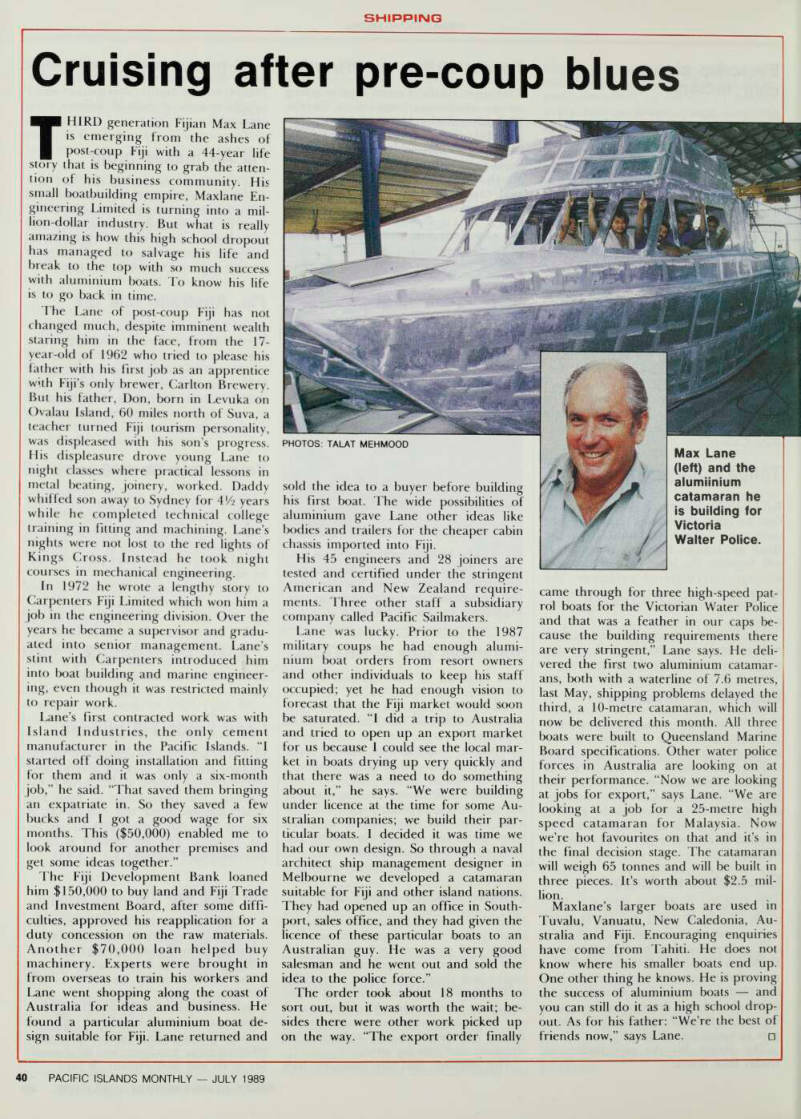
came through for three high-speed pat rol boats for the Victorian Water Police and that was a feather in our caps be cause the building requirements there are very stringent,” Lane says. He deli vered the first two aluminium catamar ans, both with a waterline of 7.6 metres,
last May, shipping problems delayed the
third, a 10-metre catamaran, which will now be delivered this month. All three boats were built to Queensland Marine Board specifications. Other water police forces in Australia are looking on at their performance. “Now we are looking at jobs for export,” says Lane. “We are looking at a job for a 25-metre high speed catamaran for Malaysia. Now we’re hot favourites on that and it’s in the final decision stage. The catamaran will weigh 65 tonnes and will be built in three pieces. It’s worth about $2.5 mil lion.
Maxlane’s larger boats are used in Tuvalu, Vanuatu, New Caledonia, Au
stralia and Fiji. Encouraging enquiries
have come from Tahiti. He does not know where his smaller boats end up.
One other thing he knows. He is proving the success of aluminium boats and you can still do it as a high school drop out. As for his father: “We’re the best of friends now,” says Lane. □
Photos: Talat Mehmood
Max Lane (left) and the alumiinium catamaran he is building for Victoria Walter Police.