Lindsay Swanson
p. 18 · Read in the full issue
Bougainville nightmare
By Richard Dinnen
IT was a difficult time to leave home.
The Bougainville crisis dragged on,
dominating headlines and battering
investor confidence. The scandal-thirsty Australian media had earlier carried talk of a military coup, or at least a break down of law and order in Port Moresby, Against this gloomy backdrop Rabbie Namaliu arrived in Canberra to sign an aid agreement with his Australian coun terpart, Bob Hawke. But the terms of that agreement had largely been deter mined by negotiations conducted by a Papua New Guinea delegation that vi sited Australia earlier this year. Namaliu came on a mission far more challenging to encourage Australian investment in
Png.
The Australian economy continued to overheat during May, forcing up interest rates and tightening money markets.
High risk investment is not on the agen da, and based on media reports, the risks of investment in PNG seemed enor mous to most Australian business lead ers. Namaliu tackled the problem on two fronts, addressing business people over lunch and media executives over dinner.
Attention predictably was focused on the Bougainville crisis, but the Prime Minis ter managed to inject a note of optimism with news of the Porgera joint venture where a recently signed agreement had satisfied landowners and seemed set to become a model for future negotiations.
“What we have done,” Namaliu said, “is to develop procedures which ensure that all future mining projects are negotiated in a way that not only in volves landowners and the relevant pro vincial governments at the very begin ning, but provides the mechanism for quickly and effectively resolving difficul ties and disputes. The Development Forum, used for the first time in nego tiating Porgera, has been an unqualified success. I venture to suggest that had this process been used twenty years ago when Bougainville was approved, we would not have the problems we face
today.”
Reporting of events in PNG was high on the agenda with Namaliu walking the tightrope between criticising and offend ing the notoriously parochial Australian media. The PNG delegation told of wide-spread dissatisfaction with the “fly
in-fly-out” brand of journalism prevalent
in the Pacific region. Reporters working
against tight deadlines are expected to
file as soon as they arrive in a country
and then return home. Those reporters cannot hope to develop a grasp of the real issues behind a story, argued the PNG delegation. “The reasons for the current problems go back to the very beginnings of the development,” Nama liu told a Canberra Press conference. “I don’t think it is understood enough that these problems are deep-seated and complex and are extremely sensitive.”
In their defence, media executives complained of difficulties with access, visas and communication links. But these problems cannot atone for some recent coverage. In the weeks prior to Nama liu’s visit, a newspaper told Australian readers that Michael Somare is still Prime Minister, and one radio reporter elevated Namaliu to the rank of Rabbi.
Namaliu left Canberra for Sydney with the Australian Government’s seal of approval. The Bougainville strife domin ated talks with Hawke and several Au stralian ministers but statements later re leased to the media had the Australian
Prime Minister strongly supporting
Namaliu’s Government. Despite obvious concern for the safety of Australians re siding in PNG an Australian was shot
and wounded on Bougainville just prior
to the PM’s visit Hawke said appropri ate measures were being taken by the
Namaliu government and there was no reason to believe it could not handle the situation. Speaking at a lunch in honour of Namaliu, Hawke said PNG had shown
itself capable of negotiating periods of
difficulty with flexibility and common sense. As evidence of the goodwill gener ated by the visit, both Hawke and newly
appointed Opposition Leader Andrew
Peacock accepted invitations to visit PNG later this year.
Despite the public pronouncement of support, the aid agreement signed by the two Prime Ministers represents a 16 per cent drop in the level of Australian aid over the next five years. Support over the period will drop 15 per cent of PNG’s total budget revenue to 10 per cent, compared with the early 1980 s level of 27 per cent. The package is worth SAI.S billion, geared to reduce as revenue from PNG’s mineral resources increases in the mid-19905. Namaliu said both parties had made several comprom ises negotiating the aid package but ex pressed satisfaction with the overall re sult. Both Prime Ministers said the aid reductions was a vote of confidence in the PNG Government’s economic
strategies.
Australia also pledged four Iroquois helicopters for surveillance and troop
deployment with two-year training
courses for PNG pilots to be provided by the RAAF. PNG has no military helicop ters of its own; the new additions, drawn
from Australia’s 35-strong helicopter
fleet based at Fairbairn and Townsville, will bring a welcome strengthening of resources. But Hawke was careful to point out the helicopters were part of the normal aid commitment to PNG.
They were not, he said, being handed over for immediate operation against re bel landowners on Bougainville. Austra lia’s defence minister Kim Beazley was vague on the helicopter package: no de tails had been discussed, he said, and it was not certain when the aircraft would be delivered or if pilot training would take place in Australia or PNG.
It remains to be seen if the Australian business community has taken Namaliu’s message to heart. His impact on investor confidence will take many months to assess and subsequent events on Bougainville have not helped matters.
His polite and informative answers to often ignorant questioning from the media made a good impression that may
lay the groundwork for better reporting
of events in PNG.
The PNG delegation returned home well satisfied with the Australian visit.
For Rabbie Namaliu, the real challenge remains, as before, in the jungles of
Bougainville. D
Lindsay Swanson
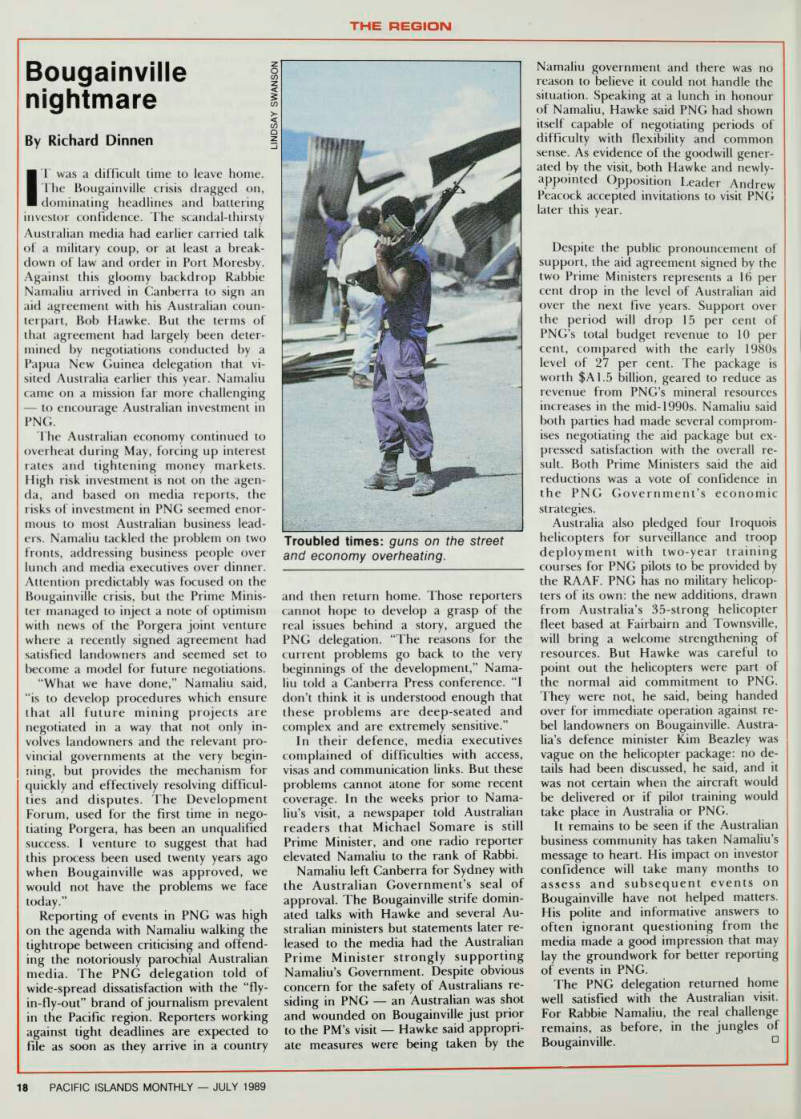
Troubled times: guns on the street and economy overheating.