HMS Bounty: the bloodless mutiny
p. 54 · Read in the full issue
Out Of The Past
Sven Wahlroos looks behind the history to find the men and the motives, 200 years ago
WE HAVE arrived at the mutiny on the Bounty's own bicentenaij. It was on Satur il 4, 1789, that the Bounty weighed anchor and sailed out from Toaroa harbour in Tahiti. On board were 1015 breadfruit plants in 774 pots, 39 tubs and 24 boxes, samples of other South Seas plants, 25 hogs, 17 goats and a number of chickens. As if that weren’t enough, the deck was crowded with last-minute gifts from Tahitian taios (special friends): coco nuts, plantains, breadfruit, yams, bananas and so on. The Bounty, hav ing been overcrowded, was now bur sting at the seams.
On April 23 the Bounty arrived at Nomuka, 1800 miles west of Tahiti primarily to replace one dead and two or three “sickly looking” breadfruit plants . . . out of 1015. He also wanted to “wood and water” less than three weeks after leaving Tahiti.
But the visit to Nomuka has far greater significance, for it was during and immediately after this stop that the incidents which triggered the
mutiny occurred.
Blign and his second-in-command, Fletcher Christian, had been friends on two previous voyages. Christian was the only one of the officers that Bligh trusted indeed, Bligh prom oted him to his second-in-command soon after the Bounty left England but in Capetown a quarrel started be tween them and it was to fester throughout the voyage. Still Bligh gave Christian the most important assignment in Tahiti: full command over shore operations.
Perhaps Bligh was jealous of bache
lor Christians popularity with the Tahitian women when he himself felt bound by his marriage vows to stay chaste, but whatever its causes, the conflict between Bligh and Christian was greatly exacerbated on the voyage from Tahiti, to the point that Christ ian during the mutiny told Bligh: “I have been in hell with you for weeks.”
Bligh was definitely at his worst on the voyage from Tahiti: fault-finding,
insulting, petty and condescending.
He seems to have relished humiliating all his officers, and it is clear that he went out of his way to torment Christ ian. At Nomuka, Bligh sent Christian in command of a snore party with orders not to use any weapons but to leave them in the boat. When Christ ian encountered hostile Tongans who threatened him and his party with
spears, clubs and rocks, he had to re treat to the boat, losing an adze to
thieving Tongans.
On hearing of the incident, Bligh damned Christian for a “cowardly ras cal”, asking if he were afraid of a set of naked savages while he had arms”.
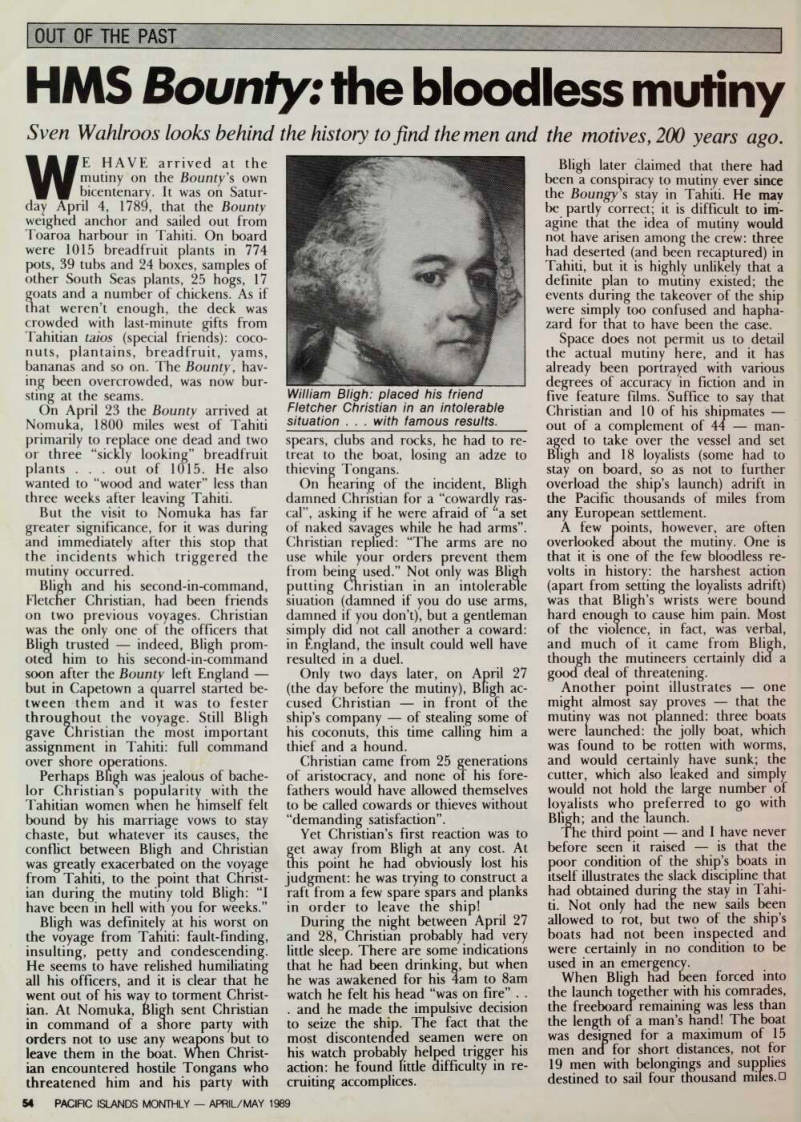
Christian replied: “The arms are no use while your orders prevent them from being used.” Not only was Bligh putting Christian in an intolerable siuation (damned if you do use arms, damned if you don’t), but a gentleman simply did not call another a coward: in England, the insult could well have resulted in a duel.
Only two days later, on April 27 (the day before the mutiny), Bligh ac cused Christian in front of the ship’s company of stealing some of his coconuts, this time calling him a thief and a hound.
Christian came from 25 generations of aristocracy, and none of his fore fathers would have allowed themselves to be called cowards or thieves without
“demanding satisfaction”.
Yet Christian’s first reaction was to get away from Bligh at any cost. At this point he had obviously lost his judgment: he was trying to construct a raft from a few spare spars and planks in order to leave the ship!
During the night between April 27
and 28, Christian probably had yery little sleep. There are some indications that he had been drinking, but when he was awakened for his 4am to Sam watch he felt his head “was on fire” . . . and he made the impulsive decision to seize the ship. The fact that the most discontended seamen were on
his watch probably helped trigger his
action: he found little difficulty in re cruiting accomplices.
Bligfi later claimed that there had been a conspiracy to mutiny ever since the Boungy s s stay in Tahiti. He may be partly correct; it is difficult to im agine that the idea of mutiny would not have arisen among the crew: three had deserted (and been recaptured) in Tahiti, but it is highly unlikely that a definite plan to mutiny existed; the events during the takeover of the ship were simply too confused and hapha zard for that to have been the case.
Space does not permit us to detail the actual mutiny here, and it has already been portrayed with various degrees of accuracy in fiction and in five feature films. Suffice to say that Christian and 10 of his shipmates out of a complement of 44 man aged to take over the vessel and set Bligh and 18 loyalists (some had to stay on board, so as not to further overload the ship’s launch) adrift in the Pacific thousands of miles from any European settlement.
A few points, however, are often overlooked about the mutiny. One is that it is one of the few bloodless re volts in history: the harshest action
(apart from setting the loyalists adrift)
was that Bligh’s wrists were bound hard enough to cause him pain. Most of the violence, in fact, was verbal, and much of it came from Bligh, though the mutineers certainly dicf a
good deal of threatening.
Another point illustrates one might almost say proves that the mutiny was not planned: three boats were launched: the jolly boat, which was found to be rotten with worms, and would certainly have sunk; the cutter, which also leaked and simply would not hold the large number of loyalists who preferred to go with Bligh; and the launch.
The third point and I have never before seen it raised is that the poor condition of the ship’s boats in itself illustrates the slack discipline that had obtained during the stay in Tahi ti. Not only had the new sails been allowed to rot, but two of the ship’s boats had not been inspected and were certainly in no conaition to be used in an emergency.
When Bligh had been forced into the launch together with his comrades, the freeboard remaining was less than the length of a man’s hand! The boat was designed for a maximum of 15 men and for short distances, not for 19 men with belongings and supplies destined to sail four thousand miles. □
William Bligh: placed his friend Fletcher Christian in an intolerable situation . . . with famous results.