Peter Schroeder
pp. 44-47 · Read in the full issue

Pacific Report
□ New Radio Waves
RADIO Australia has lifted its Paci fic profile with the launch of a new programme aimed specifically at the region. Pacific Beat is heard on shortwave each weekday. Its format initially will focus on news, in formation and entertainment with further shaping likely after listener response is considered.
The new programme will be heard between 0500-0900 Universal Co-ordinated Time (add 12 hours in Fiji, Kiribati, Tuvalu; add 13 hours in Tonga; deduct 10 hours in Cook Islands; deduct 11 hours in Samoa and Niue; add 10 hours in Papua New Guinea).
Pacific Beat will be heard on 11770 kHz, 15160, 17750 and all Radio Australia channels in use for English language programmes dur ing those hours.
□ Fui Yacht Invasion
FIJI is bracing for an invasion of yachties as the Auckland-Fukuoka Ocean Race nears completion. A fleet of between 65 and 70 yachts left Auckland on April 22 to com pete in two races the Auckland- Fukuoka and Auckland-Suva. The yachts are expected to arrive in Suva from May 2 and preparations for the influx have been underway for some time.
About 800 crew members are ex pected and the strong Japanese in terest in the race sees a contingent of some 200 Japanese competitors.
Berthing facilities at the Royal Suva Yacht Club have been upgraded and accommodation and catering has been arranged.
The yachts will set sail for Guam on the second leg on May 9.
□ Mission From Tonga
THE principal of a new agricultu ral college in Tonga is attempting to find ways of encouraging desti tute young people to take up a career on the land. Reverend Mar lamarla Vaea heads the Tupuo
Young Farmers’ Training College.
Reverend Vaea recently spent time at the University of Western Syd ney to develop a special syllabus for application in Tonga.
A l have a wide ministry to serve, but I particularly want to help des titute young people; Tonga’s street people, to get a start in farming,” ne said. “We want a syllabus that will provide the opportunity for students who don’t complete their secondary education to learn all aspects of farming.”
The Tupou College is situated on farmland, part of which operates as a commercial enterprise. Rev Mar
lamarla hopes the practical experi
ence of work on the college farm will dispel the perception many Tongans hold that life on the land is inferior or lacks prestige.
□ King Wants Wind Power
KING Taufa’ahau Tupou IV of Tonga has expressed interest in wind power and aquaculture. On a recent visit to Hawaii the King toured examples of both technolo fies and invited officials to visit onga to examine the prospects of introducing them in his nation.
Both technologies offer consider able benefits for Tonga. The wind plant on Oahu Island can produce 54 million kilowatt hours a year enough to replace 40,000 barrels of oil for power generation while
the aquafarm visited by the King
produces both wetfish and shellfish.
The King is reportedly keen on de veloping mullet for export to Japan, wnere a single egg sac sells for as much as $l3O.
Wind power technology may re
place oil-generated electricity on
Tongatapu and could be used to produce power on outer islands of Tonga.
□ Fui Expels Priest
FIJI’S interim government has ex pelled a New Zealand Catholic priest critical of alleged human rights abuses. Father Tom Rouse had worked among Fiji’s under-
privileged for 12 years. He was given four days’ notice to leave the country and while no official ex planation was offered for his expul sion, supporters believe it was poli
tically motivated.
Father Rouse was one of 18 peo ple arrested in Suva during a
prayer vigil last May. Arriving in
Sydney after his expulsion, Father Rouse told reporters that racial, re ligious and class divisions were in creasing in Fiji. He said the de velopment of tree trade zones had been accompanied by worker ex ploitation. Father Rouse also criti cised the continued presence of the military and said numan rights were not being addressed.
□ Png Huack Scare
SECURITY at Papua New Guinea’s airports has been tightened follow ing threats of a hijacx attempt. Civil Aviation Minister Bernard Vogae says unconfirmed reports had been received of possible threats against civil aviation. Check-in times for domestic flights are now two hours before scheduled departure, while international passengers must check in three hours before take-off.
Mr Vogae says delays must be ex pected but the decision to extend security checks will be reviewed
early in May.
□ Soviet Ban Lifted
PAPUA NEW GUINEA has lifted a
Tole Mour medical officer David Higgins conducts a literally barefoot doctor clinic in the Marshall Islands.
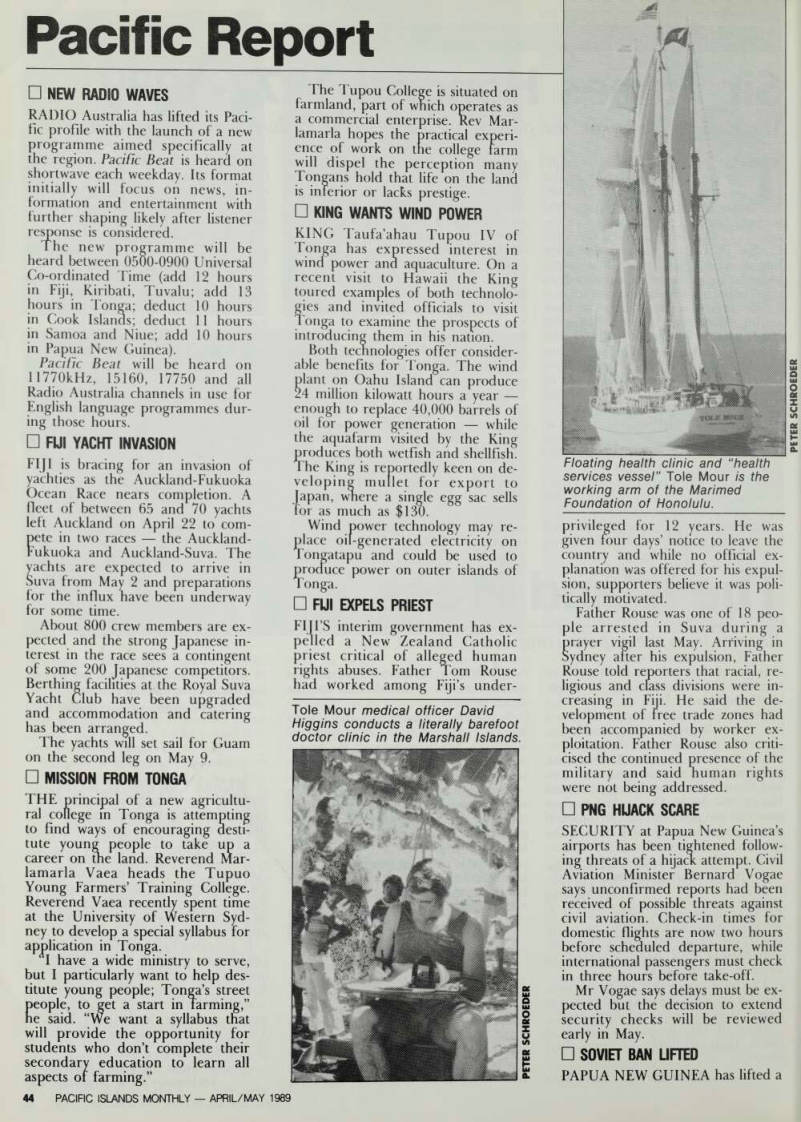
Floating health clinic and "health services vessel” Tole Mour is the working arm of the Marimed Foundation of Honolulu.
Peter Schroeder
10-year ban on port calls by Soviet cruise ships. The move paves the way for the opening of diplomatic relations between the two countries.
The ban was imposed in 1979 as a protest against Soviet intervention m Afghanistan. Foreign Minister Michael Somare said the easing of certain aspects of the ban was de signed to enable normal relations between PNG and the Soviet Union to be restored.
Soviet cruise ships will be allowed to dock in PNG ports and their sailors will be allowed ashore but the ban will still apply to Soviet fishing vessels. Negotiations with Moscow over a possible fishing agreement were reportedly unlikely before diplomatic ties are formally established.
□ Marshalls Health Cruise
ISOLATED islands often cannot provide adequate medical care and health services. To overcome this problem, a three-masted 50-metre schooner, the Tole Mour, has com menced operation around the Mar shall Islands as a floating health cli nic. The Marimed Foundation of Honolulu funded construction of the traditional tall ship, which has been serving communities in the Marshalls since December 1988.
The ship spent one month at Arno Atoll providing health ser vices and training clinics. A 17member health team of staff and volunteers visited eleven communi ties on the atoll.
Tole Mour is not a hospital ship but rather a “health services vessel .
It is equipped with an exam room, dental and eye clinics, a diagnostic
laboratory, X-ray room and
pharmacy. It is designed to help the Marshall Islands Health Minis try conduct its programme of health care on isolated coral atolls.
□ Iguanas On Increase
IGUANA population has increased on the Fijian island of Yaduatabu since the National Trust of Fiji de clared it a protected area. When the trust took over the island there were only 500 of the rare crested iguana to be found. But since the listing of the area as protected in 1981 the population has increased to almost 8000.
The people of Yaduatambu used the island to raise goats until 1981 when it was found the iguanas were dying out because the goats were destroying the vegetation. An agreement was reached with the re sidents, the goats were removed and a marked increase in iguana numbers was noticed almost im
mediately.
□ Nauru: A Correction
A REPORT on page 36 of the February issue of Pacific Islands Monthly, headed ‘Australia, NZ Si lent on Nauru Compensation Claim’ contained two errors.
The article stated: “The three na tions, Australia, NZ and UK, made
a pre-independence payment of $2l million intended to cover re habilitation costs to that date.” A spokesman for the Republic of Nauru has asked us to point out that it was, in fact, the Republic of Nauru that paid $2l million to the British Phosphate Commission under the requirements of the 1967 Phosphate Agreement be tween the Nauruan Local Govern ment Council and the three partner governments.
In the same article, Nauruan President Hammer Deßoburt is quoted as saying that Nauruans could not be asked to use their own funds to rehabilitate mining that had taken place both before and after independence. His statement said that Nauruans could not be ex pected to use their funds for pre
independence rehabilitation.
□ Sounds Of Music
A SPECIAL exhibition of Pacific musical instruments will be on show at Auckland Museum during May.
“The Sounds of Oceania” display coincides with the publication of a new book, by Auckland University ethnomusicology lecturer Dr Richard Moyle, wnich describes the Museum’s collection for an interna tional audience.
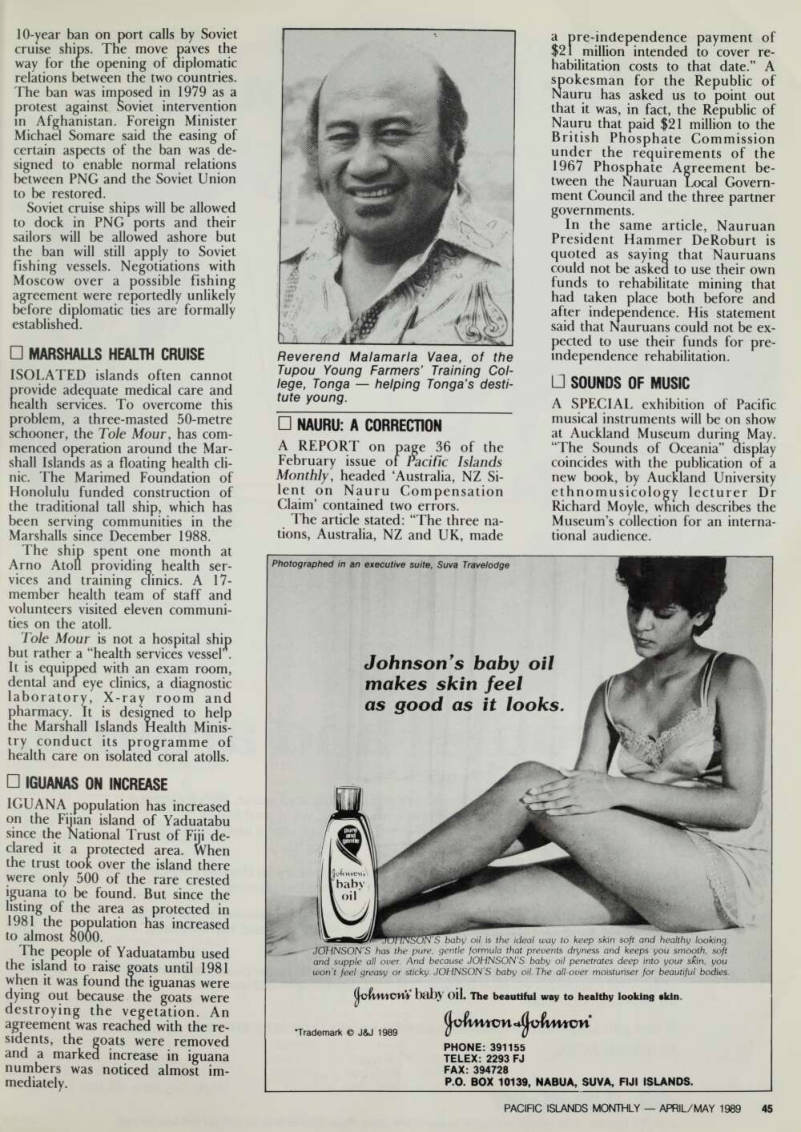
Reverend Malamarla Vaea, of the Tupou Young Farmers’ Training Col lege, Tonga helping Tonga's desti tute young.
□ Vanuatu’S Coconut Crabs
Endangered
A RECENT STUDY has warned that extinction could be a possibility for Vanuatu’s coconut craos unless urgent attention is paid to the proper management and conserva tion of a resource that has been disappearing from its natural habi tats almost as quickly as it has been vanishing down the throats of tour ists.
Despite a two-year population
survey, scientists have been unable
to find single juvenile specimen of
Birgus latro. They nave also
noticed the areas with reasonable stocks of crabs in 1985 were severe
ly depleted by 1987. These data,
over-exploitation of crab popula
tions for the tourist market, are causing anxiety in the Vanuatu
Fisheries Department.
The population study was part of a research and conservation man agement project funded by ACIAR (the Australian Centre for Interna tional Agricultural Research) and
designed by the Queensland De
partment of Fisheries, the Universi ty of Queensland and the Vanuatu
Fisheries Department. Craig Schil
ler, an Australian biologist who took part in the study, estimates that “Coconut crabs wherever they are with the exception of those on Christmas Island are headed for extinction.”
Dr Rick Fletcher, senior on-site biologist for the project, wrote in the March 1988 issue of Naika (the newsletter of the Vanuatu Natural Science Society) that “to be abso lutely sure of saving the coconut crabs, it may be necesasary to ban all collections for sale in restaurants ...” Coconut crabs feature heavily in tourist promotions as an exotic
and very popular culinary experi
ence that travellers are encouraged to try.
Coconut crabs are primarily noc turnal, and are usually founa with in a few hundred metres of the sea but contrary to conventional wis dom, coconuts do not form a major part of their diet. Many crabs five where there are no coconut palms, but even more compelling evidence for the species’ mis-naming is that a large crab can take up to three weeks to open a coconut! Small crabs cannot open them at all and it has been revealed that the anim als are, in fact, omnivorous scaven gers that willingly consume coconut meat . . . when it is used as bait by humans. The minimum legal size for commercial coconut crab is 9 centimetres along the top of the shell: a crab of mis size would be between 12 and 15 years old, while
a large, mature specimen
weighing more than two kilograms would be at least 30 years of age.
Dr Fletcher’s article makes five recommendations: that a publicity campaign be established to draw attention to the problem; that stronger legislation be introduced to restrict crab sales to licensed ven dors, with a quota system on har vesting; that the Vanuatu Fisheries Department maintain a yearly sam pling programme to assess remain ing crab stocks; that sanctuary areas for coconut crabs be provided; and that areas are regularly ‘reseeded’ with juveniles crabs that have been reared in captivity.
Larry Vallance, manager of Natai (the commercial processing and marketing arm of tne Fisheries De partment) says the findings of the study have resulted in a “gentle man’s agreement between village chiefs, local councils and ourselves.”
Villagers of the Banks and Torres Island groups, where the main commercial stocks of coconut crabs are harvested, have established a voluntary quota of catching no more than 10 per cent of the total
estimated crab population each
year over a 10-month season (the restricted months of November and December are part of the crabs’ breeding season). Natai has been authorised to deduct 5 per cent of the total value of the catch, and this amount is passed on to the local councils to help with the cost of
monitoring the crab populations.
Natai is not, however, the only
buyer of crabs from the Banks and Torres groups one of the inter national hotels in Port Vila is buying directly from an operator in the islands but the islands are the only participants in the volun tary quota scheme. If the crabs purchased by Natai are not sold in one calendar month, there is a proportional restriction on the next month’s catch. After the May 1988 riot, the demand for crab slumped along with the number of tourists, so after three months Natai had stockpiles of 1.5 tonnes of frozen crabs. A total restriction on crab
harvesting followed until early
February this year, by which time when the frozen stock had been sold.
The economic value of Vanuatu’s coconut crab industry is difficult to estimate, and there are few reliable figures available. According to Vail ance, Natai supplies about 60 per cent of the Port Vila crab market and would buy approximately $A35,000 worth of crab from the Banks and Torres Communities each year.
The concept of establishing sanc tuary areas is currently under con sideration, and two islands are being investigated with a view to
restocking with crabs purchased
with aid funds from Natai. The feasibility of sanctuaries will de pend on research currently in progress at the University of Queensland, where Shane Lavery, a doctoral student, is studying the genetic makeup of coconut crabs.
If genetic differences are found in crabs from different areas, they are unlikely to undertake mass migrations and numbers must be replaced from within the local stock: if this is the case, each crab resource must then have to be
managed separately whether dis
tinct populations are found on indi vidual islands or in separate areas on one island.
Restocking an area with live crabs from a different area may there fore be harder than it sounds; but according to Shane Lavery, “the in dications are that coconut crabs in Vanuatu are generally the same which means restocking them or culturing them is possible,” said
Lavery.
Although no official sanctions on serving coconut crabs to tourists have been instituted, public aware
ness is being heightened through
the sale of T-shirts (profits from which go to further conservation research) that bear the warning, in Bislama, LUKAOT! BAMBAE
Krab Kokonas Inomokat.
Matthew McKee
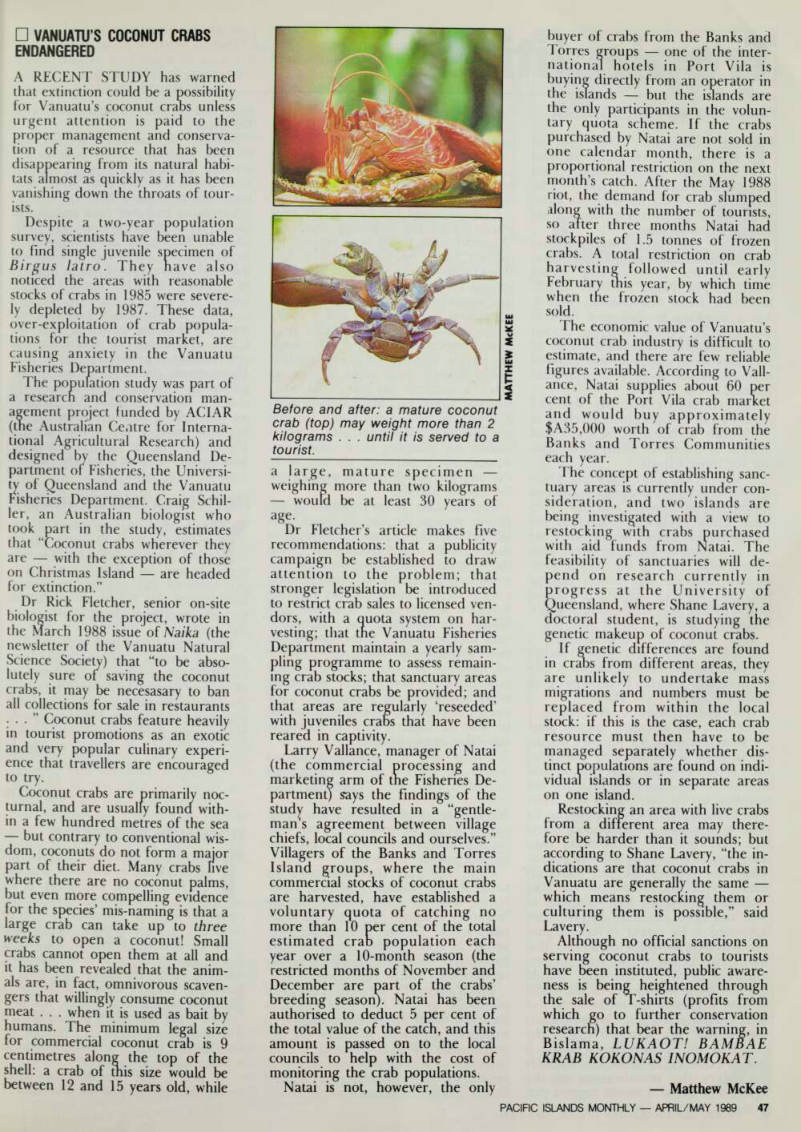
Before and after: a mature coconut crab (top) may weight more than 2 kilograms . . . until it is served to a tourist.