Government? What government?
French Polynesia
The administration declared “illegal” by a Papeete court is still facing an uncomfortable and politically
embarrassing crisis.
By David Robie
FTER THE embarrassment of
last year’s “yo-yo ministers”
affair, in which three minis ters who had resigned were hurriedly
reappointed to push through Tahiti’s
budget, President Alexandre Leontieff was caught in a Catch-22 crisis. Was his Government legal or not?
According to the local Government Commission, the press and the Admi nistrative Court, it was not. The three
judge tribunal including Chief Jus
tice Jean Levoignat ruled that the Government had in fact been illegal since last June because of the uncon stitutional appointment of five minis ters. The verdict plunged Tahiti into its biggest political crisis since Leon tieff came to power in October 1987.
“The Government no longer has
any credibility,” declared Opposition
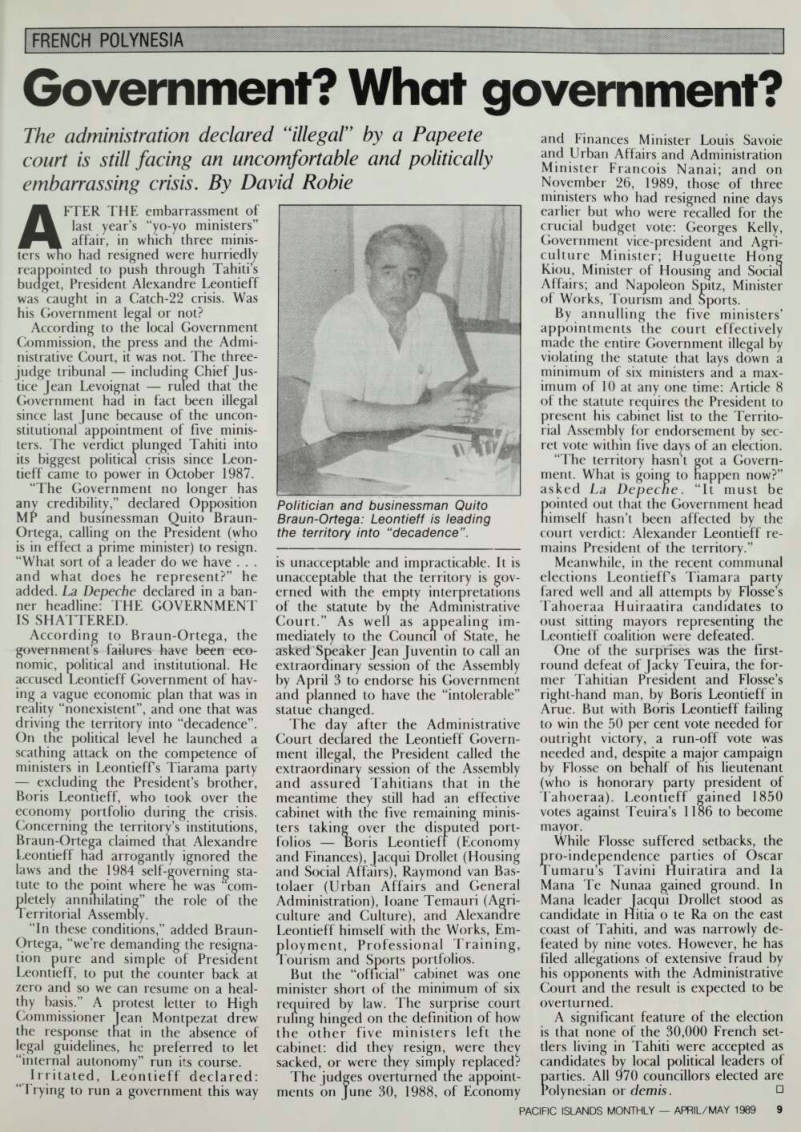
MP and businessman Quito Braun- Ortega, calling on the President (who is in effect a prime minister) to resign.
“What sort of a leader do we have . . . and what does he represent?” he added. La Dcpcche declared in a ban ner headline: THE GOVERNMENT
Is Shattered.
According to Braun-Ortega, the
government’s failures have been eco nomic, political and institutional. He accused Leontieff Government of hav ing a vague economic plan that was in reality “nonexistent”, and one that was driving the territory into “decadence”.
On the political level he launched a scathing attack on the competence of ministers in Leontieffs Tiarama party excluding the President’s brother, Boris Leontieff, who took over the economy portfolio during the crisis.
Concerning the territory’s institutions,
Braun-Ortega claimed that Alexandre Leontieff had arrogantly ignored the laws and the 1984 self-governing sta tute to the point where he was com pletely annihilating” the role of the
Territorial Assembly.
“In these conditions,” added Braun-
Ortega, “we’re demanding the resigna
tion pure and simple of President Leontieff, to put the counter back at zero and so we can resume on a heal thy basis.” A protest letter to High
Commissioner jean Montpezat drew
the response that in the absence of
legal guidelines, he preferred to let
“internal autonomy” run its course.
Irritated, Leontieff declared: “Trying to run a government this way
is unacceptable and impracticable. It is unacceptable that the territory is gov erned with the empty interpretations of the statute by tne Administrative Court.” As well as appealing im mediately to the Council of State, he asked Speaker Jean Juventin to call an extraordinary session of the Assembly by April 3 to endorse his Government and planned to have the “intolerable”
statue changed.
The day after the Administrative Court declared the Leontieff Govern ment illegal, the President called the extraordinary session of the Assembly and assured Tahitians that in the meantime they still had an effective cabinet with the five remaining minis ters taking over the disputed port folios Boris Leontieff (Economy and Finances), Jacqui Drollet (Housing and Social Affairs), Raymond van Bas tolaer (Urban Affairs and General Administration), loane Temauri (Agri culture and Culture), and Alexandre Leontieff himself with the Works, Em
ployment, Professional Training,
Tourism and Sports portfolios.
But the “official” cabinet was one minister short of the minimum of six
required by law. The surprise court
ruling hinged on the definition of how the other five ministers left the
cabinet: did they resign, were they
sacked, or were tney simply replaced?
The judges overturned tne appoint ments on June 30, 1988, of Economy
and Finances Minister Louis Savoie and Urban Affairs and Administration Minister Francois Nanai; and on November 26, 1989, those of three ministers who had resigned nine days earlier but who were recalled for the
crucial budget vote: Georges Kelly,
Government vice-president and Agri
culture Minister; Huguette Hong Kiou, Minister of Housing and Social Affairs; and Napoleon Spitz, Minister of Works, Tourism and Sports.
By annulling the five ministers’
appointments the court effectively
made the entire Government illegal by violating the statute that lays down a minimum of six ministers and a max imum of 10 at any one time: Article 8 of the statute requires the President to present his cabinet list to the Territo rial Assembly for endorsement by sec ret vote within five days of an election.
“The territory hasn’t got a Govern ment. What is going to nappen now?” asked La Depecne. “It must be pointed out that the Government head himself hasn’t been affected by the court verdict: Alexander Leontieff re mains President of the territory.”
Meanwhile, in the recent communal elections Leontieffs Tiamara party fared well and all attempts by Flosse’s Tahoeraa Huiraatira candidates to oust sitting mayors representing the Leontieff coalition were defeated.
One of the surprises was the first round defeat of Jacky Teuira, the for mer Tahitian President and Flosse’s right-hand man, by Boris Leontieff in Arue. But with Boris Leontieff failing to win the 50 per cent vote needed for outright victory, a run-off vote was
needed and, despite a major campaign
by Flosse on behalf of his lieutenant (who is honorary party president of Tahoeraa). Leontieff gained 1850 votes against Teuira’s 1186 to become mayor.
While Flosse suffered setbacks, the
pro-independence parties of Oscar
Tumaru’s Tavini Huiratira and la Mana Te Nunaa gained ground. In Mana leader Jacqui Drollet stood as candidate in Hitia o te Ra on the east coast of Tahiti, and was narrowly de feated by nine votes. However, he has filed allegations of extensive fraud by his opponents with the Administrative Court and the result is expected to be overturned.
A significant feature of the election is that none of the 30,000 French set tlers living in Tahiti were accepted as candidates by local political leaders of Parties. All 970 councillors elected are olynesian or demis . □
Politician and businessman Quito Braun-Ortega: Leontieff is leading the territory into “decadence”.