Ciguatera: blame it on the bomb?
The Region
An Australian researcher has found links between
military activity and a potentially fatal toxin.
By David Robie
DOCTORS AND researchers well know the often deadly
course of ciguatera poisoning
but the causes of outbreaks have re mained unknown. Australian medical researcher Dr Tilman Ruff may have solved the mystery.
Dr Ruff is a researcher at Mel bourne’s Monash Medical School. He says outbreaks of ciguatera poisoning in the Pacific are more serious and freouent than has previously been maae public. “While in Tahiti I learned of outbreaks, probably or possibly related to military activities, that have not been documented or studied, in the past and about which there is no published information,” the doctor says.
The British medical journal The Lancet has published Dr Ruffs find ings, which suggest a link between
ciguatera poisoning and military activi
ties in the region. Tahiti’s Health and Environment Ministry is studying the report, though one official said “there is nothing new, it is really a review of existing data”. The link has long been suspected. “I don’t think it is a big secret,” says Dr Ruff, “it’s just that this is the first time the data has been put together in a credible, scientific way.”
Dr Ruff says recent outbreaks and changes in the incidence of poisoning indicate direct and indirect links be tween ciguatera and nuclear explo sions in the Pacific. While he nas found no direct link between radioac tive fallout and ciguatera, the only re
ported study addressing this question
was conducted in the central Pacific 30 years ago further research is vital.
‘Nuclear explosions directly damage
atolls and coral reefs. Underground blasts may trigger earthquakes,” Dr Ruff says. “The indirect effects are probably larger and related to the eco
logically disruptive impact of human
activities on fragile island and coral reef ecosystems.” The military are often responsible for those activities missile tests, port facilities, airfields, ship and submarine movements, dredging and channel blasting, seabed drilling and the dumping of refuse.
The Pacific has long been an impor tant military theatre, with naval, air and communications bases in the re gion. But only France continues to ex plode nuclear devices in the region and by the end of 1988 had staged 103 underground tests at Moruroa
and Fangataufa atolls in the Tuamoto archipelago.
The incidence of ciguatera in the region is severely under-reported: the South Pacific Commission estimates that official statistics reflect, at best, a mere 20 per cent of actual cases. For the region as a whole, excluding Papua New Guinea, 219 cases per 100,000 population were reported for
1987. Dr Ruffs research for the period 1973-87 shows rates more than three times the regional average were recorded in French Polynesia, some of the isolated island groups in the north-central Pacific (Kiribati, Tokelau and Tuvalu), the Marshall islands in north-east Micronesia and Vanuatu.
Ciguatera is less common in the west ern Melanesian nations of PNG and the Solomon Islands, where the population is less dependent on marine resources and where reporting of cause of death is less complete.
“Between 1960 and 1984 there was
a general flare-up of ciguatera in
French Polynesia, with more than 24,000 cases being recorded among a population that grew from 34,500 in 1960 to 174,000 in 1985,” says Dr Ruff. The number rose sharply through the 19605, peaking in 19/2- 75 at 1200 per 100,000 a ten-fold increase over the 1960 figure.
Ciguatera had not occurred in Hao before January 1965 when the French Atomic Energy Commission began to convert the atoll for a staging base for nuclear testing at Moruroa and Fanga taufa atolls. The building of an army camp for 2000 soldiers, a permanent base for bomb assembly and a 3500 metre runway required the construc tion of piers and dredging of large quantities of coral. The first case of ciguatera reported from Hao involved fish caught at the original French landing site in August 1966. The dis ease then spread to other areas of the atoll over tne next two years.
“Fishing in the Moruroa lagoon has been officially banned ever since the nuclear test explosions began,” says Dr Ruff, “although the ban has not al
ways been respected, particularly by
Polynesians. Moruroa has had a hign incidence of ciguatera over the past 20 years, in which time there has been extensive coral damage caused by the construction of military infrastructure and by the explosions themselves.
Several submarine slides have accom panied nuclear tests and large areas of the atoll continue to subside.”
Dr Ruff says the impact of ciguatera can only be reduced by curbing ecolo gically disruptive human activities on and near coral reefs. “Military activity conducted in the Pacific by nations distant from the affected regions is an assault on a delicate ecosystem and the human population it supports.” □
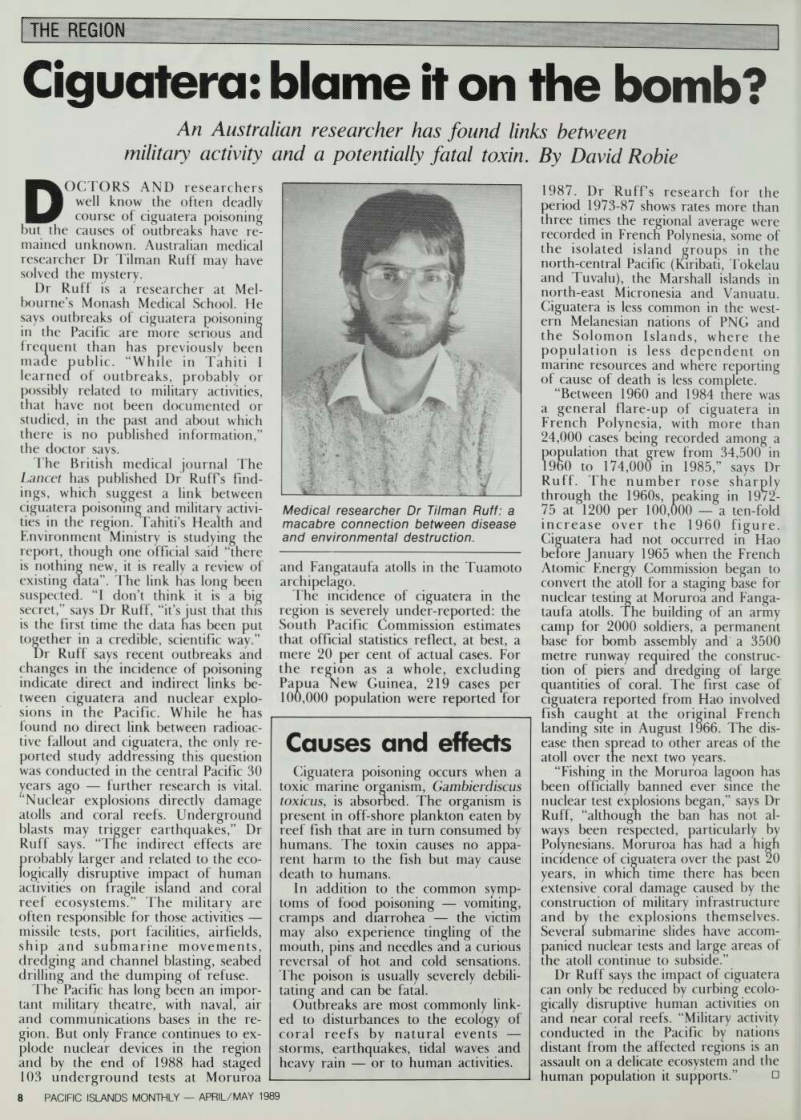
Medical researcher Dr Tilman Ruff: a macabre connection between disease and environmental destruction.