Waiting for the skies
pp. 26-30 · Read in the full issue


skies to open
The villagers of Sulphur Bay, Vanuatu, gather to hasten the return of John and his magical cargo. Text and photographs by Matthew McKee
EACH year around the middle of
February, the people of Sulphur
Bay, headquarters of the John
frum Custom Movement, gather to celebrate the anticipated return of
their prophet.
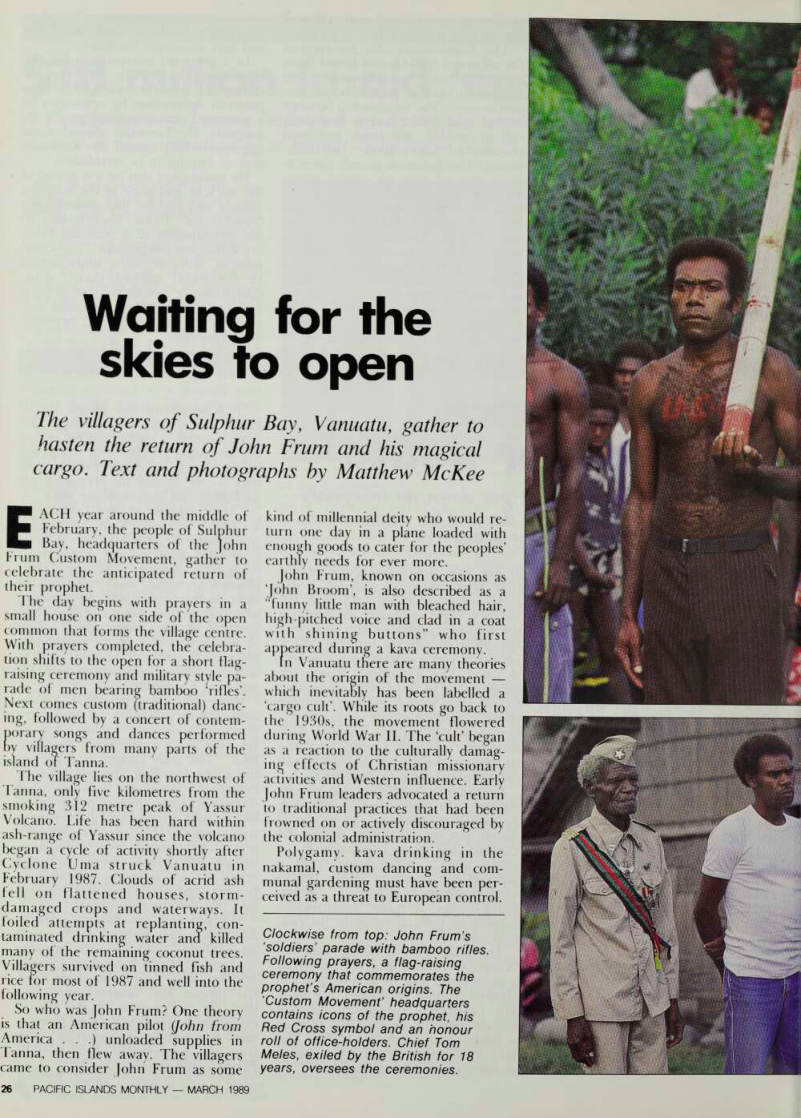
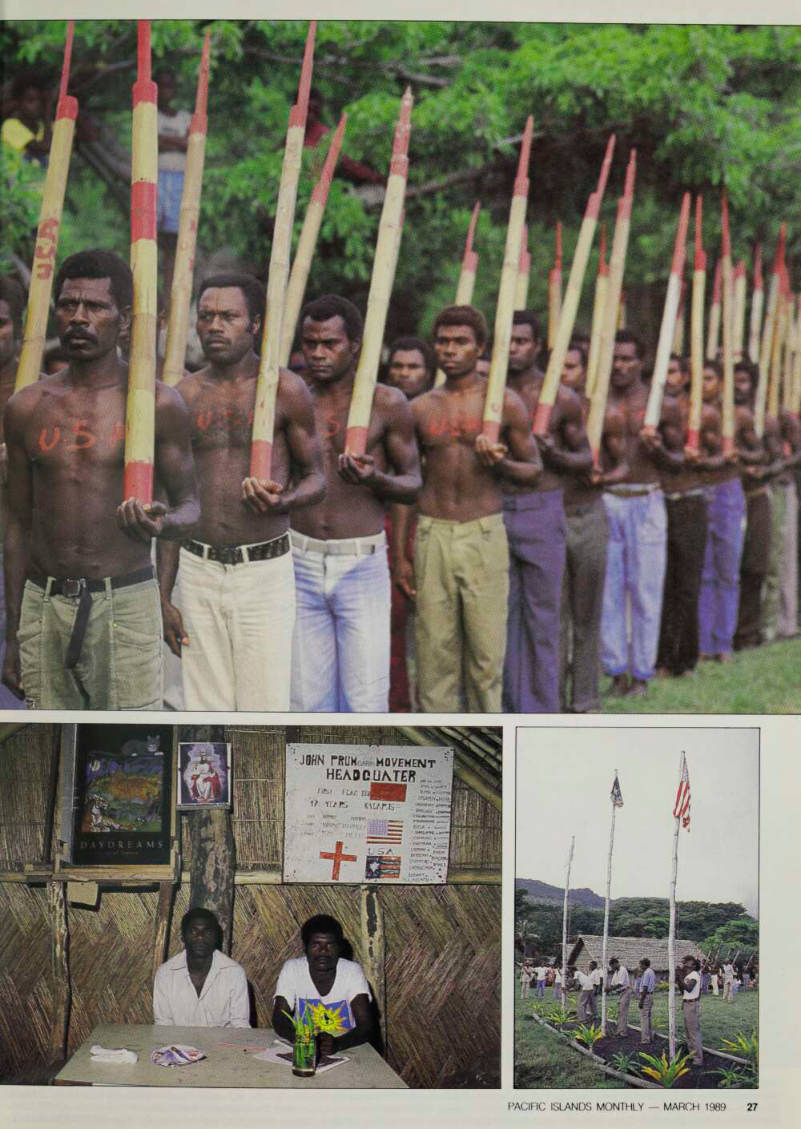
I he day begins with prayers in a small house on one side of the open common that forms the village centre, With prayers completed, the celebration shifts to the open for a short flag-
raising ceremony and military style pa-
rade of men bearing bamboo ‘rifles’, Next comes custom (traditional) dancing, followed by a concert of contemporary songs and dances performed by villagers from many parts of the island of Tanna.
I he village lies on the northwest of I anna, only five kilometres from the smoking 312 metre peak of Yassur Volcano. Life has been hard within ash-range of Yassur since the volcano began a cycle of activity shortly after Cyclone Uma struck Vanuatu in February 1987. Clouds of acrid ash lell on flattened houses, stormdamaged crops and waterways. It foiled attempts at replanting, con laminated drinking water and killed many of the remaining coconut trees.
Villagers survived on tinned fish and skszf 1987 an<l "" ,he So who was John Frum? One theory is that an American pilot (John from America . . .) unloaded supplies in Tanna, then flew away. The villagers came to consider John Frum as some
kind of millennial deity who would re turn one day in a plane loaded with enough goods to cater for the peoples’ earthly needs for ever more.
John Frum, known on occasions as John Broom’, is also described as a funny little man with bleached hair, high-pitched voice and clad in a coat with shining buttons” who first appeared during a kava ceremony. in Vanuatu there are many theories about the origin of the movement which inevitably has been labelled a ‘cargo cult’. While its roots go back to the 19305, the movement flowered during World War 11. The ‘cult’ began as a reaction to the culturally damag ing effects of Christian missionary activities and Western influence. Early John Frum leaders advocated a return to traditional practices that had been
frowned on or actively discouraged by
the colonial administration.
Polygamy, kava drinking in the nakamal, custom dancing and com munal gardening must have been per ceived as a threat to European control.
Clockwise from top: John Frum’s ‘soldiers’ parade with bamboo rifles.
Following prayers, a flag-raising ceremony that commemorates the prophet’s American origins. The Custom Movement’ headquarters contains icons of the prophet , his Red Cross symbol and an honour roll of office-holders. Chief Tom Meles, exiled by the British for 18 years, oversees the ceremonies.
because the British administration’s re sponse was to attempt to quash the movement. From 1941 to 1943, adhe rents were arrested, large fines im posed and leaders exiled to outer is lands of the group. Many of these Eeople arrested were put to work on IS Air Force bases at Vila and Santo which meant they were able to ‘spread the good word’ throughout the coun try. Meanwhile, back at the bases, Frum followers were exposed to the sight of black American airmen
apparently in charge of huge quanti
ties of war material and spending large amounts of money. It seemed to them that the missionaries had been lying and that in truth it was black men such as these who were really running the world. The administra tion’s policy was, in reality, greatly to the advantage of the John Frum movement and the opposite of what the British had intended: John Cleese as John Bull versus John Frum.
Arrests and banishments continued even after the Americans departed at the end of the war. The movement was very discreet in its activities, if not
quite underground, during the 1950 s
and ’6os, but reappeared as a political force during the shaky period prior to
independence in July 1980.
John Frum did not return to his followers at Sulphur Bay this year . . . but as one villager explained, “the people had been waiting a long time for Jesus, too”. □
Right: Yassur Volcano still rumbles, reminding the villagers of Sulphur Bay of its destructive power. Below: 'Custom' dancing is an important and serious part of the annual celebrations. Below right: Yassur’s most recent eruption followed hard on the heels of Cyclone Uma, destroying crops and imperilling villagers’ lives.