Book Review
pp. 44-45 · Read in the full issue
The Sacred Remains: Myth,
History And Polity In Belau
By Richard J. Parmentier. University of Chicago Press, 1987. $US 17.95.
Reviewed by Harvey Zone Helfand «HE BELAU archipelago has been the subject of several noted
Western anthropological and
ethnographical studies, beginning in
the 19th century with J S Kubary and Augustin Kramer ana continuing to modern times with the works of Ro land and Maryanne Force, Homer Barnett and others. Smith College’s Professor Richard J Parmentier contri butes to this body of research in The Sacred Remains. The book is a fasci nating description of Belauan culture, both anthropological and historical
perspectives.
The “sacred remains” are the
olangch, or the “permanent signs
whicn function as present evidence of a significant past . These signs are varied and include sacred stones, ex change valuables, carved stories, sea ting patterns, titles, names, and even tree plantings, among others. The olangch can be both “signs of history” and “signs in history”. For example, the traditional meeting house bai con structed for Belau’s museum was cal led Ngesechel a Cherechar (reminder of the past) and was “designed as a
unifying pan-Belauan sign of history .
. . until it became also a sign in history when it was vandalised and then burned to the ground during recent
political struggles”. A more typical,
and less catastrophic recollection of earlier times is that of one village pre senting a sacred stone to another vil lage as payment for providing assist ance in battle. In this way the stone, “a sign of history”, was utilised for socio political purpbses, so that it also served as a “sign in history”.
This concept of continuity contrasts with the more traditionally separate views of history by historians and
anthropologists.
Parmentier concentrates his study in Ngeremlengui, on the west coast of Babeladob, where he lived for two years, recording stories and observing the use of historical markers in Be lauan culture. He informs the reader that the book “is not about Belau in general, but about Belau from the
vantage point of Ngeremlengui”
where he was led to find the elderly man known for his expertise in myths and historical narratives. The stories he heard “depict Ngeremlengui as the highest-ranking district in the
arcnipelago”.
In addition to these first-hand accounts, Parmentier draws from the oral history tapes recorded some years earlier by the Palau Community Ac tion Agency, and the text is enriched by more than 25 priceless stories, songs and chants, recounting origin mytns, village histories and cultural
events including “The Closely
Guarded Story of Ngeremlengui”.
As historical evidence is often sub jective and incomplete, the author also plays the sleuth in referring to written accounts of Western contact in Belau to find and fill in the gaps. Excerpts from the observations of Captain Hen ry Wilson and his ship-wrecked crew in 1783, the trader Andrew Cheyne in the mid-19th century, and others, reinforce or clarify names and events as well as illustrate the outside world’s influence on Belauan polity.
A structure of social relations is de scribed, based on the four physical concepts of the path, the side, the cor nerpost. and the contrast between lar ger and smaller. These elements,
however, have been compromised by
historical changes: “The decision to base colonial governmental and com mercial institutions on Oreor village (Koror) automatically undermined the co-ordinated political relations charac teristic of the traditional cornerposts of Belau. Oreor in fact became a dis trict centre, a notion completely alien
to Belauan political ideology.”
By their nature, scholarly ethnog
raphic books may be somewhat esoteric and slow-moving for the lay reader. While The Sacred Remains has such moments, it is a valuable re source for anyone wanting a better understanding of Belau. The text in cludes a well organised geographical,
cultural and historical introduction and, in addition to illustrations, maps and tables, is supplemented by a short English-Belauan glossary, a list of place names, and an extensive list of references.
This is a sensitive and thorough
study that provides an insightful look
at the roots of Belauan culture.
TAI - HEART OF A TREE: A
Collection Of Poems By
Momoe Malietoa von Reiche. ISBN 0-908652-36-4. New Women’s Press $NZ19.95 Reviewed by Leonie Hellmers VHE ENJOYMENT of poetry for S many of the world’s children is
I effectively prevented by over
zealous educators determined to hand down their own concept of the artform rather than a broad perspec tive of the many faces of verse. Too many impressionable young minds have been switched off for ever by teachers thumping out stiff iambic verse groaning under the weight of
impossible rhyme, or by the
academic’s quest for enlightenment and meaning in the accidental juxta position of words in vapid ‘free’ verse.
Interest in poetry, and other forms of literature rapidly flags and in most cases, is never revived.
Tai Heart of a Tree is an accessi ble collection of poetry that could win back many of those lost hearts and minds. Samoan-born writer Momoe Malietoa von Reiche here offers a selection of more than 100 poems ori
ginally published in Fiji and Western
§amoa as three booklets between 1979 and 1986. Von Reiche’s gift for rich, evocative imagery and her painter’s eye transform ner poems generally brief, one-scene sketches into vivid and thought-provoking works. She is mainly concerned with the lot of a Pacific woman searching for love, rais ing nine children, stoically enduring the iniquities of insensitive men and discovering the curious ways of the ‘outside’ world.
She also manages to give optimistic voice to the strange hybrid combina tion of island and Western cultures in heartwarming (and sometimes bitter
sweet) images;
It was a far cry From being a flat-footed Samoan, When I got on those Planes.
The reason pushed hard, And I wasnt scared to dare The blue skies.
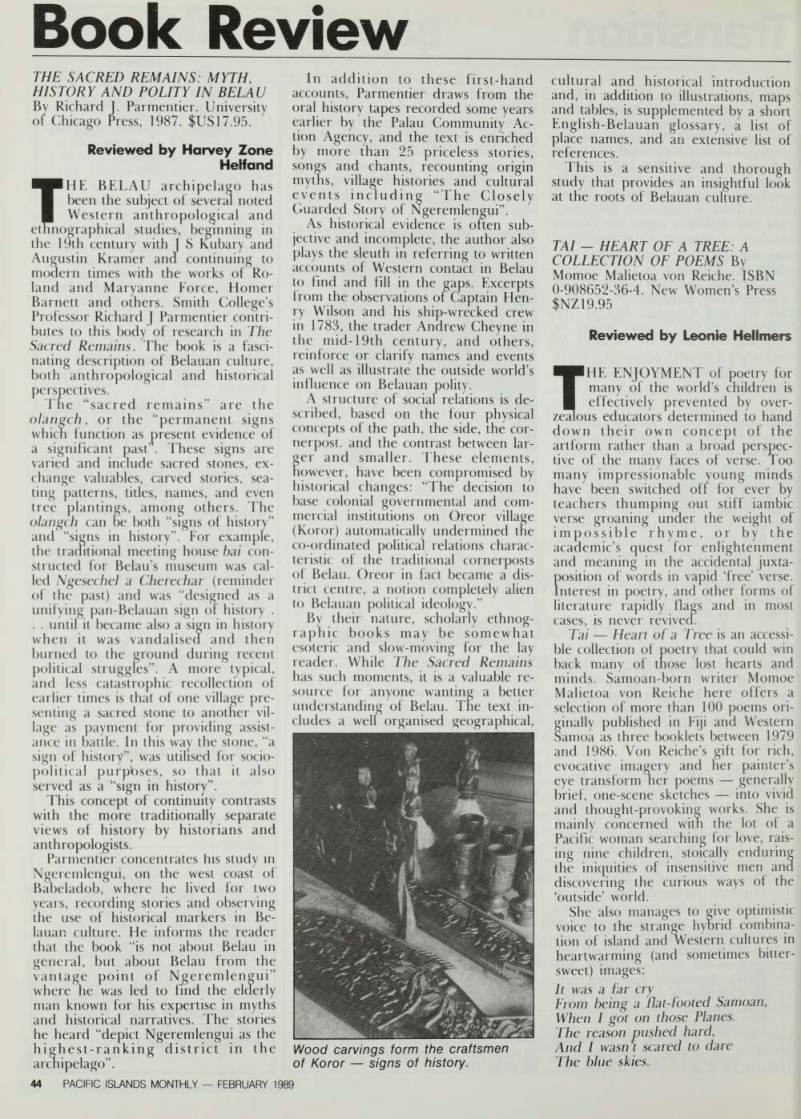
Wood carvings form the craftsmen of Koror - signs of history.
Hijack was a spook,
But I prayed to all the gods, And the one God To preserve me For no other better purpose Than to see my Five babies again.
I felt like a neanderthal being Threading the space age, But after two flights, It was fun.
Von Reiche is particularly sharp with her accounts of male-female rela tionships, and she runs the gamut of emotions from romantic exuberance to scorn for the young bed-hopping men so admired in sections of the male-dominated Pacific society. In many modern poets these themes
seem to inspire only terminal cynicism
and gloomy dirges, but von Reiche has a joyous approach that finds hope and humour even in despair. She also writes with strength of anger, dis
appointment and betrayal, while
avoiding the trap of self-indulgence.
She is a true citizen of the Pacific born in Western Samoa and educated in New Zealand at Wellington Teachers’ College and Victoria Uni versity. She returned to Western Samoa in the mid 1960 s to teach art, to marry and then to raise her nine children. She is now back in New Zea land, working on a new volume of poetry and preparing an exhibition of her paintings to be shown in Whan garei later this year. This volume is the first book by a Samoan woman to be published in New Zealand.
Momoe von Reiche’s strength as a poet lies in the fact that she is also a
painter; she approaches her writing
with the attitude of a visual artist. She sets a scene, colours it with her perceptions and leaves room for the reader’s own responses to become part of the message. Her vision of the Paci fic is undoubtedly romantic, tamed by the perspective of a healthy realist: ‘Who wants to buy a Lantern? Four tala a .
Save your breath old man Those young girls are laughing At you. They don’t need lanterns yet.
Thev’d rather fumble in the Dark, in the foliage, By the sea, with their Bare-chested lovers That laugh in the night wind.
It has been argued that poetry romanticises simple events and confers on them meanings that could not be found at the time. But the truth appears to be that romance and high er meaning can be found everywhere; a poet finds the ability to perceive those elements and to portray them in writing. In Tai Heart of a Tree, von Reiche shows this ability in abund ance. It is an adult selection, but it is a fine answer to the young child’s ques tion “What is poetry?”
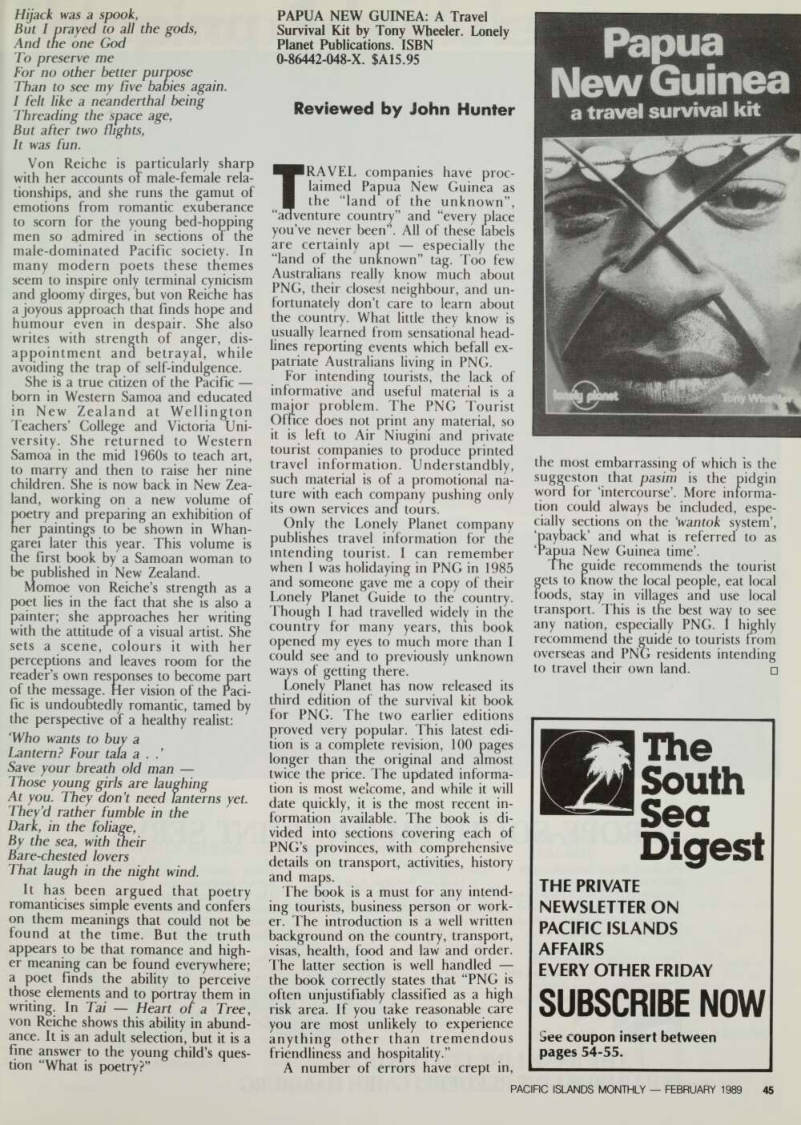
Papua New Guinea: A Travel
Survival Kit by Tony Wheeler. Lonely Planet Publications. ISBN 0-86442-048-X. $A15.95 Reviewed by John Hunter companies have proc |i laimed Papua New Guinea as H| the “land of the unknown”,
“aoventure country” and “every place
you’ve never been. All of these labels
are certainly apt especially the
“land of the unknown” tag. Too few Australians really know much about PNG, their closest neighbour, and un fortunately don’t care to learn about the country. What little they know is usually learned from sensational head lines reporting events which befall ex patriate Australians living in PNG.
For intending tourists, the lack of informative and useful material is a major problem. The PNG Tourist Office does not print any material, so it is left to Air Niugim and private
tourist companies to produce printed
travel information. Understandbly, such material is of a promotional na ture with each company pushing only its own services and tours.
Only the Lonely Planet company publishes travel information for the intending tourist. I can remember when I was holidaying in PNG in 1985 and someone gave me a copy of their Lonely Planet Guide to the country.
Though I had travelled widely in the country for many years, this book opened my eyes to much more than I could see and to previously unknown ways of getting there.
Lonely Planet has now released its third edition of the survival kit book for PNG. The two earlier editions proved very popular. This latest edi tion is a complete revision, 100 pages longer than the original and almost twice the price. The updated informa tion is most welcome, and while it will date quickly, it is the most recent in formation available. The book is di vided into sections covering each of
PNG’s provinces, with comprehensive
details on transport, activities, history and maps.
The book is a must for any intend ing tourists, business person or work er. The introduction is a well written background on the country, transport, visas, health, food and law and order.
The latter section is well handled the book correctly states that “PNG is often unjustifiably classified as a high risk area. If you take reasonable care you are most unlikely to experience anything other than tremendous friendliness and hospitality.”
A number of errors have crept in,
the most embarrassing of which is the suggeston that pasim is the pidgin word for ‘intercourse’. More informa tion could always be included, espe cially sections on the wantok system’, ‘payback’ and what is referred to as ‘Papua New Guinea time’.
The guide recommends the tourist gets to know the local people, eat local foods, stay in villages and use local transport. This is the best way to see any nation, especially PNG. I highly recommend the guide to tourists from overseas and PNG residents intending to travel their own land. □