Japanese Investment
pp. 14-15 · Read in the full issue
Hawaii
Alarms Residents
By Michael Moriarty
ftOTH MAINLAND and Hawaiian Americans have
been growing apprehensive
and suspicious about Japanese invest ment in the US for several years. In certain automobile producing areas of the US it is not advisable to drive an ‘un-American’ vehicle, and in some cities parking lots have special stalls designated ‘foreign car’: one cannot help but wonder if these are for the purpose of identifying targets. Even though the have invested slightly less than a third as much as British corporate investors in US in dustries a little under SUS 3 billion the Japanese have been the prime targets of America’s growing national ist sentiment.
Some observers catch the glint of racism in this whole scenario; for ex ample, there was relatively little outcry over the sale of Hawaii’s gas supplier (Pacific Resources Incorporated) to an Australian firm. It seems there are those who cannot forget their experi ences during World War 11.
The issue is particularly acute in Hawaii, where Japanese investors have purchased significant chunks of the State's real estate and hotel industry.
One of the more spectacular examples surfaced in mid-January, and it con tains elements many Hawaiians find
particularly unpalatable disregard
for local inhabitants, and large tracts of land changing hands repeatedly without any of the parties doing any vyork on the land itself; ‘pure’ specula tion at its worst.
The area concerned is the North Kohala area of the Big Island, where around 7700 hectares owned by Castle and Cook (which had closed clown its sugar plantation during the 1970 s and had been seeking a buyer for some time) was sold last April to Statesman Mortgage Company of lowa and Hart ford Realty Corporation. These two
companies then assigned purchase
rights to Southmark Corporation of Georgia in July: Southmark then made a deal with SoPac Kohala (a
California-based corporation).
In September, officers of the Cha lon Corporation, a Japanese firm, were reported to have visited the Big Island to investigate purchase of the land based on information provided
by Royal Coast Realty. In October,
Hartfort and SoPac agreed to sell the property to Royal Coast Development.
Allegedly, the Chalon Corporation,
on becoming aware of the deal, then indicated its interest in buying the property. An article in the January 19 issue of the West Hawaii Today news paper reported that Royal Coast had claimed it would not sell unless Royal Coast Development and Realty were
appointed by Chalon as developer and
exclusive broker for the land.
A 53-page complaint in Federal
Court by Royal Coast Realty and
Royal Coast Development details some
hair-raising events Tiat allegedly
occurred shortly after the sale to Cha lon: allegations of racketeering, fraud, conspiracy, breach of contract and other criminal violations.
The complaint states that Chalon re fused to honour a marketing and de velopment agreement in which the
firm agreed to provide monthly pay
ments of $U522,500, to give a 20 per cent share of profits from the de velopment (the plaintiff estimates a total of $U531.54 million) and com missions from exclusive brokerage sales (estimated to be $5.8 million).
The complaint states that the “ . . . defendants threatened, directly or in directly, various individuals associated with tne plaintiffs with murder and/ or other serious bodily injury, for the purpose of forcing them to consent to
the restructured purchase agreement”.
It goes on to say that George Matsuo, born and raised in Japan and a Royal Coast stockholder, according to Attor ney General Darryl Johnston, was in formed by a Mr Snoichi Kamon Presi dent of Chalon Corporation that he should be concerned for the welfare of his family still living in Japan.
Kamon allegedly stated that he nad in the past relied on the Yamaguchigumi faction of the Yakuza (the so-called Japanese Mafia’) to arrange the terms he wanted in business deals.
The complaint also alleges that on November 10 last year, “ ... at the Halekulani hotel, in front of five wit nesses, Kamon told Louis Rees [who was negotiating the restructured agreement] that if he created prob lems for Chalon, Kamon would see to it that Rees would be a ‘dead
roundeye’.”
The suit alleges further that on January 12 this year, in a phone call to Matsuo, Kamon reportedly said that “if Royal Coast Development con tinued to demand that Cnalon Japan observe the terms of the development and marketing agreement, Kamon would use all means, including illegal means, to get what he wanted’ v . Roval Coast attorney Johnson asserted that in racketeering cases damages can be tripled, and in this instance damages
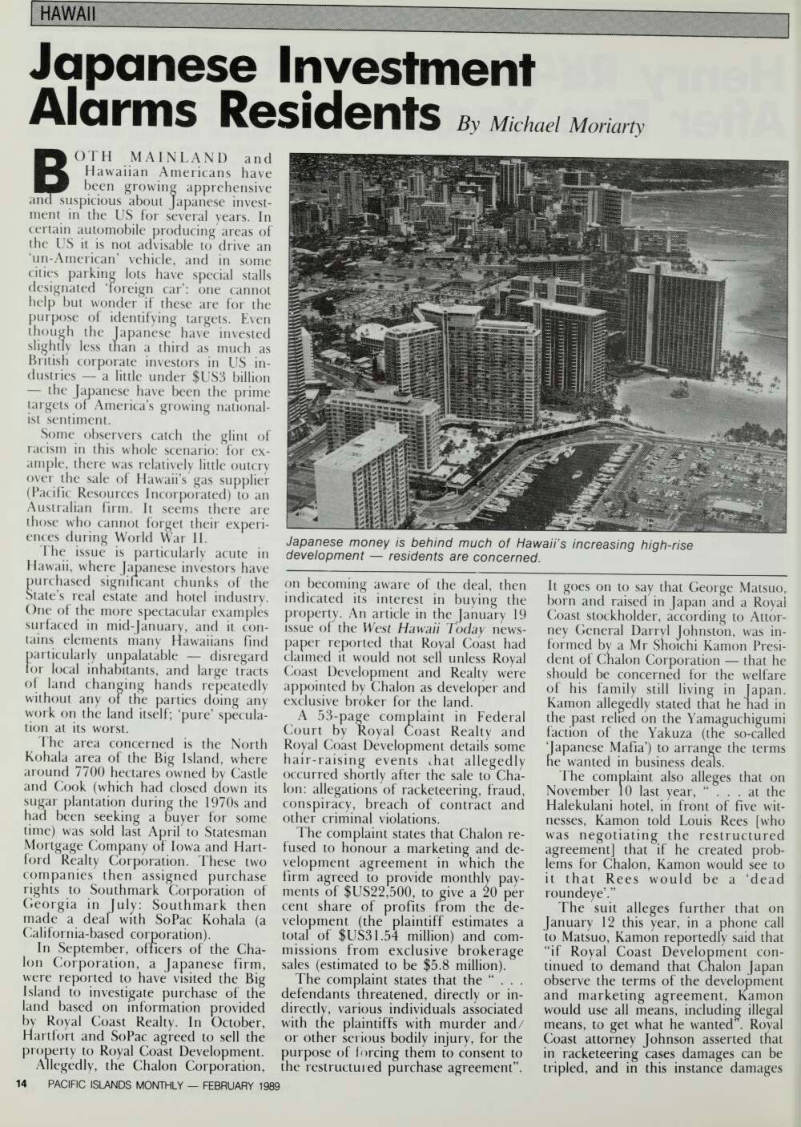
Japanese money is behind much of Hawaii’s increasing high-rise development - residents are concerned.
could amount to SUS 112 million.
David Nakashima, Counsellor for Chalon Corporation (the parent com pany of Chalon International of Hawaii) in a statement to the press said, “ . . . the case is without merit and is based, in my opinion, on mis
representation, manipulation and de
ceit”. He is apparently preparing a countersuit for fraud, misrepresenta tion and slander.
Nakashima went on to say that the case “ . . . does not change Chalon’s commitment to North Kohala and the County of Hawaii. The company’s plans to balance the preservation of historic sites [in] the area with re creational and agricultural activities
have drawn widespread community
support.” I live in North Kohala, and it was only a few weeks ago that the sale was first announced to a wave of apprehension among concerned local residents.
All sources of public information state that Chalon’s plans for the area were unknown and nobody, to the best of my knowledge, in this com munity of 3000 people could or would reveal anything about the develop ment proposal. With no public meet ings and no real information, area re sidents are befuddled by Nakashima’s statement confusion that can only serve to increase mistrust in an
already suspicious population.
There have been other examples of
behaviour considered unacceptable by
most Hawaiian residents. In one case a Japanese citizen bought ‘Coconut Is land’ in Kaneohe Bay, only to be de ported for falsifying documentation in order to enter the United States. In the exclusive Waialae-Kahala suburb of Honolulu, Japanese investors have purchased a number of homes one buyer reportedly rode around in a
limousine, choosing properties without
leaving his car.
Honolulu Mayor Frank Fasi has made it publicly dear that he would like to stem the wave of foreign invest ment, at least in the private home market, and will be seeking ways to do Just that. Senator Rick Reed has intro duced a bill in the Hawaiian legisla ture that would prohibit non-residents of Hawaii owning residential land: the bill is likely to ne found unconstitu tional, but it highlights the strong undercurrent of feeling among Hawaiians about the apparent loss of their homeland to foreigners.
On the other hand, it must be noted that some of the Japanese-owned hotels on the Big Island have been among the county’s best citizens. The Maunalani Bay Hotel and Resort pre
served existing Hawaiian fishponds,
led the drive for a fire station in the area and voluntarily provided more housing than was -initially demanded by the county. This last move actually
forced other hotels to follow suit and effectively forced the raising of official levels of acceptable ‘afforaable hous ing’ a developer is now required by law to provide.
Even if the courts decide that Cha lon is completely innocent, this cannot
help but make it harder for legitimate Japanese businesses to function in Hawaii. If the allegations prove true,
they will provide Hawaii’s politicians
with a good excuse to implement laws that will curb Japanese business activ ity in the Hawaiian Islands. □