How the men of Mare
pp. 36-37 · Read in the full issue
New Caledonia
How the men of Mare went to war
Dr Stephen Henningham chronicles the Pacific’s unsung WWII heroes
IN RECENT years, historians of World War II and the Pacific have begun paying more attention to the involvement of Pacific islanders in the war. In such research, due recognition needs to be given to those islanders who went off to fight for the Allied cause in strange and distant lands.
And not least among them were the men of Mare, the southernmost of the three islands in the Loyalty group in New Caledonia.
V isitors to Mare nowadays are more likely to be impressed bv the charm of its people and its relaxed pace than by its martial heritage. These days more than 80 per cent of the island’s population (which is 99 per cent Melanesian) favours the independence of New Caledonia from France; but in 1940 the people of Mare rallied strongly in support of General de Gaulle following the fall of France.
More than 300 men out of a popula tion of only a couple of thousand went off to serve in the Free French forces.
Like the few photos from that time that have survived, the old soldiers and sailors of Mare are aged and weather-beaten. But the veterans re member those days with pride and are keen to talk of their experiences. One photo shows some new recruits mar
ching earnestly if untidily along
the waterfront before departing by boat for Noumea.
The veterans recall that their staunch loyalty to Free France was not matched among some sections of the European population in Noumea. In the uncertain days of mid-1940 some colonial officials, many policemen, most army officers and some local
families supported the Vichy-regime,
which had come to terms with the German invaders.
Meanwhile, others sat on the fence, but eventually the more numerous loc al supporters of Free France pre vailed, their hand strengthened by the arrival of the Australian cruiser HMAS Adelaide. Nevertheless, con
siderable uncertainty and disorganisa
tion continued.
When the Mare volunteers arrived at their barracks in Noumea in late 1940, they found there had been no preparations for their accommodation.
They also recall placing flowers on the
Noumea war memorial in memory of the dead of World War I including some of the soldiers from Mare and discovering that theirs was the only wreath.
With little French equipment on hand to outfit the Mare recruits, thev were kitted up in Australian-made uniforms and armed with British and Australian weapons. A few remained
on garrison duty in Noumea, where
they were soon impressed by the
wealth, generosity and democratic style of the American personnel who arrived in tens of thousands to use New Caledonia as a base for the de fence of the Solomon Islands and the
drive north against Japan.
However, the rest of the volunteers travelled further afield. Most of them, along with settlers and islanders from New Caledonia and French Polynesia, became part of the Pacific Battalion, which fought bravely in North Africa, Italy and Southern France. A dozen or so served in the Free French navy, which consisted mostly of British
provided ships under French flags
serving in the Atlantic, the North Sea and the Mediterranean.
The casualty rate for those serving abroad was Heavy, both from battle and disease: indeed the islanders suf fered particularly heavily from dis ease, perhaps as a result of culture shock in alien environments.
Back on the home front, on Mare the absence of most of the able-bodied men meant extra work for everyone else in fishing and agriculture. Times were difficult, but hardship was some-
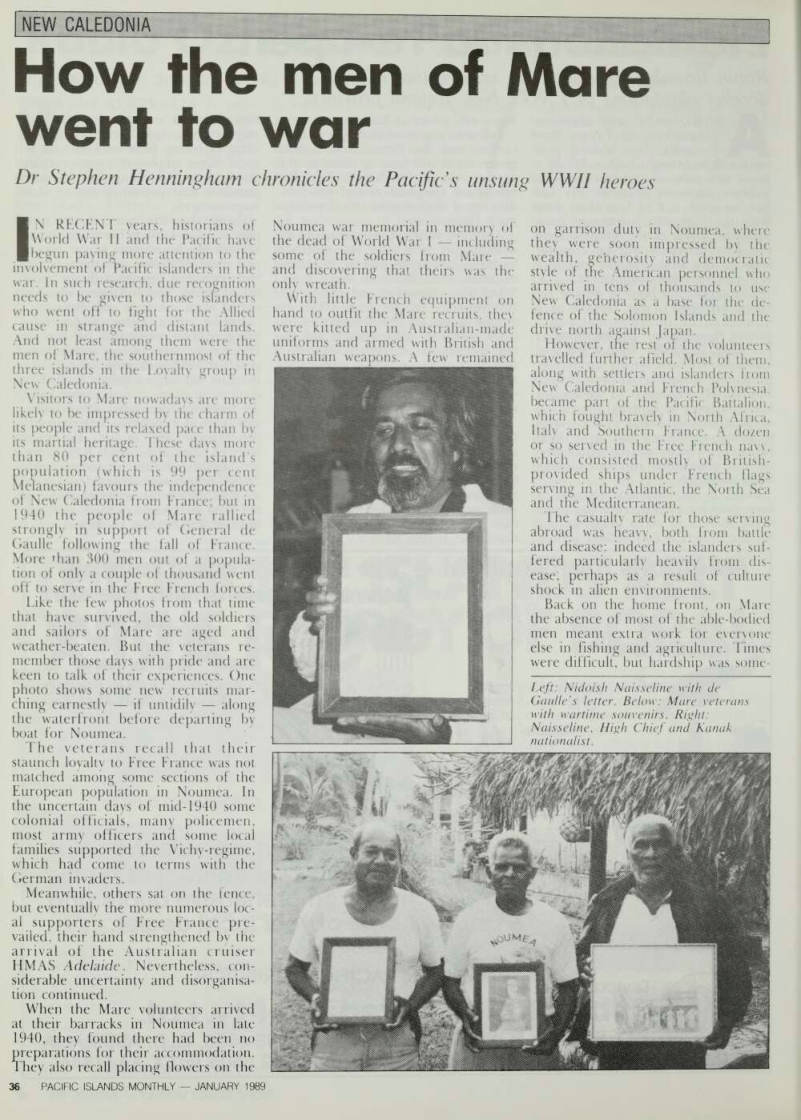
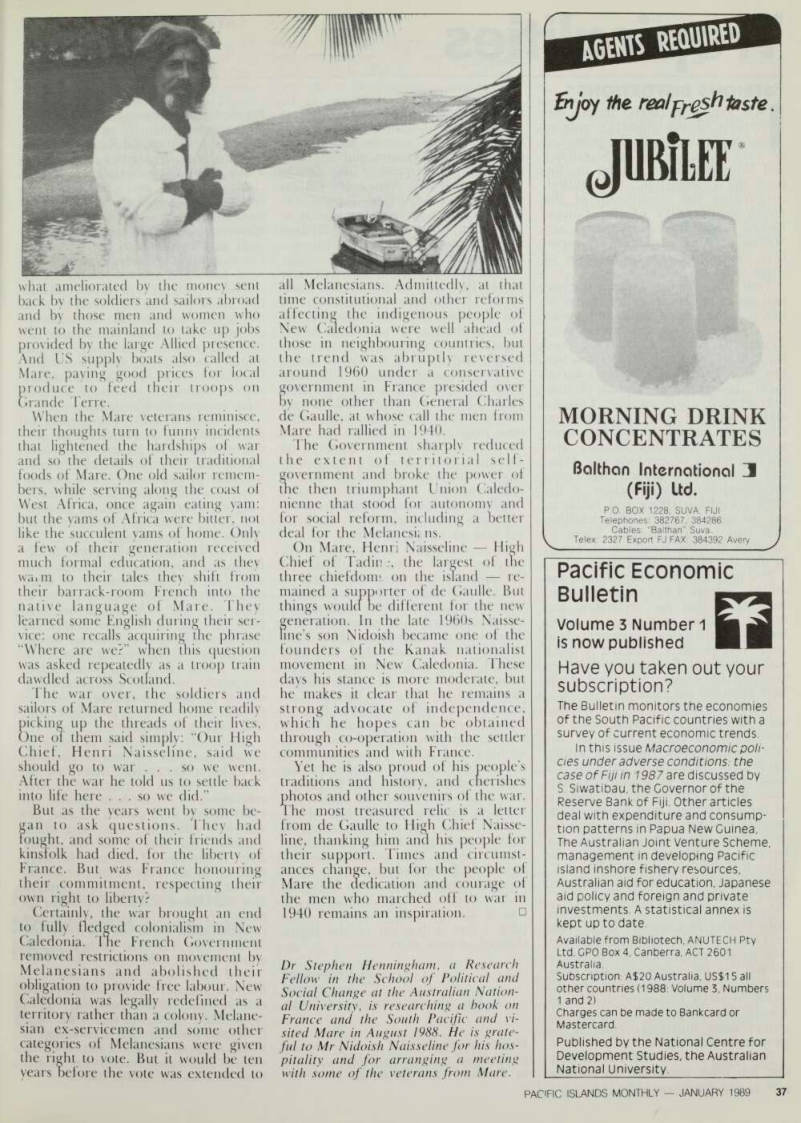
Left: Nidoish Naisseline with de Gaulle’s letter. Below: Mare veterans with wartime souvenirs. Right: Naisseline, High Chief and Kanak nationalist.
what ameliorated by the money sent back by the soldiers and sailors abroad and by those men and women who went to the mainland to take up Jobs
provided by the large Allied presence.
And US supply boats also called at
Mare, paying good prices for local
produce to feed their troops on Grande Terre.
When the Mare veterans reminisce, their thoughts turn to funny incidents that lightened the hardships of war and so" the details of their traditional foods of Mare. One old sailor remem bers, while serving along the coast of West Africa, once again eating yam: but the yams of Africa were bitter, not like the succulent yams of home. Only a few of their generation received much formal education, and as they waitn to their tales they shift from their barrack-room French into the native language of Mare. They learned some English during their ser vice: one recalls acquiring the phrase “Where are we?” when this question was asked repeatedly as a troop train dawdled across Scotland.
The war over, the soldiers and sailors of Mare returned home readily picking up the threads of their lives, One of them said simply: “Our High Chief, Henri Naisseline, said we should go to war ... so we went.
After the war he told us to settle back into life here ... so we did.”
But as the years went by some be gan to ask questions. They had fought, and some of their friends and kinsfolk had died, for the liberty of France. But was France honouring their commitment, respecting their
own right to liberty?
Certainly, the war brought an end to fully fledged colonialism in New Caledonia. Ine French Government removed restrictions on movement by Melanesians and abolished their obligation to provide free labour. New Caledonia was legally redefined as a territory rather than a colony. Melane sian ex-servicemen and some other categories of Melanesians were given the right to vote. But it would be ten years before the vote was extended to
all Melanesians. Admittedly, at that time constitutional and other reforms
affecting the indigenous people of
New Caledonia were well ahead of those in neighbouring countries, but the trend was abruptly reversed around 1960 under a conservative government in France presided over by none other than General Charles de Gaulle, at whose call the men from Mare had rallied in 1940.
The Government sharply reduced the extent of territorial self government and broke the power of tne then triumphant Union Caledo nienne that stood for autonomy and for social reform, including a better deal for the Melanesia ns.
On Mare, Henri Naisseline High Chief of Fadin', the largest of ibe three chiefdorm on the island re mained a supporter of de Gaulle. But things woulcl be different for the new generation. In the late 1960 s Naisse hne’s son Nidoish became one of the founders of the Kanak nationalist movement in New Caledonia. These days his stance is more moderate, but he makes it clear that he remains a strong advocate of independence, which he hopes can be obtained through co-operation with the settler communities and with France.
Yet he is also proud of his people’s traditions and history, and cherishes photos and other souvenirs of the war.
The most treasured relic is a letter from de Gaulle to High Chief Naisse line, thanking him and his people for their support. Times and circumst ances change, but for the people of Mare the dedication and courage of the men who marched off to war in 1940 remains an inspiration. □ Dr Stephen Henningham . a Research Fellow in the School oj Political and Social Change at the Australian Nation al University, is researching a hook on France and the South Pacific and vi sited Mare in August 1988. He is grate ful to Mr Nidoish Naisseline for his hos pitality and for arranging a meeting with some of the veterans from Mare.