Paul Gauguin: The
pp. 30-33 · Read in the full issue
Pacific Arts
Paul Gauguin: The self-created man
A major exhibition of the works of artist Paul Gauguin has opened in Paris. Nicolas Rothwell finds the Pacific dream that inspired Gauguin and other modern masters.
STARING mutely from lustrous
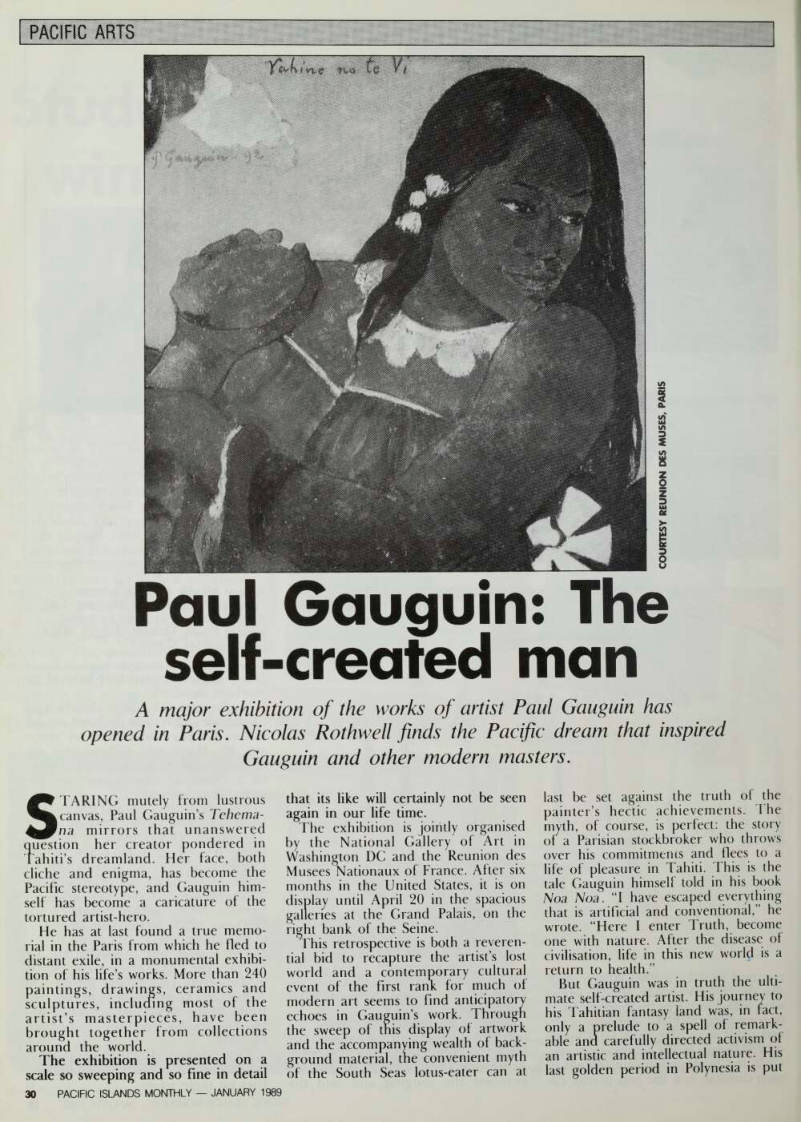
canvas, Paul Gauguin’s Tehemana mirrors that unanswered question her creator pondered in Tahiti’s dreamland. Her face, both cliche and enigma, has become the Pacific stereotype, and Gauguin himself has become a caricature of the tortured artist-hero.
He has at last found a true memorial in the Paris from which he fled to distant exile, in a monumental exhibition of his life’s works. More than 240 paintings, drawings, ceramics and sculptures, including most of the artist’s masterpieces, have been brought together from collections around the world.
The exhibition is presented on a scale so sweeping and so fine in detail
that its like will certainly not be seen again in our life time.
The exhibition is jointly organised by the National Gallery of Art in Washington DC and the Reunion des Musees Nationaux of France. After six months in the United States, it is on display until April 20 in the spacious galleries at the Grand Palais, on the right bank of the Seine.
This retrospective is both a reverential bid to recapture the artist’s lost world and a contemporary cultural event of the first rank for much of modern art seems to find anticipatory echoes in Gauguin’s work Through the sweep of this display of artwork and the accompanying wealth of background material, the convenient myth of the South Seas lotus-eater can at
last be set against the truth of the painter’s hectic achievements. The myth, of course, is perfect: the story of a Parisian stockbroker who throws over his commitments and flees to a life of pleasure m Tahiti. This is the tale Gauguin himselt told in his book Noa Noa. I have escaped everything that is artificial and conventional, he wrote. Here I enter Truth, become one with nature. After the disease ot civilisation life m this new world is a return to health.
But Gauguin was m truth the ulti mate self created artist. His journey o his Tahitian fantasy land was in to only a prelude to a spell ot rema able ana carefully directed activism o an artistic and intellectual nature, is last golden period m Polynesia is put
Courtesy Reunion Des Muses, Paris
nicely in perspective by one of this show’s curators, art historian Richard Bretell: “During the eight years be tween Gauguin’s final departure from France and his death on the island of Hiva Oa in the Marquesas, he was in the hospital at least four times, often for prolonged periods, claimed to have committed suicide once and perhaps succumbed to its temptations in 1903. He built three houses, fathered at least three children, edited one newspaper and wrote, designed and printeef another. He completed three book-length texts, sent paintings and drawings to many European ex hibitions, finished nearly 100 paintings and more than 400 woodcuts, carved scores of pieces of wood, wrote nearly 150 letters and fought both civil and ecclesiastical authorities with all the gusto of a youth.”
Hardly a relaxed existence, yet the Tahitian idyll was merely the final stage in a life measured oy displace ments and drama. Gauguin spent time in Britanny, where he composed some of his most famous canvases; on the French Caribbean island of Martiniqu e; in Denmark and Panama. He painted beside Van Gogh in Arles and absorbed the lessons of the early im pressionists. All these cycles in his career are set in perspective by the exhibition catalogue, a marvel of en
gaged scholarship. Quoted in its pages
is one of the key formulations of Gau guin’s Pacific credo: “Primitive art comes from the spirit and makes use of nature. So-called refined art pro ceeds from sensuality and serves na ture. Nature is the servant of the for mer and the mistress of the latter.”
I his characteristic yoking of abstract
idea with the artist’s personal sense of mission could stand as an emblem for the creative processes explored in the exhibition, but Gauguin was no sim pleton shedding the influences of Paris the moment he reached Papeete.
All too aware of Western art’s achieve ments, he fled to put a necessary dis tance between himself and the icons of Western culture.
Strangely transfigured by their
creator’s Journey they return, howev er, to populate what he saw as his im-
ages of Tahiti. Gauguin’s obsessive re casting of established themes is what gives his work its ‘hallucinatory’ quali ty of synthesis: in the borrowed rituals of Polynesia, in the last dramas of Marquesan life, Europe is seen anew.
But this retrospective exhibition for the first time shifts the emphasis away from the legend of the doomed artist and comes to rest squarely on the evolution of Gauguin’s thought, traced in his writings and letters. Here, too, in a pioneering enterprise treatments of a common theme in different media are compared and by such de vices, the artist’s processes of work are explored as well as the end product.
The curators rightly focus on Gau guin’s internal struggles and the ex
hibition catalogue’s introductory essay
examines the artist’s series of self portraits and concludes he was the hero of his own history: “Gauguin also saw himself as the hero of painting of his age, which seemed to him deca dent,’ it offers. Hence the artist’s ur gent desire to seek external sources of inspiration, to infuse the exotic into the commonplace, in short, Gauguin’s need for the Pacific.
Only in the wake of the pioneering exhibition of primitive art held in the early 1980 s at the New York Museum of Modern Art has it been possible to judge the extraordinary and almost decisive shaping influence of Pacific arts on the development of modern sensibility. Other key masters of our age turned inexorably to Pacific
sources: Picasso’s proto-cubist painting
Les Demoiselles d’Avignon is now known to have been conditioned by the painter’s knowledge of a Vanuatu mask; and Henry Moore, the shaper ol 20th century sculpture, took much ol his inspiration from such sources as Papua New Guinea’s Malanggan carv
ings. Gauguin is merely the best
known of many artists to reveal a Paci fic influence in their work.
But for Gauguin (at least during his early days in Tahiti) the ocean was essentially a key to unlock what he saw as the secrets of the spheres. The more primitive, the better. He even conceived himself as a kind of primi tive figure, proud of his distant Inca ancestry and self-conscious about the correct style for the work he hoped to produce. As a seeker after a new art and inventor of his own myth, he star tled the Tahitians on his arrival in 1918. As a contemporary observer re called, Gauguin drew catcalls and looks of astonishment from the na tives, especially the women. “He had a tall, straight, powerful build, and man aged to preserve an air of profound disdain despite his curiosity about Tahiti and his keen anticipation of the work he would do there.
The twin peaks of this exhibition are the periods Gauguin spent in
[?] NA[?]NAL GALLEY OF ARI, WASHINGION DO, USA
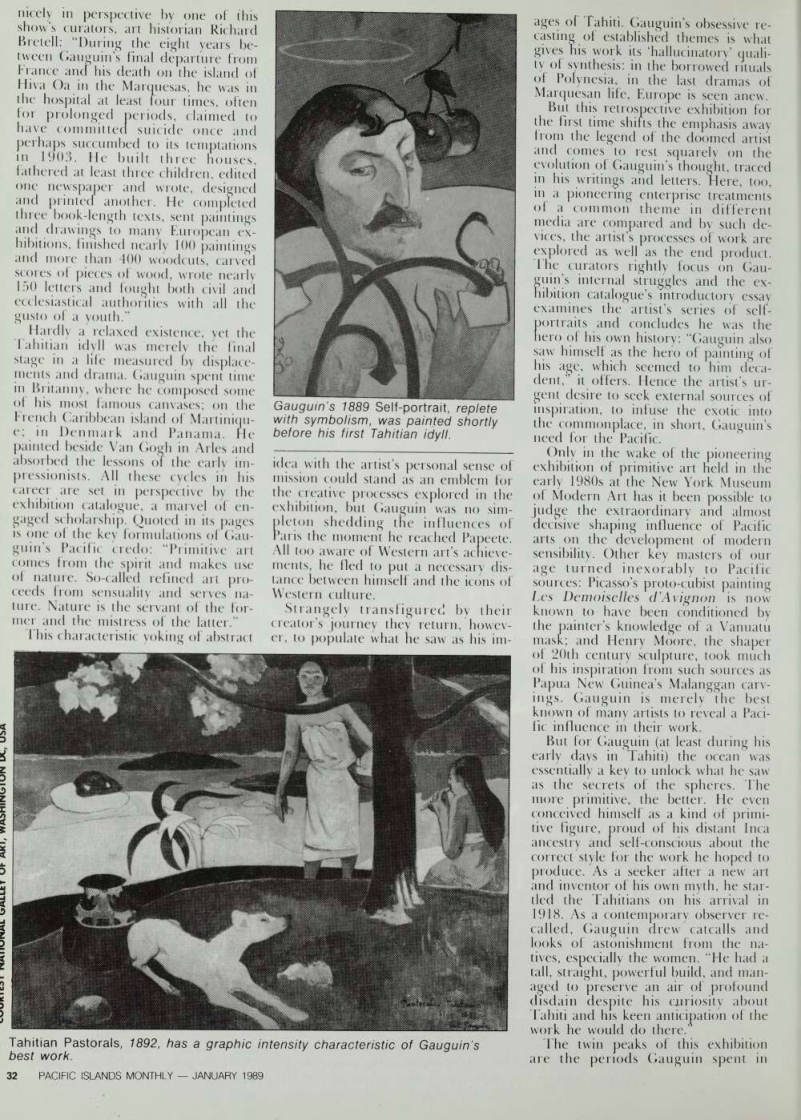
Tahitian Pastorals, 1892, has a graphic intensity characteristic of Gauguin’s best work.
Gauguin's 1889 Self-portrait, replete with symbolism, was painted shortly before his first Tahitian idyll.
Polynesia; the first, from April 1891 to July 1893, yielding paintings of a greater immediacy than the haunted finale of the artist’s career from mid -1895 to his death in November 1903.
Neatly bisecting these two Polynesian
spells is Gauguin’s intriguing return to
Paris, an interval that produced sever al of his most aggresively modern
masterpieces. Then quality suggests
the artist operated with equal ease away from his imagined paradise or within its confines.
Virtually every sketch, painting and carving included in the show is sub jected to a complex analysis by the curators. It is an extraordinary plea sure to trace, through their work, the steps of Gauguin’s art and in this un usual respect the exhibition is both hard work and a delighted reward. Its chief task, like all such prestige inter national retrospectives, is to docu ment, to establish, to pin art’s butterfly to the mounting-case. In a sense, its very thoroughness defeats this aim: Gauguin was a versatile artist whose imagination consumed and assimilated all it found and a painted canvas could not hold him.
Gauguin’s carvings receive their due place here. The most obviously Pacific influenced of his works, together with
his virtuoso woodcuts they display his fearless enthusiasm for new forms of expression. The exhibition gives cor rect prominence to his series of wooden idols, including the object Oviri and a bizarre enamelled MasK of
a Savage rescued from obscurity on Reunion. Partially reconstructed tor the exhibition is The House of Plea
sure, a startling assemblage of symbols
and a totem of his own artistry carved in Atuona on Hiva Oa.
Paul Gauguin rose to an extraordin ary challenge when he sought to bridge the two worlds of Europe and the Pacific. His strange life was a hel ter-skelter of deftly chosen myths and legends, which yields a legacy of the artist’s inexhaustible visions. The ex hibition catalogue notes that “he still lies buried in Atuona, with a small bronze cast of Oviri now on his tomb, but his art can be found on every con tinent, in socialist and capitalist coun tries, in public and private collections and, in reproduction, on the walls of hundreds of thousands, perhaps mil lions, of rooms across the world. In this exhibition, we can once again study him in the original”.
There is certainly no substitute and, perhaps, the time has come at last to return some of these masterpieces to the islands that gave them birth. □
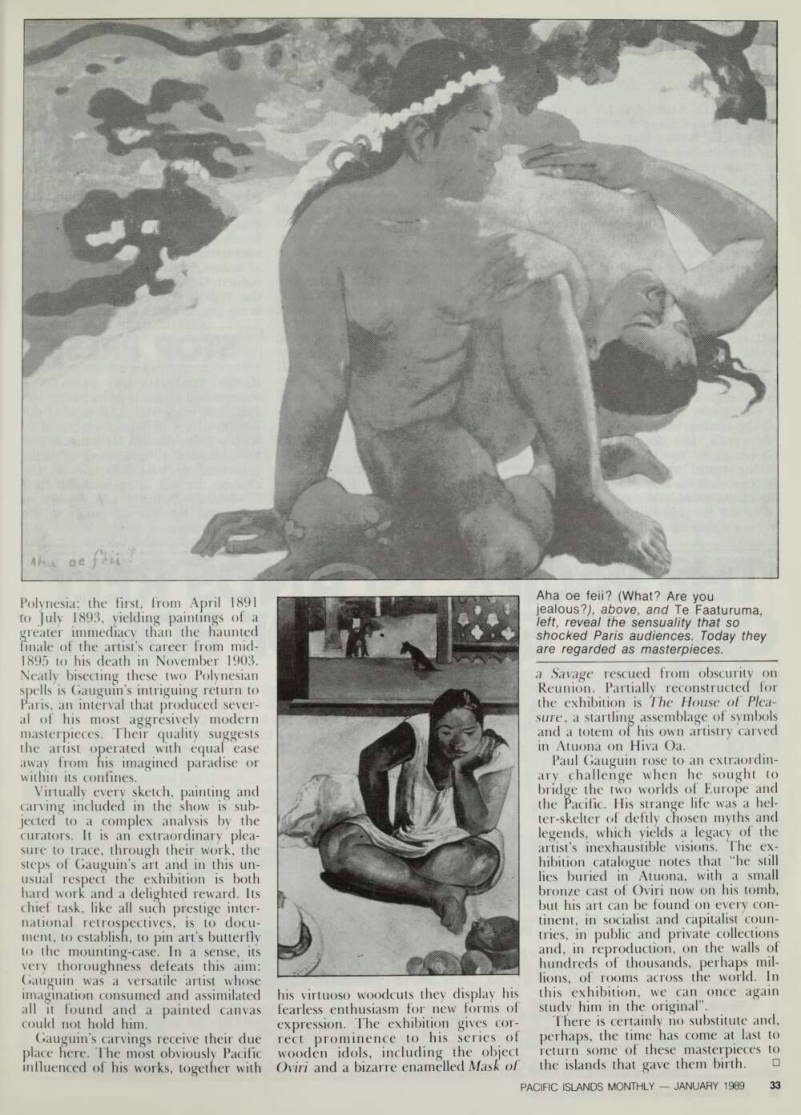
Aha oe feii? (What? Are you Jealous?), above, and Te Faaturuma, left, reveal the sensuality that so shocked Paris audiences. Today they are regarded as masterpieces.