Gentle Budget for Fiji
Fiji
The interim Government cuts duties and seeks to encourage the private sector, but a mini-budget later this year could bring new taxes. By Vijendra Kumar
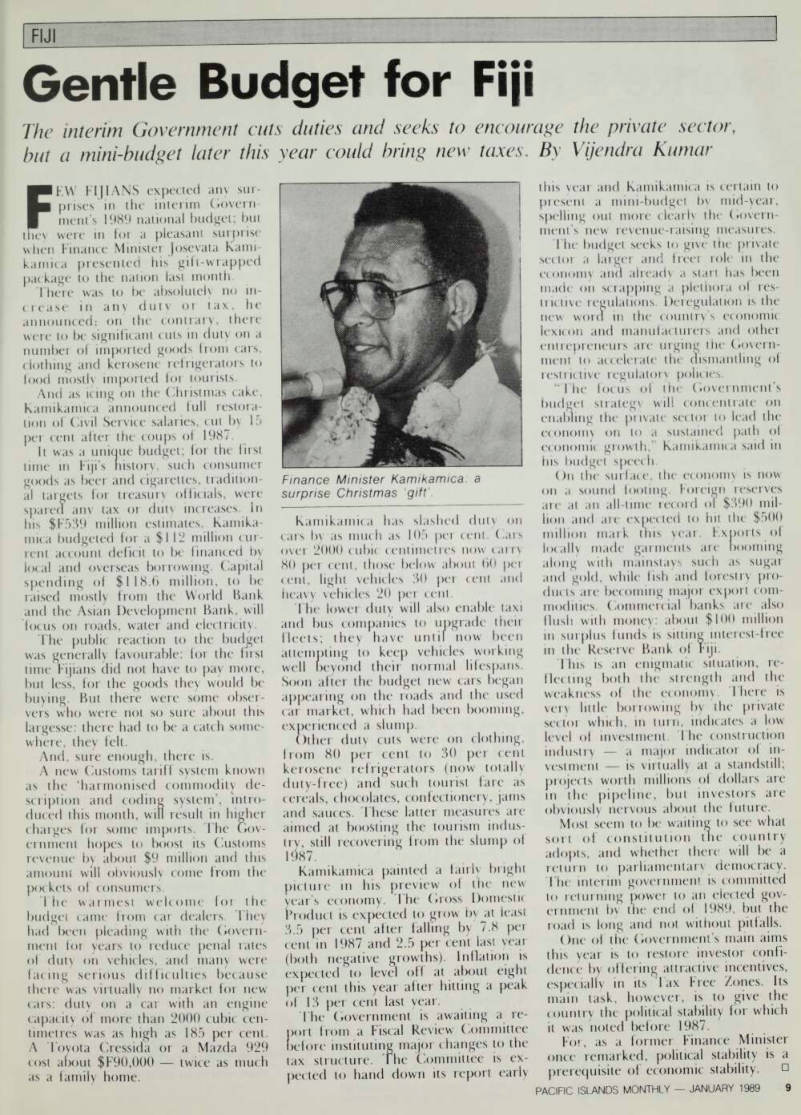
FEW FIJIANS expected any sur
prises in the interim Govern ment’s 1989 national budget; but they were in foi a pleasant surprise when Finance Minister Josevata Kami
kamica presented his gift-wrapped
package to the nation last month There was to be absolutely no in crease in any duty or tax. he announced: on the contrary, there were to be significant cuts in duty on a number of imported goods from cars, clothing and kerosene refrigerators to food mostly imported for tourists.
And as icing on the Christmas cake, Kamikamica announced lull restora tion of Civil Service salaries, cut by 15 per cent after the coups of 1987.
It was a unioue budget; tor the first time in Fiji’s bistory, such consumer goods as beer and cigarettes, tradition al targets for treasurv officials, were spared any tax or duty increases. In his $F539 million estimates, Kamika mica budgeted for a $ll2 million cur rent account deficit to be financed by local and overseas borrowing. Capital spending of $1 18.6 million, to be raised mostly from the World Bank and the Asian Development Bank, will focus on roads, water and electricity .
The public reaction to the budget was generally favourable: for the first time Fijians did not have to pay more, but less, for the goods they would be buying. But there were some obser vers who were not so sure about this largesse: there had to be a catch some where, they fell.
And, sure enough, there is.
A new Customs tariff system known as the ‘harmonised commodity de
scription and coding system’, intro
duced this month, will result in higher charges for some imports. The Gov ernment hopes to boost its Customs revenue by about $9 million and this amount will obviously come from the pockets of consumers.
The warmest welcome for the budget came from car dealers. They had been pleading with the Govern ment for years to reduce penal rates of duty on vehicles, and many were facing serious difficulties because there was virtually no market for new cars; duty on a car with an engine capacity of more than 2000 cubic cen timetres was as high as 185 per cent.
A Toyota Cressida or a Mazda 929 cost about $F'9O,OOO twice as much as a family home.
Kamikamica has slashed duty on cars by as much as 105 per cent. Cars over 2000 cubic centimetres now carry 80 per cent, those below about 60 per cent, light vehicles 30 per cent and heavy vehicles 20 per cent.
The lower duty will also enable taxi and bus companies to upgrade their fleets; they have until now been
attempting to keep vehicles working
well beyond their normal lifespans.
Soon after the budget new cars began appearing on the roads and the used car market, which had been booming,
experienced a slump.
Other duty cuts were on clothing, from 80 per cent to 30 per cent
kerosene refrigerators (now totally
duty-free) and such tourist fare as cereals, chocolates, confectionery, jams and sauces. These latter measures are aimed at boosting the tourism indus try, still recovering from the slump of I^B7.
Kamikamica painted a tairh bright picture in his preview of the new' year’s economy. The Gross Domestic Product is expected to grow by at least 3.5 per cent after falling by 7.8 per cent in 1987 and 2.5 per cent last year (both negative growths). Inflation is expected to level off at about eight per cent this year after hitting a peak of 13 per cent last year.
The Government is awaiting a re port from a Fiscal Review Committee bef ore instituting major changes to the lax structure. The Committee is ex pected to hand down its report earlv
this vear and Kamikamica is certain to present a mini-budget by mid-year, spelling out more clearly the Govern ment’s new revenue-raising measures.
The budget seeks to give the private sector a larger and freer role in the economy and already a start has been made on scrapping a plethora of res trictive regulations. Deregulation is the new word in the country's economic lexicon and manufacturers and other entrepreneurs are urging the Govern ment to accelerate the dismantling of
restrictive regulatory policies.
“The focus of the Government’s budget strategy will concentrate on enabling the private sector to lead the economy on to a sustained path of economic growth. Kamikamica said in
his budget speech.
On the surface, the economy is now on a sound footing. Foreign reserves are at an all-time record of $390 mil lion and are expected to hit the $5OO million mark this yeai. Exports of locally made garments are booming along with mainstays such as sugar and gold, while fish and forestry pro ducts are becoming major export com modities. Commercial banks are also flush with money: about $lOO million in surplus funds is sitting interest-free in the Reserve Bank of Fiji.
This is an enigmatic situation, re flecting both the strength and the weakness of the economy There is
very little borrowing by the private
sector which, in turn, indicates a low level of investment. The construction industry a major indicator of in vestment is virtually at a standstill; projects worth millions of dollars are in the pipeline, but investors are obviously nervous about the future.
Most seem to be waiting to see what sort of constitution tne country adopts, and whether there will be a return to parliamentary democracy.
The interim government is committed to returning power to an elected gov ernment by the end of 1989, but the road is long and not without pitfalls.
One of the Government’s main aims this year is to restore investor confi dence by offering attractive incentives, especially in its lax Free Zones. Its main task, however, is to give the country the political stability for which it was noted before 1987.
For, as a former Finance Minister once remarked, political stability is a prerequisite of economic stability. □
Finance Minister Kamikamica: a surprise Christmas ‘gift’.