A Christmas ghost story
p. 54 · Read in the full issue
Out Of The Past
Stuart Inder recalls a chilling tale of murder and haunting from Rotuma.
HUGH Hastings Romilly may
have made his mark as a not able administrator in the Brit mial Pacific had he lived longer but by 1892 he was dead from fev er, at the age of 36.
He left us, however, with several books, including A True Story of the Western PaciTic, published in 1882.
Fondon-born, Oxford-educated Romilly arrived in Fiji in 1879 at the age of 23 to join the staff of Sir Arthur Gordon, Governor of Fiji and British High Commissioner for the Western Pacific. He then went on to become Deputy Commissioner of a variety of Pacific territories before suc
cumbing to tropical illnesses.
Romilly’s first visit to Rotuma fol lowed a request made by the island’s three most powerful chiefs in October 1879, for British annexation of their islands. While the petition was sent to London for a decision, Gordon sent a relative, Mr Arthur Gordon, and Romilly to Rotuma as advisers. An Australian half-caste, Thomas Simp son, went as interpreter.
On Christmas Eve 1879, Romilly and Gordon spent the night in the house of one of the chiefs, Alipati.
The next day Alipati reported with
excitement that one of his men had been attacked with a large knife while he slept, his head being nearly cut in half, yet he was still alive. Alipate,
under repeated questioning said,
“Tom, he Kill him.”
Romilly and Gordon visited the wounded man, Tom Simpson accom panying them without hesitation: Romilly and Gordon decided to sus
pend judgment on Tom’s alleged in
volvement until they could come up with better evidence. The victim s head was bandaged with cloth, se cured by strips of banana leaves tied in what Romilly described as “a pecul iar fashion”. The man was unable to talk, and soon died. But in the next day or two it became obvious the whole of Rotuma was in no doubt that Tom was the attacker. He had entered several houses that night, lifting mos quito nets to find out who was be neath then passing on to the next house. Tom was seen with the knife entering the victim’s house, his foot prints were found inside and he had been out all Christmas Eve.
There was nothing for it but to arrest Tom and take him to Fiji for trial. Romilly set off with him in February in the Thistle , a cutter that had called at Rotuma en route to Fiji via the Wallis and Futuna islands.
What was supposed to have been a
three-week trip to Fiji took nearly
three months, for the master, Evans, turned out to be a notorious character who had no certificate, couldn’t navi gate and ill-treated his islander crew.
One regular punishment was to sus pend a culprit from the rigging by a rope around his neck. By long prac tice Evans had ascertained the exact amount of strangulation a man could bear without dying.
When finally Thistle made the har bour of Fiji’s old capital, Levuka, Evans was dead of opium poisoning within a week and Romilly was told it was impossible to try Tom without wit nesses. In May 1880, Tom was tried in
Rotuma by Fiji’s Chief justice and
sentenced to death, later commuted to
21 years in prison. The motive for the murder turned out to be theft: Tom had stolen money from Gordon and hidden it in the dead man’s house, but the man had discovered it.
When the Queen agreed to the peti tion for annexation, Romilly was sent back to Rotuma that September as De puty Commissioner to make arrange ments for the hoisting of the flag ny the Governor the following May. Two days before Christmas, however, Ali pati and other Rotumans told Romilly of their fear. “Dead man he walks,’ said Alipati. “What dead man?” asked Romilly. “Kimueli the man Tom killed,’’ was the answer.
The reports grew. People said Kimueli had been seen in a number of houses, his head tied in banana leaves and his face covered in blood, but no
body had heard him speak. Romilly
thought it possible that “some mad man was impersonating Kimueli” and announced his intention of sitting out side Alipati’s house that night, Qirist mas Eve, and watching for the ‘ghost’.
“I also told Alipati that I would bring a rifle and have a shot if I saw
the ghost,” Romilly recorded.
That day Alipate was very nervous.
He, Romilly and another white man, W L Allardyce, a linguist who later became Governor of the Falklands, sat for two hours on the verandah watch
ing. Then Alipati suddenly clutched
Romilly’s elbow, pointed and whis pered “Kimueli”. The figure of a man was walking from the bush.
A recollection of having seen that
figure was forcing itself on Romilly’s
mind when suddenly he saw clearly that it was the murdered man he and Gordon had visited the same face covered with blood, the dirty cloth kept in place by the banana leaves, all tied knot for knot in the same fashion.
He jumped up and with Allardyce gave chase. Despite the bight moon fight they could find no trace of him, and Romilly retreated with feelings of consternation and annoyance. He watched again the next night, but without result.
“The fact of its being Christmas Day [when we saw him]; the anniversary of Tom’s attack on Kimueli, made it still more remarkable,” Romilly wrote. “I can offer no explanation for this story.
“I am not a believer in ghosts. I believe a natural explanation of the story to exist, but the reader must find it for himself.” n
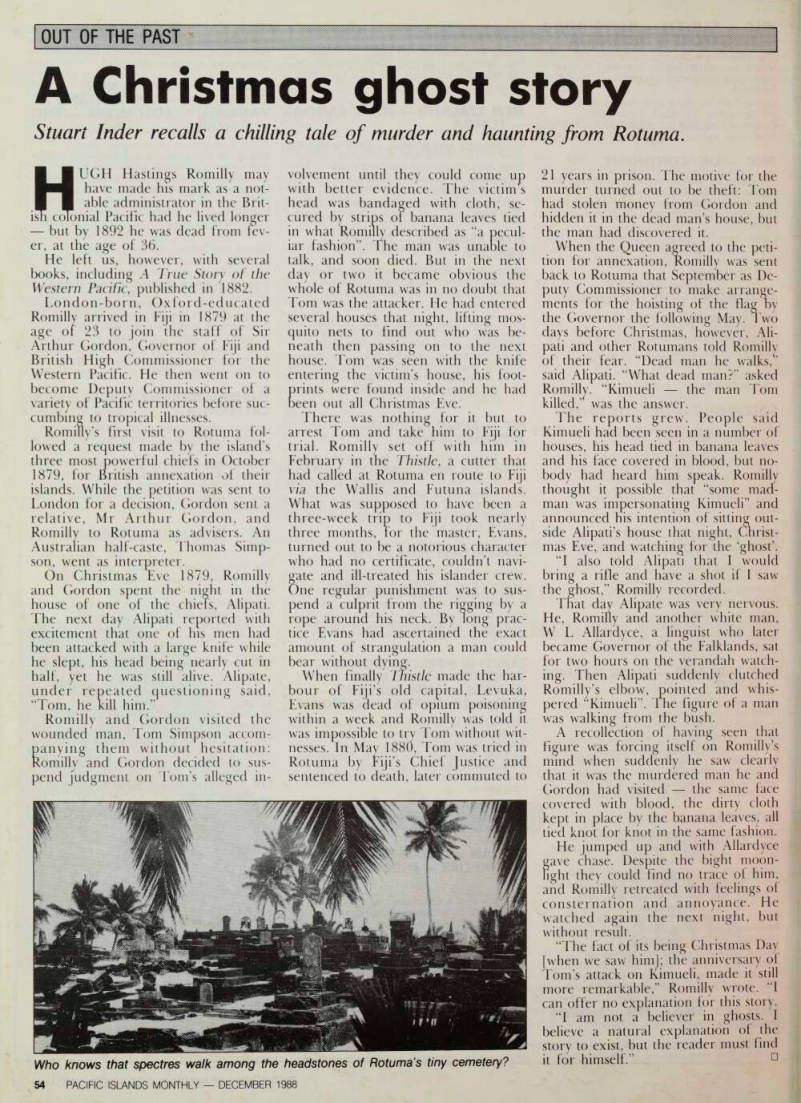
Who knows that spectres walk among the headstones of Rotuma’s tiny cemetery?