Book Reviews
pp. 48-49 · Read in the full issue
LAST FRONTIERS: The explorations of Ivan Champion of Papua By James Sinclair. Pacific Press. RRPSBS (SUS 69) Reviewed by Dr lan Downs
OF THE many books about ex ploration in Papua, Ivan Champion’s own book Across New Guinea from the Fly to the Sepik is in a class above the rest. Yet, by reconstructing that epic journey with a fresh eye and writing what amounts to a biography of Ivan Champion from his birth in Port Moresby in 1904 until the conclusion of World War 11, James Sinclair has produced a new classic in the historv of Papua.
Ivan Champion always wanted to be a naval officer. From a very early age he pursued his ambition, only to be denied the opportunity because he could not pass the strict Navy medical examination because he has always had to wear spectacles.
Ivan’s Champion’s love for the sea, shipping and naval affairs was not centred on uniforms or glory. His consuming interest was navigation. He belonged to the era before radar, pocket calculators, computers and satellites, and we learn that in his last year at the Southport School in Queensland, an extraordinary head master, James Dixon, was teaching an extraordinary pupil how to use a
plane-table for mapping by triangula
tion. Ivan was already familiar with the use of a prismatic compass and correcting for magnetic variation.
With the help of ships’ masters visit ing Port Moresby, Ivan learned how to use a sextant and how to use the observed positions of stars to calculate fixed positions at sea. He was soon to adapt his knowledge to the use of a theodolite on land or the use of sex tant with a built-in artificial horizon.
Charles Karius was chosen by Lieutenant-Governor Sir Hubert Mur ray to lead what was to be called the ‘North-East Patrol’, an expedition to cross the island of New Guinea from south to north . . . and Karius chose Ivan Champion to accompany him.
There are two kinds of explorers: those who know where they are in terms of latitude and longitude, and those who do not. Many of the latter have not survived their experience.
Some who survived have dealt in fan tasy to describe where they have been.
Ivan Champion always knew where he was when on patrol. Even on routine journeys he kept a perfect re cord and within the past few years the latest aerial photography has con
firmed the accuracy of some of his
important observations.
Ironically, the Navy accepted Ivan without testing his eyesight soon after the Japanese invasion of New Guinea in 1942. He served with great distinc tion rescuing Australian soldiers,
transporting coastwatchers, piloting
American ships and carrying out front-line hydrographic surveys.
Sinclair’s book is not just about ex ploration and patrolling. His vignettes of social life in parochial Port Mores by, where a dozen connected families did their best to uphold what amounted to British colonial traditions under the watchful eye of the aloof but parental Lieutenant-Governor liv ing on the hill above the town, are fascinating. The quotes from Sinclair’s interviews with Ivan Champion bring the era to life.
Under parsimonious Australian gov ernments, this outpost of Australian sovereignty barely managed to exist.
Unlike the then politically separate Mandated Territory of New yuinea,
Papua lacked comparable fertile agri
cultural land, did not at that time share in large-scale mineral discoveries and there was little scope for Papuans to achieve economic development.
The policy of Sir Hubert Murray to protect the culture and traditions of
the people against exploitation by
foreigners was made possible only be cause Papua seemed in those days to have so little to offer. His ‘outside men’ administered law and justice in a manner reminiscent of the Royal Canadian Mounted Police (though the country was almost everywhere unsuit able for horses, and even if it had been, the government could not have afforced the cost of saddlery!). Field officers in Papua faced extraordinary hardships in pursuit of criminals, par
ticularly murderers.
Time and again the routine of administration was interrupted when a murder or tribal fight in some remote area was reported.
Unencumbered by the constraints of preparing reports for the League of Nations or a significant local bureaucracy, the ‘outside men’, accom panied by a handful of Papuan Police, would do everything to get their man, even if this meant wading for days through swamps or risking personal
injury by intervening in tribal fighting
while the combatants were in action.
This is a book of great merit and historical importance. It is a magnifi cent production, with maps and photographs that are a credit to the author, to the publishers and to the printers (Boolarong of Brisbane). Each copy of this special commemorative edition of 1000 copies has been signed by the author and by Ivan Champion.
Pacific Books House is offering Last Frontiers to PIM readers at the pre publication price of SAS9 (SUSSO) plus postage (Australia SAS per copy, Asia/Oceania SAB, elsewhere $A10), for orders received with a copy of this review by January 14, 1989.
HIENGHENE, Le Desespoir Caledonien, by Lionel Duroy.
Barrault, 98FF; Le Dossier lien, by Jean-Paul Besset.
Cahiere Libres/Editions La Decouverte FFBS: Mourir a Ouvea, by Edwy Plenel and Alain Rollat.
Editions La Decouverte/La Mande, 89FF: Les Senders de L’Espoire by Claude Gabriel and Vincent Kernel.
Editions de la Breche. 70FF: Les Mysteres d’Ouvea, by Patrick Forestier. Editions filipacci, 95 FF.
NEW CALEDONIA’S political
paroxysms have spawned a publishing boom, timed neat ly to coincide with the aftermath of November’s crucial French referen dum on the development of the terri tory. With the dispassionate commit
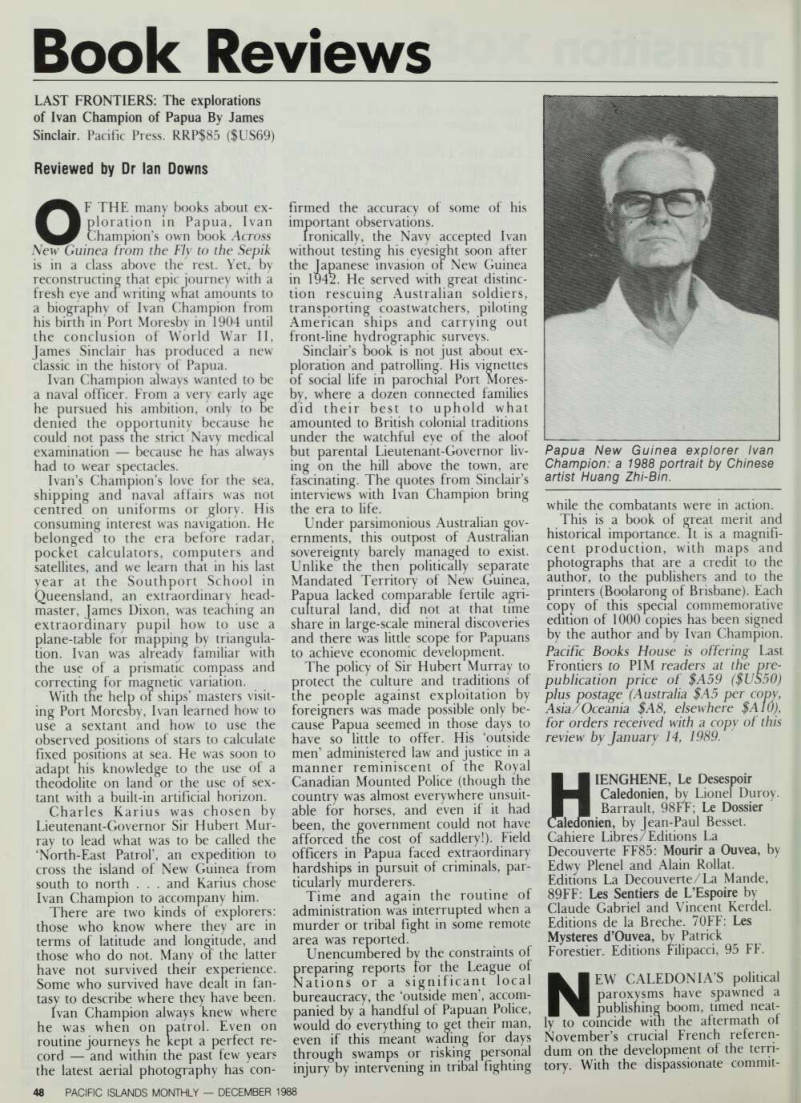
Papua New Guinea explorer Ivan Champion: a 1988 portrait by Chinese artist Huang Zhi-Bin.
ment of medical researchers tracing the origins of some virulent tropical disease. French journalists have fo cused on New Caledonia’s agonies over the past decade, subjecting this sliver of Pacific territory to an intense political and social analysis.
Lionel Duroy went to Kanak inde pendence leader Jean-Marie Tjibaou’s rock-girt redoubt of Hienghene, sup ported by the flower of French news
magazines, LEvenement du Joudi :
casting a cold eye on a hundred years of history, he produces a vivid, emblematic tale that reaches a climax with the ‘Hienghene massacre’ of 5 December 198 A, an attack in which two of Tjibaou’s brothers died.
The massacre has been seen in scores of reports as the nadir of New Caledonian violence, and in Lionel Durov’s account the tensions between the different communities of Grande Terre that formed the prologue to the killings, and set in motion an inexor able tragic progress, are well traced.
Le Dossier Caledonien, a thorough background briefing on France’s role in the Pacific territory, is explicitly de signed as a handbook to the political fallout from the November referen dum. The author, a journalist on the Paris radical journal Polids, is well qualified for his task; he was previous ly one of the key figures benind the Journal de Nouvelle-Caledonie, an im
pressive but short-lived independent
Noumea newspaper known by its en thusiasts simply as the Journal Bleu’.
Jean-Paul Besset adopts an austere style, similar to that relayed by Jean- Marie Kohler in his recent overview of New Caledonian history.
He seeks to answer various ques tions a reasonable Martian might pose, on being acquainted with the realities of New Caledonia today: Is continued French status the only way to resolve
the problems peacefully? Is independ
ence a realistic option? What do the
independentists want?
The actual result of the November referendum would clearly have star tled Besset, who places Tjibaou and the leader of the European commun ity on the territory, Jacques Lafleur, on his front cover, their hands amic
ably clasped. On voting day Tjibaou
delivered his tribe in the name of the Matignon Accord brokered by Prime Minister Rocard: Lafleur did not.
In the wake of the result, New Cale donia’s political future seems as prob lematic as ever. Right-wing political
formations are reportedly gaining
force in Noumea; the glow of concord that suffused the territory as Besset was writing his book may yet evapo rate, giving its helpful presentation of New Caledonian history and econo mics a poignant, ironic tone. Besset considers the lessons of the past cen tury plain: one people has done vio
lence to another, and the time has come for France to make reparations by preparing the way for independ ence. He even contends that only this future will allow France to maintain its high Pacific presence, for it would be clear “this presence was oriented to ward peace and development”.
Edwy Plenel and Alain Rollat have previously collaborated on a politial biography of France’s ultra-right lead er, Jean-Marie Le Pen of the National Front. Le Pen’s political formation seems destined to play a significant role in New Caledonia's future, since its opposition to the legislation de veloped after the Matignon Accord was shared by a majority of the Euro pean community of the territory.
In Mourir a Ouvea, Plenel and Rol lat provide far more than a “quickie” account of the extraordinary events on the northernmost of the Loyalty Is lands this April. They offer a detailed reconstruction of the political response to the crisis posed, on the eve of the presidential elections, by the Kanak se izure of police hostages. By this chro nology they aim to indict the Govern ment of Gaullist Prime Minister Jac ques Chirac and his Overseas Terri tories Minister, Bernard Pons.
The Ouvea crisis is presented as the turning-point that made possible the Matignon Accord and the authors highlight the parallels beween the con duct of the French State during this nightmare and during the 1985 Ram bow Warrior affair, when there was a similar reluctance to investigate the behaviour of the military.
In the pages of Le Monde earlier this year, the authors broke the story that members of the Kanak comman do of Ouvea died ater being taken alive by the military. Here they offer
further testimony, suggesting these
men were summarily executed. For French readers with long memories there are disturbing echoes of the worst excesses of the war in Algeria.
The key documents surroundings
the Ouvea operation are printed as an appendix: the handwritten on the grotto of Gossanah, where the hos tages were held; the “Legonus report” by the head of the French elite bri
gade involved; the military inquiry
into the deaths of the Kanaks in capti vity; and, as a coda, the full text of the Matignon Accord reached under the guidance of Michel Rocard the re solution of the tragedy of Ouvea.
Les Senders de L’Espoir is a newly
published potted history by Claude
Gabriel ana Vincent Kermel, journal ists on the Trotskyist paper Rouge. At the other end of the spectrum is Pat rick Forestier’s Les Mysteres d’Ouvea this Paris-Match journalist enthuses over the conduct of the police, those
“soldiers-of-the-law”, during April’s
tormented days on Ouvea. □