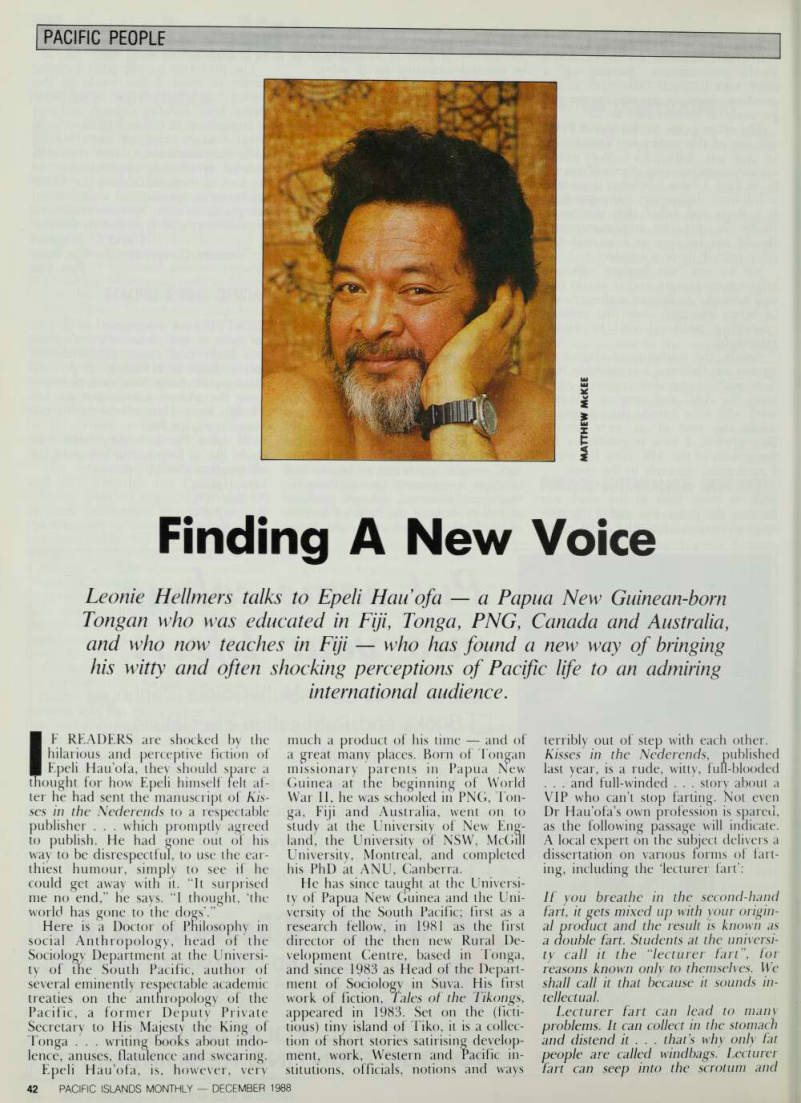
Matthew Mckee
pp. 42-44 · Read in the full issue
Pacific People
Finding A New Voice
Leonie Hdimers talks to Epeli Hau’ofa a Papua New Guinean-born Tongan who was educated in Fiji ,Tonga, PNG, Canada and Australia, and who now teaches in Fiji who has found a new way of bringing his witty and often shocking perceptions of Pacific life to an admiring international audience.
IF READERS are shocked by the hilarious and perceptive fiction of Epeli Hau’ofa, they should spare a ought for how Epeli himself felt af ter he had sent the manuscript of Kis ses in the Nederends to a respectable publisher . . . which promptly agreed to publish. He had gone out of his way to be disrespectful, to use the ear thiest humour, simply to see if he could get away with it. “It surprised me no end,” he says. “I thought, ‘the world has gone to the dogs’.”
Here is a Doctor of Philosophy in social Anthropology, head of the Sociology Department at the Universi ty of the South Pacific, author of
several eminently respectable academic
treaties on the anthropology of the Pacific, a former Deputy Private Secretary to His Majesty the King of Tonga . . . writing doors about indo lence, anuses, flatulence and swearing.
Epeli Hau’ofa, is, however, very
much a product of his time and of a great many places. Born of Tongan
missionary parents in Papua New
Guinea at the beginning of World War 11, he was schooled in PNG, Ton ga, Fiji and Australia, went on to study at the University of New Eng land, the University of NSW, McGul
University, Montreal, and completed
his PhD at ANU, Canberra.
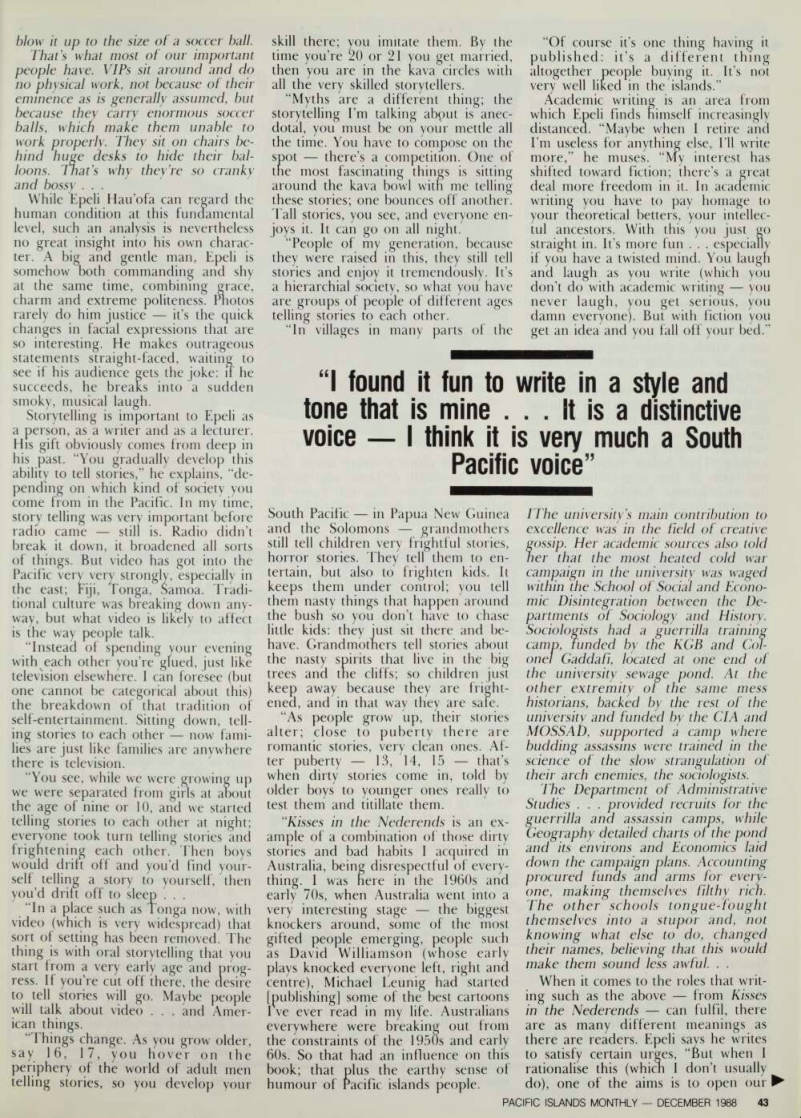
He has since taught at the Universi ty of Papua New Guinea and the Uni versity of the South Pacific; first as a research fellow, in 1981 as the first director of the then new Rural De velopment Centre, based in Tonga, and since 1983 as Head of the Depart ment of Sociology in Suva. His first work of fiction, Tales of the Tikongs, appeared in 1983. Set on the (ficti tious) tiny island of Tiko, it is a collec tion of snort stories satirising develop ment, work, Western and Pacific in stitutions, officials, notions and ways
terribly out of step with each other.
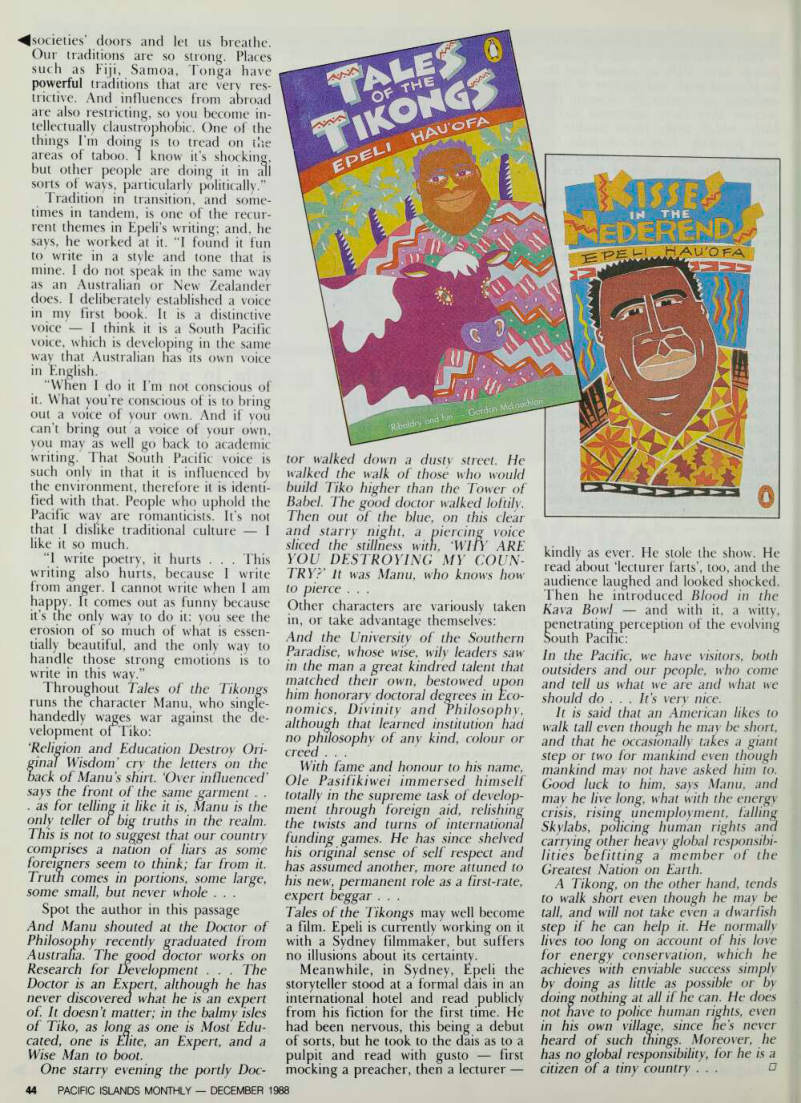
Kisses in the Nederends, published last year, is a rude, witty, full-blooded . . . and full-winded . . . story about a VIP who can’t stop farting. Not even Dr Hau’ofa’s own profession is spared, as the following passage will indicate.
A local expert on the subject delivers a dissertation on various forms of fart ing, including the ‘lecturer fart’: If you breathe in the second-hand fart, it gets mixed up with your origin al proouct and the result is known as a double fart. Students at the universi ty call it the “lecturer fart'\ for reasons known only to themselves. We shall call it that because it sounds in tellectual.
Lecturer fart can lead to many problems. It can collect in the stomach and distend it .. . thafs why only fat people are called windbags. Lecturer fart can seep into the scrotum and
Matthew Mckee
blow it up to the size of a soccer ball.
That’s what most of our important people have. VIPs sit around and do no physical work, not because of their eminence as is generally assumed, but because they carry enormous soccer balls, which make them unable to work properly. They sit on chairs be hind huge desks to hide their bal
loons. Tnafs why they’re so cranky
and bossy . . .
While Epeli Hau’ofa can regard the human condition at this fundamental level, such an analysis is nevertheless no great insight into his own charac ter. A big and gentle man, Epeli is somehow both commanding and shy at the same time, combining grace, charm and extreme politeness. ITiotos rarely do him justice it’s the quick changes in facial expressions that are so interesting. He makes outrageous
statements straight-faced, waiting to
see if his audience gets the joke: If he succeeds, he breaks into a sudden
smoky, musical laugh.
Storytelling is important to Epeli as
a person, as a writer and as a lecturer.
His gift obviously comes from deep in his past. “You gradually develop this ability to tell stories,” he explains, “de pending on which kind of society you come from in the Pacific. In my time, story telling was very important before radio came still is. Radio didn’t break it down, it broadened all sorts of things. But video has got into the Pacific very very strongly, especially in the east; Fiji, Tonga, Samoa. Tradi tional culture was breaking down any way, but what video is likely to affect is the way people talk.
“Instead of spending your evening with each other you’re glued, just like television elsewhere. I can foresee (but one cannot be categorical about this) the breakdown of that tradition of self-entertainment. Sitting down, tell ing stories to each other now fami lies are just like families are anywhere there is television.
“You see, while we were growing up we were separated from girls at about the age of nine or 10, and we started telling stories to each other at night; everyone took turn telling stories and frightening each other. Then boys would drift off and you’d find your self telling a story to yourself, then you’d drift off to sleep . . .
“In a place such as Tonga now, with video (which is very widespread) that sort of setting has been removed. The thing is with oral storytelling that you start from a very early age and prog ress. If you’re cut off there, the desire to tell stories will go. Maybe people will talk about video . . . and Amer
ican things.
“Things change. As you grow older, say 16, 17, you hover on the periphery of the world of adult men telling stories, so you develop your
skill there; you imitate them. By the time you’re 20 or 21 you get married, then you are in the kava circles with all the very skilled storytellers.
“Myths are a different thing; the storytelling I’m talking about is anec dotal, you must be on your mettle all the time. You have to compose on the spot there’s a competition. One of
the most fascinating things is sitting
around the kava bowl with me telling these stories; one bounces off another.
Tall stories, you see, and everyone en joys it. It can go on all night.
“People of my generation, because they were raised in this, they still tell stories and enjoy it tremendously. It’s a hierarchial society, so what you have are groups of people of different ages telling stories to each other.
“In villages in many parts of the
“I found it fun to write in a style and tone that is mine ... It is a distinctive voice I think it is very much a South Pacific voice”
South Pacific in Papua New Guinea and the Solomons grandmothers still tell children very frightful stories, horror stories. They tell them to en tertain, but also to frighten kids. It keeps them under control; you tell them nasty things that happen around the bush so you don’t have to chase little kids: they just sit there and be have. Grandmothers tell stories about the nasty spirits that live in the big trees and the cliffs; so children just
keep away because they are fright
ened, and in that way they are safe.
“As people grow up, their stories alter; close to puberty there are romantic stories, very clean ones. Af ter puberty 13, 14, 15 that’s when dirty stories come in, told by older boys to younger ones really to test them and titillate them.
“Kisses in the Nederends is an ex ample of a combination of those dirty stories and bad habits I acquired in Australia, being disrespectful of every thing. I was here in the 1960 s and early 70s, when Australia went into a very interesting stage the biggest knockers around, some of the most
gifted people emerging, people such
as David Williamson (whose early plays knocked everyone left, right and centre), Michael Leunig had started [publishing] some of the best cartoons Eve ever read in my life. Australians everywhere were breaking out from the constraints of the 1950 s and early 60s. So that had an influence on this book; that plus the earthy sense of humour of Pacific islands people.
“Of course it’s one thing having it published: it’s a different thing
altogether people buying it. It’s not
very well liked in the islands.”
Academic writing is an area from which Epeli finds himself increasingly distanced. “Maybe when I retire and I’m useless for anything else, I’ll write more,” he muses. “My interest has shifted toward fiction; there’s a great deal more freedom in it. In academic writing you have to pay homage to your theoretical betters, your intellec tul ancestors. With this you just go straight in. It’s more fun . . . especially if you have a twisted mind. You laugh and laugh as you write (which you don’t do with academic writing you never laugh, you get serious, you damn everyone). But with fiction you get an idea and you fall off your bed.”
IThe university’s main contribution to excellence was in the Held of creative gossip. Her academic sources also told her that the most heated cold war
campaign in the university was waged
within the School of Social and Econo mic Disintegration between the De partments of Sociology and History.
Sociologists had a guerrilla training
camp, funded by the KGB and Col onel Gaddafi, located at one end of the university sewage pond. At the other extremity of the same mess historians, backed by the rest of the university and funded by the CIA and MOSSAD, supported a camp where budding assassins were trained in the science of the slow strangulation of their arch enemies, the sociologists.
The Department of Administrative Studies . . . provided recruits for the guerrilla and assassin camps, while Geography detailed charts of the pond and its environs and Economics laid
down the campaign plans. Accounting
procured funds ana arms for every one, making themselves filthy rich.
The other schools tongue-fought themselves into a stupor and, not knowing what else to do, changed their names, believing that this would make them sound less awful. . .
When it comes to the roles that writ ing such as the above from Kisses in the Nederends can fulfil, there are as many different meanings as there are readers. Epeli says he writes to satisfy certain urges, “But when I rationalise this (which I don’t usually do), one of the aims is to open our ►
doors and let us breathe.
Our traditions are so strong. Places such as Fiji, Samoa, Tonga have powerful traditions that are very res trictive. And influences from abroad are also restricting, so you become in tellectually claustrophobic. One of the things I’m doing is to tread on the areas of taboo. I know it’s shocking, but other people are doing it in all sorts of ways, particularly politically.”
Tradition in transition, and some times in tandem, is one of the recur rent themes in Epeli’s writing; and, he says, he worked at it. “I found it fun to write in a style and tone that is mine. I do not speak in the same way as an Australian or New Zealander does. I deliberately established a voice in my first book. It is a distinctive voice 1 think it is a South Pacific voice, which is developing in the same way that Australian has its own voice
in English.
“When I do it I’m not conscious of it. What you’re conscious of is to bring out a voice of your own. And if you can’t bring out a voice of your own, you may as well go back to academic writing. That South Pacific voice is such only in that it is influenced by the environment, therefore it is identi fied with that. People who uphold the Pacific way are romanticists. It’s not that I dislike traditional culture I like it so much.
“I write poetry, it hurts . . . This writing also hurts, because I write from anger. I cannot write when I am happy. It comes out as funny because it’s the only way to do it: you see the erosion of so much of what is essen tially beautiful, and the only way to handle those strong emotions is to write in this way.”
Throughout Tales of the Tikongs runs the character Manu, who single handedly wages war against the de velopment of Tiko: ‘Religion and Education Destroy Ori ginal Wisdom ’ cry the letters on the oack of Manu’s shirt. ‘Over influenced’ says the front of the same garment . . . as for telling it like it is, Manu is the only teller of big truths in the realm.
This is not to suggest that our country comprises a nation of liars as some foreigners seem to think; far from it.
Truth comes in portions, some large, some small, but never whole ...
Spot the author in this passage And Manu shouted at the Doctor of
Philosophy recently graduated from
Australia. The good doctor works on Research for Development . . . The Doctor is an Expert, although he has never discovered what he is an expert of It doesn’t matter; in the balmy isles of Tiko, as long as one is Most Edu cated, one is Elite, an Expert, and a Wise Man to boot.
One starry evening the portly Doc-
tor walked down a dusty street. He walked the walk of those who would build Tiko higher than the Tower of Babel. The good doctor walked loftily.
Then out of the blue, on this clear and starry night, a piercing voice sliced the stillness with, ‘WIiY ARE
You Destroying My Coun
TRY?’ It was Manu, who knows how
to pierce . . .
Other characters are variously taken in, or take advantage themselves: And the University of the Southern Paradise, whose wise, wily leaders saw in the man a great kindred talent that matched their own, bestowed upon him honorary doctoral degrees in Eco nomics, Divinity and Philosophy, although that learned institution had no philosophy of any kind, colour or creed . . .
With fame and honour to his name, Ole Pasifikiwei immersed himself totally in the supreme task of develop
ment through foreign aid, relishing
the twists and turns of international funding games. He has since shelved his original sense of self respect and has assumed another, more attuned to his new, permanent role as a first-rate,
expert beggar . . .
Tales of the Tikongs may well become a film. Epeli is currently working on it with a Sydney filmmaker, but suffers no illusions about its certainty.
Meanwhile, in Sydney, Epeli the storyteller stood at a formal dais in an international hotel and read publicly from his fiction for the first time. He had been nervous, this being a debut of sorts, but he took to the dais as to a pulpit and read with gusto first mocking a preacher, then a lecturer
kindly as ever. He stole the show. He read about ‘lecturer farts’, too, and the audience laughed and looked shocked.
Then he introduced Blood in the Kava Bowl and with it, a witty,
penetrating perception of the evolving
South Pacific: In the Pacific, we have visitors, both outsiders and our people, who come and tell us what we are and what we should do . . . It’s very nice.
It is said that an American likes to walk tall even though he may he short, and that he occasionally tares a giant step or two for mankind even though mankind may not have asked him to.
Good luck to him, says Manu, and may he live long, what with the energy
crisis, rising unemployment, falling
Sky labs, policing human rights and
carrying other heavy global responsibi
lities Defitting a member of the Greatest Nation on Earth.
A Tikong, on the other hand, tends to walk short even though he may be tall, and will not take even a dwarfish step if he can help it. He normally lives too long on account of his love for energy conservation, which he achieves with enviable success simply by doing as little as possible or by aoing nothing at all if he can. He does not nave to police human rights, even in his own village, since he’s never heard of such things. Moreover, he has no global responsibility, for he is a citizen of a tiny country ... o