Small-scale industry
pp. 38-39 · Read in the full issue
Trade Winds
Small-scale industry boost for Kiribati
By Rosalind Temariti
MO RE JOBS for the people of Kiribati will result from the establishment of four small scale industries, recently announced oL the Re P ubl . c s Government. About 200 people will be employed in the garment industry under a scheme to be owned and operated by the Government. In another development, syrup derived from over-boiled toddy will be marketed as anew export product; as well as its export value to Kiribati, the syrup is also in great demand in Tarawa.
Financial benefit will flow especially to the people of Kiribati’s outer islands, as they will produce toddy syrup and sell it to a central factory that will boil and reboil the syrup until it reaches a prescribed consistency, The syrup can then be stored for up to 10 years. It can be used for cooking and for drinks after being.
An idustrial estate is to oe set up in South Tarawa, to accommodate both small business employers and their employees who do not own land
there: the general idea is to increase efficiency through economies of scale, by gathering the bulk of small businesses in one place. Kiribati’s bis cuit factory has already been in opera tion for several years, producing coco nut biscuits, today biscuits and plain biscuits: 10 people are employed in the factory at present, but when the Government’s plans are implemented more local workers will be needed.
The four projects have been approved by the Kiribati Development Co-ordinating Committee; all will be government-owned and managed, and
are planned to begin production in
1989. The Government is hoping to reduce its dependence on imported goods through these small-scale in dustrial projects, though it recognises that materials and machinery will have to be imported.
Already in progress are enterprises in metal work, production of exercise books, snack foods, ice-cream, a black and-white photo studio, soap, oil and
confectionery making. □
□ Loan For Western Samoa
THE ASIAN Development Bank has allocated about SUS 6 million as an in terest-free loan to Western Samoa for the second Multiproject.
Repayable over 40 years with a 10year grace period, the loan will assist
three sub-projects involving coconut
oil refining, wood processing and
forestry development.
Additional refining facilities to the existing mall near Apia, also provided from an ADB loan, will enable all crude natural coconut oil to be mar keted as refined bleached oil, enhanc ing export income.
Natural forest timber is primarily used for home consumption. The wood processing sub-project will im prove efficiency in timber production, and the forestry development sub project supports present efforts to maintain a renewable resource of tim ber from plantation forests.
Three technical assistance grants, co-funded by the United Nations, will back up the loan by providing consul tant services to estaohsh a comprehen sive database for land resource plan ning, assist the Treasury Department in project implementation and two of the implementing agencies in financial management. It will also assist the Government in determining a formula
for fixing copra prices.
□ How Do You Do It?
OWNERS or managers of small to medium businesses in the Pacific are being offered a free service to help them with technological information.
The International Labour Organisa tion has established a databank that is intended to disseminate information on technological innovations for de veloping nations and to promote tech
nological data exchange between
countries.
The databank, codenamed IN STEAD, can provide information on a wide range of subjects, including food processing (for example oil extraction, vegetable and fruit processing, fish smoking and so on), energy i[biogas digester, waste recycling and so on), agricultural tools ana implements (animal-drawn equipment, manual tools, water pumps), building materials (stabilised earthworks, roofing tiles, sanitation), or handicrafts (weaving,
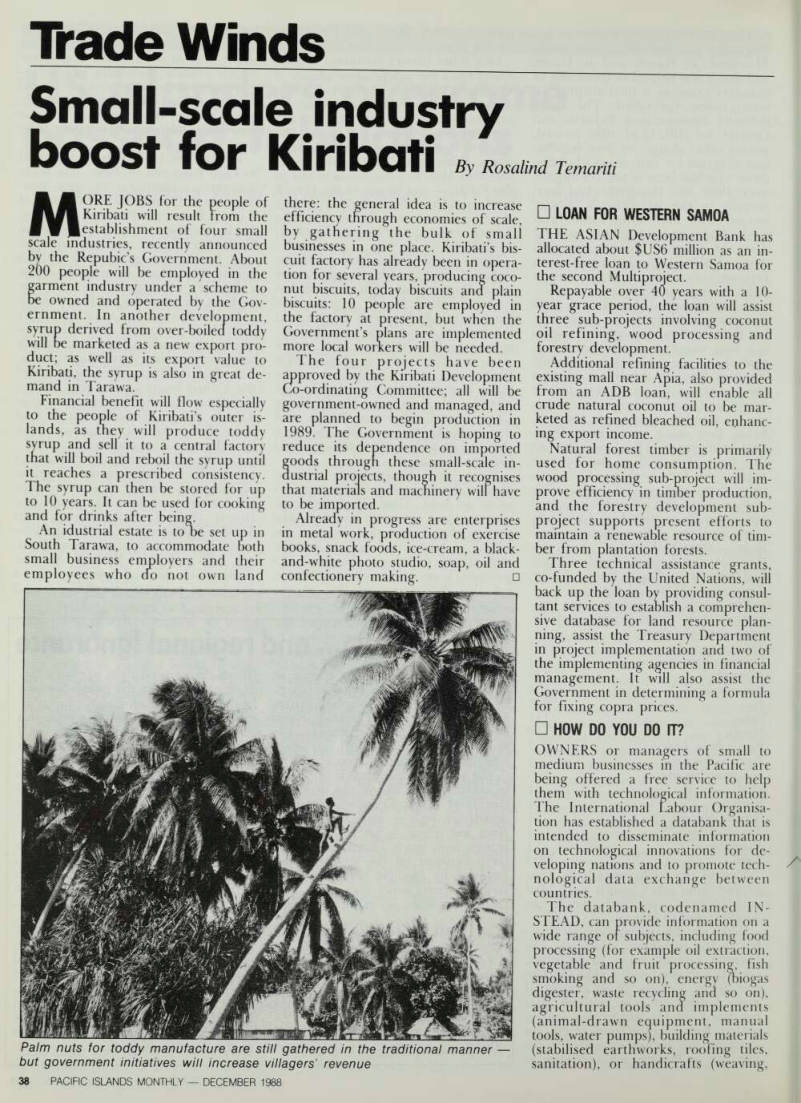
Palm nuts for toddy manufacture are still gathered in the traditional manner but government initiatives will increase villagers’ revenue
pottery, footwearand leather tanning).
These are only examples of the vari ety of technological fields covered by the service. Requests for information can be addresesd to: The ILO Office for the South Pacific, PO Box 14500, Suva, Fiji (Fax 30 0248). INSTEAD promises that every effort wil be made to prepare an information package as complete as possible for each request.
This information package will be pro vided free of charge.
□ Power Loan For Kiribati
TFIE ASIAN Development Bank has lent the Government of Kiribati the equivalent of |US9OO,OOO on its stan dard concessional terms (repayment over 40 years, 10 years’ grace period) to extend the power distribution net work in Tarawa. The project will bring electricity to about 1000 more homes and help the Government program of developing residential areas of North Tarawa.
The Government has embarked on a project to link the islands of North Tarawa with causeways and provide them with basic infrastructure.
□ Japan Helps Apia Port Growth
THE JAPANESE Government has announced a grant of 69 million yen
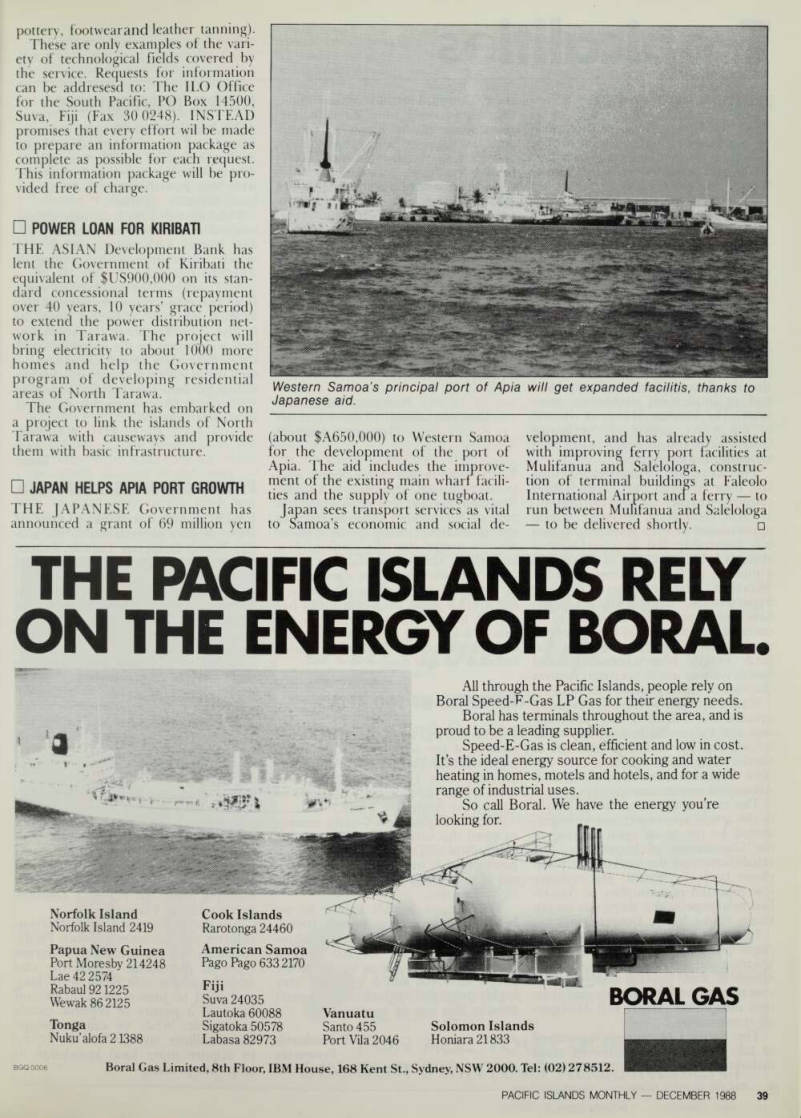
(about $A650,000) to Western Samoa for the development of the port of Apia. The aid includes the improve ment of the existing main wharf facili ties and the supply of one tugboat.
Japan sees transport services as vital to Samoa’s economic and social de
velopment, and has already assisted with improving ferry port facilities at Mulifanua and Salelologa, construc tion of terminal buildings at Faleolo International Airport ana a ferry to run between Mulifanua and Salelologa to be delivered shortly. □
Western Samoa’s principal port of Apia will get expanded fad litis, thanks to Japanese aid.