'Blood Feud'
pp. 22-23 · Read in the full issue
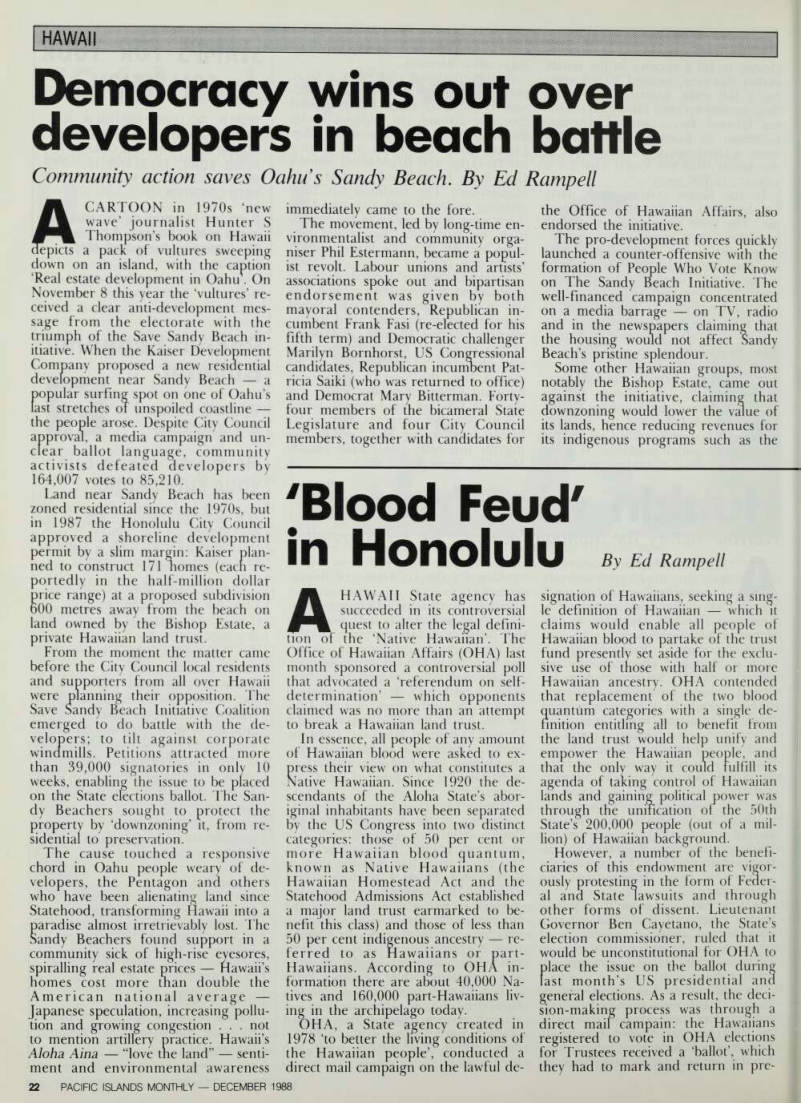
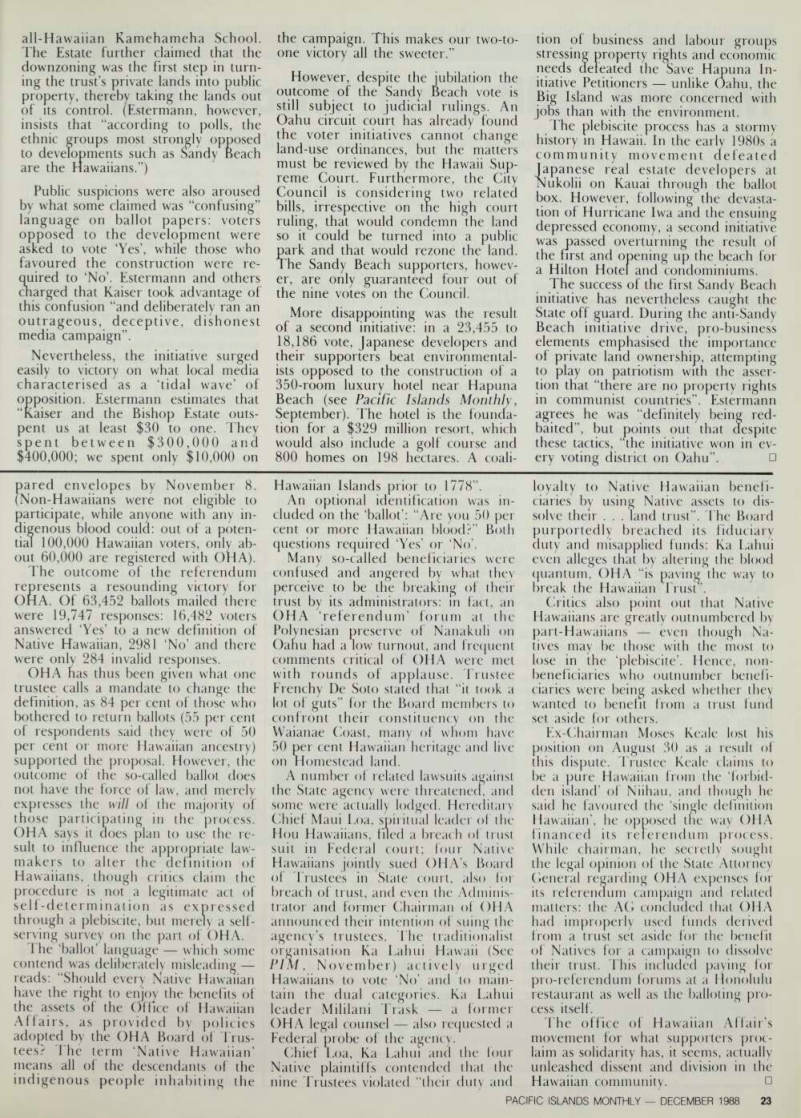
in Honolulu
By Ed Rampell
A HAWAII State agency has succeeded in its controversial quest to alter the legal defini tion of the ‘Native Hawaiian’. The Office of Hawaiian Affairs (OHA) last month sponsored a controversial poll that advocated a ‘referendum on self determination’ which opponents claimed was no more than an attempt to break a Hawaiian land trust.
In essence, all people of any amount of Hawaiian blood were asked to ex press their view on what constitutes a Native Hawaiian. Since 1920 the de scendants of the Aloha State’s abor iginal inhabitants have been separated by the US Congress into two distinct categories: those of 50 per cent or more Hawaiian blood quantum, known as Native Hawaiians (the Hawaiian Homestead Act and the Statehood Admissions Act established a major land trust earmarked to be nefit this class) and those of less than 50 per cent indigenous ancestry re ferred to as Hawaiians or part- Hawaiians. According to OHA in formation there are about 40,000 Na tives and 160,000 part-Hawaiians liv
ing in the archipelago today.
OHA, a State agency created in 1978 ‘to better the living conditions of the Hawaiian people’, conducted a direct mail campaign on the lawful de
signation of Hawaiians, seeking a sing le definition of Hawaiian which it claims would enable all people of Hawaiian blood to partake of the trust fund presently set aside for the exclu sive use of tnose with half or more Hawaiian ancestry. OHA contended that replacement of the two blood quantum categories with a single de finition entitling all to benefit from the land trust would help unify and empower the Hawaiian people, and that the only way it could fulfill its agenda of taking control of Hawaiian lands and gaining political power was through the unification of the 50th State’s 200,000 people (out of a mil lion) of Hawaiian background.
However, a number of the benefi ciaries of this endowment are vigor ously protesting in the form of Feder al and State lawsuits and through other forms of dissent. Lieutenant Governor Ben Cayetano, the State’s election commissioner, ruled that it would be unconstitutional for OHA to place the issue on the ballot during last month’s US presidential and general elections. As a result, the deci sion-making process was through a direct mail campain: the Hawaiians registered to vote in OHA elections for Trustees received a ‘ballot’, which they had to mark and return in pre
pared envelopes by November 8.
(Non-Hawaiians were not eligible to participate, while anyone with any in digenous blood could: out of a poten tial 100,000 Hawaiian voters, only ab out 60,000 are registered with OHA).
The outcome of the referendum represents a resounding victory for OHA. Of 63,452 ballots mailed there were 19,747 responses: 16,482 voters answered ‘Yes’ to a new definition of Native Hawaiian, 2981 ‘No’ and there were only 284 invalid responses.
OHA has thus been given what one trustee calls a mandate to change the definition, as 84 per cent of those w ho bothered to return ballots (55 per cent of respondents said they were of 50 per cent or more Hawaiian ancestry) supported the proposal. However, the outcome of the so-called ballot does not have the force of law', and merely expresses the will of the majority of those participating in the process.
OHA says it does plan to use the re sult to influence the appropriate law makers to alter the definition of Hawaiians, though critics claim the procedure is not a legitimate act of self-determination as expressed through a plebiscite, but merely a self serving survey on the part of OHA.
The ‘ballot’ language which some
contend was deliberately misleading
reads; “Should every Native Hawaiian have the right to enjoy the benefits of the assets of the Office of Hawaiian
Affairs, as provided by policies
adopted by the OHA Board of Trus tees? The term ‘Native Hawaiian’ means all of the descendants of the
indigenous people inhabiting the
Hawaiian Islands prior to 1778”.
An optional identification was in cluded on the ‘ballot’: “Are you 50 per cent or more Hawaiian blood?” Both questions required ‘Yes’ or ‘No’.
Many so-called beneficiaries were
confused and angered by what they
perceive to be the breaking of their trust by its administrators: m fact, an OHA referendum’ forum at the Polynesian preserve of Nanakuli on Oahu had a low turnout, and frequent comments critical of OHA were met with rounds of applause. Trustee Frenchy De Soto stated that “it took a lot of guts” for the Board members to confront their constituency on the Waianae Coast, many of whom have 50 per cent Hawaiian heritage and live on Homestead land.
A number of related lawsuits against the State agency were threatened, and
some were actually lodged. Hereditary
Chief Maui Loa, spiritual leader of the Hou Hawaiians, filed a breach of trust suit in Federal court; four Native Hawaiians Jointly sued OHA’s Board of Trustees in State court, also for breach of trust, and even the Adminis trator and former Chairman of OHA announced their intention of suing the agency’s trustees. The traditionalist organisation Ka Lahui Hawaii (See
PIM, November) actively urged
Hawaiians to vote ‘No’ and to main tain the dual categories. Ka Lahui leader Mililani Trask a former OHA legal counsel also requested a f ederal probe of the agency.
Chief Loa, Ka Lahui and the four Native plaintiffs contended that the nine Trustees violated “their duty and
loyalty to Native Hawaiian benefi ciaries by using Native assets to dis solve their . . . land trust”. The Board
purportedly breached its fiduciary
duty and misapplied funds: Ka Lahui even alleges that by altering the blood quantum, OHA “is paving the way to break the Hawaiian Trust.
Critics also point out that Native Hawaiians are greatly outnumbered by
part-Hawaiians even though Na
tives may be those with the most to lose in the ‘plebiscite’. Hence, non beneficiaries who outnumber benefi ciaries were being asked whether they wanted to benefit from a trust fund set aside for others.
Ex-Chairman Moses Keale lost his position on August 30 as a result of this dispute. Trustee Keale claims to be a pure Hawaiian from the ‘forbid den island’ of Niihau, and though he said he favoured the ‘single definition Hawaiian’, he opposed the way OHA financed its referendum process.
While chairman, he secretly sought the legal opinion of the State Attorney General regarding OHA expenses for its referendum campaign and related matters: the AG concluded that OHA had improperly used funds derived from a trust set aside for the benefit of Natives for a campaign to dissolve their trust. This included paying for pro-referendum forums at a Honolulu restaurant as well as the balloting pro cess itself.
The office of Hawaiian Affair’s movement for what supporters proc laim as solidarity has, it seems, actually unleashed dissent and division in the Hawaiian community. □