US islands split vote
pp. 20-21 · Read in the full issue
United States
Republicans and Democrats score four wins each in elections in Guam, Hawaii and American Samoa. David S North reports from Washington.
US ISLAND voters like
Americans generally split
their ballots in the November
elections, giving Republicans and
Democrats four major victories each.
The main battle, the race to succeed Fofo Sunia as American Samoa’s dele gate in Congress, was so close that a runoff was required before Eni Hunk in was confirmed (see opposite page).
The big Republican victories were: Peter Tab Coleman’s election to the American Samoa Governorship; Ben Blaz’s re-election as Guam’s delegate in Washington; Patricia Saiki’s re election as member of Congress from the Honolulu district; and Frank Fasi’s re-election as mayor of America’s
largest Pacific city, Honolulu.
Balancing them were four Democra tic wins. Hawaii was one of a handful of states voting for Democratic pres idential candidate Michael Dukakis; in fact, Hawaii gave him a larger share of the vote (5o per cent) than any of the Mainland states, including his home state, Massachusetts.
Hawaii also re-elected Spark Matsu naga to the US Senate and re-elected Congressman Dan Akaka.
Guam gave the Democrats a 13-8
majority in the Territorial Senate.
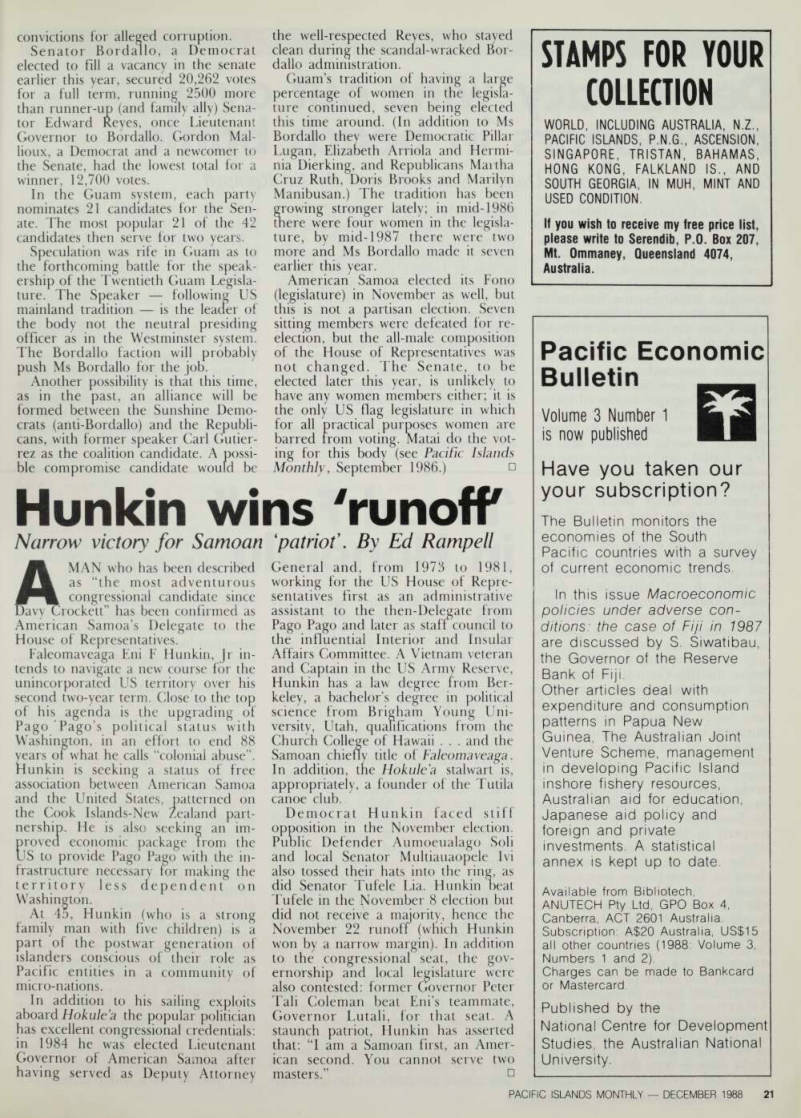
Peter Coleman, American Samoa’s first elected Governor, had served for two terms but was barred from seek ing a third consecutive term four years ago. Governor A P Lutali ran and won in 1984. This year the two governors clashed and Coleman was leading with all ‘on island’ votes counted by a margin of 5261 to 4344; 1800 absentee votes remained un counted, but were highly unlikely to change matters. (That almost 20 per cent of the voters were absentees is remarkable by mainland standards; it reflects the extent of the out migration from the island to Hawaii and the mainland.
Galea’i Poumele was Coleman’s run ning mate and will be the new Lieute nant Governor.
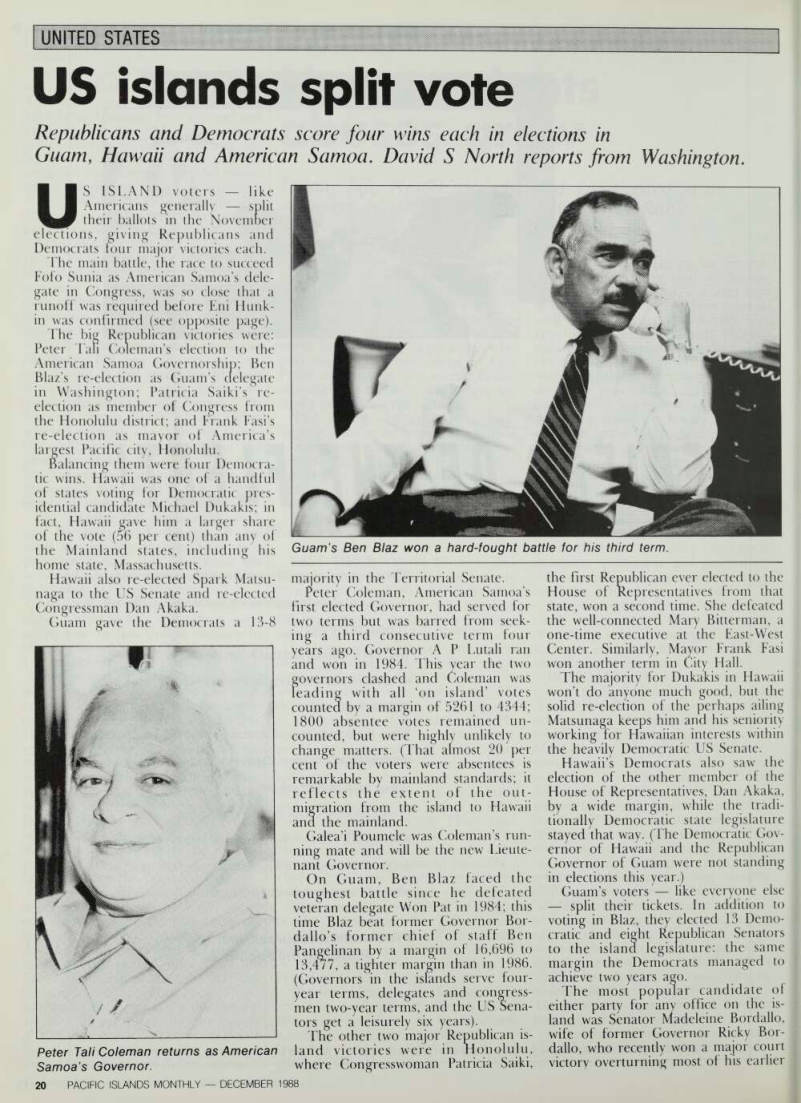
On Guam, Ben Blaz faced the toughest battle since he defeated veteran delegate Won Pat in 1984; this time Blaz beat former Governor Bor dallo’s former chief of staff Ben Pangelinan by a margin of 16,696 to 13,4/7, a tighter margin than in 1986. (Governors in the islands serve four year terms, delegates and congress men two-year terms, and the US Sena tors get a leisurely six years).
The other two major Republican is land victories were in Honolulu, where Congresswoman Patricia Saiki,
the first Republican ever elected to the House of Representatives from that state, won a second time. She defeated the well-connected Mary Bitterman, a one-time executive at the East-West Center. Similarly, Mayor Frank Fasi won another term in City Hall.
The majority for Dukakis in Hawaii won’t do anyone much good, but the solid re-election of the perhaps ailing
Matsunaga keeps him and his seniority
working for Hawaiian interests within the heavily Democratic US Senate.
Hawaii’s Democrats also saw the election of the other member of the House of Representatives, Dan Akaka, by a wide margin, while the tradi
tionally Democratic state legislature
stayed that way. (The Democratic Gov ernor of Hawaii and the Republican Governor of Guam were not standing in elections this year.) Guam’s voters like everyone else split their tickets. In addition to voting in Blaz, they elected 13 Demo cratic and eight Republican Senators to the island legislature: the same margin the Democrats managed to achieve two years ago.
The most popular candidate of either party for any office on the is land was Senator Madeleine Bordallo, wife of former Governor Ricky Bor dallo, who recently won a major court victory overturning most of his earlier
Peter Tali Coleman returns as American Samoa's Governor.
Guam's Ben Blaz won a hard-fought battle for his third term.
convictions for alleged corruption.
Senator Bordallo, a Democrat elected to fill a vacancy in the senate earlier this year, secured 20,262 votes for a full term, running 2500 more than runner-up (and family ally) Senator Edward Reyes, once Lieutenant Governor to Bordallo. Gordon Mailioux, a Democrat and a newcomer to the Senate, had the lowest total for a winner, 12,700 votes.
In the Guam system, each party nominates 21 candidates for the Senate. The most popular 21 of the 42 candidates then serve for two years.
Speculation was rife in Guam as to the forthcoming battle for the speakership of the Twentieth Guam Legislature. The Speaker following US mainland tradition is the leader of the body not the neutral presiding officer as in the Westminster system, The Bordallo faction will probably push Ms Bordallo for the job.
Another possibility is that this time, as in the past, an alliance will be formed between the Sunshine Democrats (anti-Bordallo) and the Republicans, with former speaker Carl Gutierrez as the coalition candidate. A possible compromise candidate would be
the well-respected Reyes, who stayed
clean during the scanaal-wracked Bor dallo administration, Guam’s tradition of having a large percentage of women in the legista ture continued, seven being elected this time around. (In addition to Ms Bordallo they were Democratic Pillar Lugan, Elizabeth Arriola and Hermi nia Dierking, and Republicans Martha Cruz Ruth, Doris Brooks and Marilyn Manibusan.) The tradition has been growing stronger lately; in mid-1986 there were four women in the legisla ture, by mid-1987 there were two more and Ms Bordallo made it seven earlier this year, American Samoa elected its Fono (legislature) in November as well, but this is not a partisan election. Seven sitting members were defeated for re election, but the all-male composition of the House of Representatives was not changed. The Senate, to be elected later this year, is unlikely to have any women members either; it is the only US flag legislature in which for all practical purposes women are barred from voting. Matai do the vot ing for this body (see Pacific Islands
Monthly, September 1986.) □