Rabbie Namaliu
pp. 16-18 · Read in the full issue
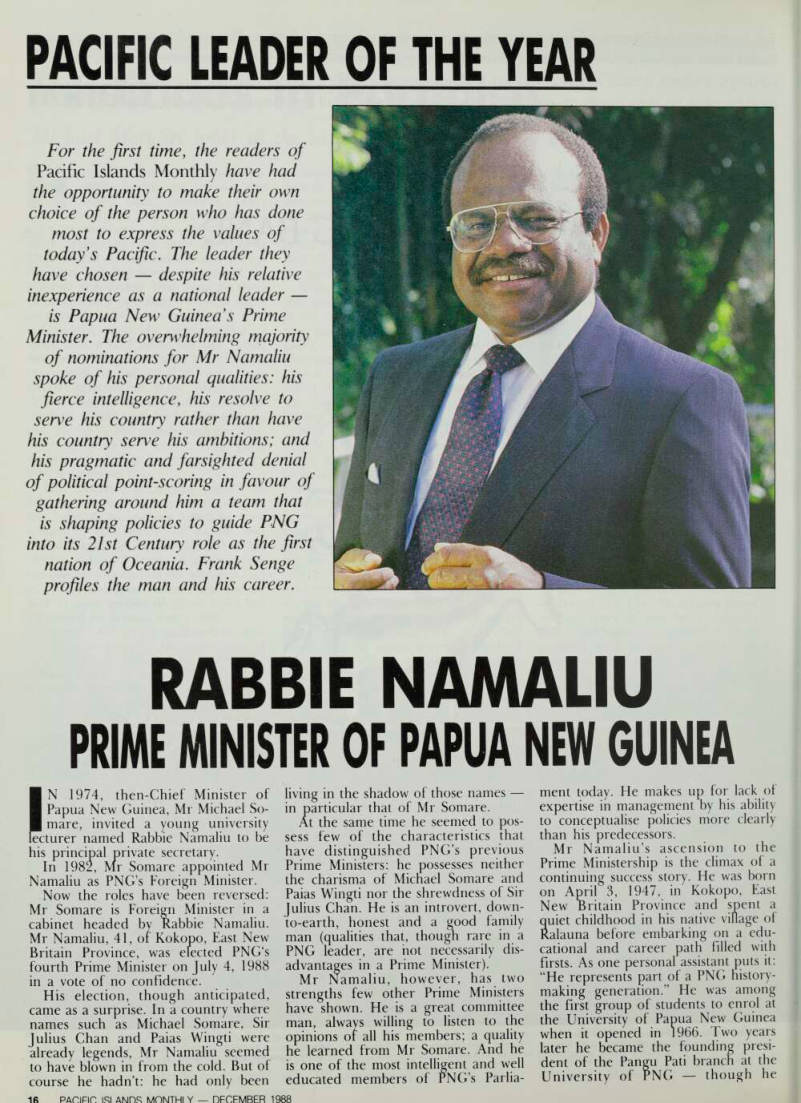
Prime Minister Of Papua New Guinea
I N 1974, then-Chief Minister of 9 Papua New Guinea, Mr Michael So mare, invited a young university lecturer named Rabbie Namaliu to be
his principal private secretary.
In 1982, Mr Somare appointed Mr Namaliu as PNG’s Foreign Minister.
Now the roles have been reversed: Mr Somare is Foreign Minister in a cabinet headed by Rabbie Namaliu.
Mr Namaliu, 41, of Kokopo, East New Britain Province, was elected PNG‘s fourth Prime Minister on July 4, 1988 in a vote of no confidence.
His election, though anticipated,
came as a surprise. In a country where names such as Michael Somare, Sir Julius Chan and Paias Wingti were already legends, Mr Namaliu seemed to have blown in from the cold. But of course he hadn’t: he had only been
living in the shadow of those names in particular that of Mr Somare.
At the same time he seemed to pos sess few of the characteristics that
have distinguished PNG’s previous
Prime Ministers: he possesses neither the charisma of Michael Somare and Paias Wingti nor the shrewdness of Sir Julius Chan. He is an introvert, down to-earth, honest and a good family man (qualities that, though rare in a PNG leader, are hot necessarily dis advantages in a Prime Minister).
Mr Namaliu, however, has two strengths few other Prime Ministers have shown. He is a great committee man, always willing to listen to the opinions of all his members; a quality he learned from Mr Somare. And he is one of the most intelligent and well educated members of PNG’s Parlia
ment today. He makes up for lack of expertise in management oy his ability
to conceptualise policies more clearly
than his predecessors.
Mr Namaliu’s ascension to the Prime Ministership is the climax of a continuing success story. He was born on April 3, 1947, in Kokopo, East New Britain Province and spent a quiet childhood in his native village of Ralauna before embarking on a edu cational and career path filled with firsts. As one personal assistant puts it: “He represents part of a PNG history making generation.” He was among the first group of students to enrol at the University of Papua New Guinea when it opened in 1966. Two years later he became the founding presi dent of the Pangu Pad branch at the University of PNG though he
admits he hadn’t very much choice at that time. “It was the only party going that had clear, definite views on inde pendence,” he recalls. “It was also in students at that time to be involved with a nationalist political movement.”
Stories are still told of how Rabbie Namaliu, Mekere Morauta (now Man aging Director of the PNG Banking Corporation) and Tony Siaguru (for mer MP), walked into the ‘whites-only’ bars at both the Boroko Hotel and the Port Moresby Golf Club and deman ded to be served. Nobody wanted to gainsay three very thirsty rugby union players . . . and a significant racial barrier was broken down.
A less savoury tale told about the three friends is when they took on the UPNG cooks. Arriving late from a rugby union game, they were refused service: Mr Namaliu pushed his friends back and dived at the cooks,
fists swinging.
Later and somewhat mellowed he graduated from UPNG with a Bachelor of Arts in 1970, majoring in History and English, and was offered a Canadian Commonwealth scho larship to the University of Victoria, British Columbia.
He graduated from Columbia with a Master’s degree in History and Politic al Science m 1972, took up tutoring and lecturing at UPNG in 1973 but before the year was out, Michael So mare asked him to become his private secretary and the pressures to which the young academic was sub jected (at a time when the drive was
on to gain political independence
from Australia) brought the first se rious stirrings of political ambition.
He first thought of becoming a fu ture Prime Minister in this period be tween 1973 and 1975. But it was no more than a dream. “With charismatic leaders such as Michael Somare, Sir Julius Chan and lambakey Okuk, it was hard to think of becoming Prime Minister over their heads. You looked up to them,” Mr Namaliu remembers.
“It wasn’t until I became a member that I became interested in the lead
ership question.”
After Independence in 1975, Mr Namaliu was appointed a District Commissioner to nis home province.
East New Britain. He played a leading role in establishing up the provincial government system there and took part in quelling the North Solomons secession uprising. He remains today a firm believer in the provincial govern ment system, and as long as he is in any position of influence provincial governments will thrive.
At the end of 1976 he changed jobs again, being appointed chairman of the Public Service, and in 1978 mar ried his wife, Margaret.
In 1979 he resigned from the Public Service. A year later Michael Somare
was toppled in PNG’s first vote of no confidence, and Mr Namaliu went back to work for him. In 1981, howev er, he moved back to the academic world, accepting a lectureship in the Department of Political and Adminis trative Studies at UPNG.
But politics continued to beckon; in July 1982 he was a Pangu candidate for Kokopo electorate in the general election, defeating a long time person al friend, Oscar Tamur. At that elec tion Michael Somare regained govern ment and appointed Mr Namaliu Foreign Affairs Minister: a post in which he distinguished himself, gain ing a reputation as one of the best Foreign Ministers Papua New Guinea has ever seen.
Mr Namaliu saw his first chance at gaining the leadership of Pangu Pati m 1982, when succession and the de puty leadership of the party were dis cussed rather heatedly within party ranks. It was a testing time, with a variety of strong personalities and fac tions pulling the party in different directions. Paias Wingti. John Nilkare, Tony Siaguru, Rabbie Namaliu and Gabriel Ramoi were all beginning to talk about succession. In his usual way, Mr Somare managed them by letting the younger men fight among them selves without involving himself. When the fight became too personal, he stepped in as the peacemaker.
Regional interests began to exert themselves on considerations for lead ership, too. Mr Siaguru, from the Sepik like Mr Somare, and Rabbie Namaliu from the New Guinea Islands region the smallest in terms of rep resentation in Pangu could only to watch and wait their time.
The choice for the deputy lead ership was between two Highlanders, Paias Wingti and John Nilkaro. Mr Namaliu threw his support behind Mr Wingti to help him secure the deputy leadership, but in March 1985 Paias Wingti pulled out of Pangu with 16 members and moved a vote of no con fidence in Mr Somare. The motion failed, and the splinter group moved to the Opposition benches.
Later, four people led by Tony Siaguru and John Nilkare broke away from Pangu, rejoined and broke away again: thus weakened, Pangu lost gov ernment in a second vote of no confi dence in November to Paias Wingti.
But the defeat actually worked to Mr Namaliu’s advantage, since Paias
Wingti, Tony Siaguru, John Nilkare
and Gabriel Ramoi his rivals for the leadership were gone.
Michael Somare did not offer the leadership to his protege on a plate, however, and on September 29 last year Rabbie Namaliu confronted The Chief in his office and asked his lead er to step down.
Mr Namaliu was in time to lead
Pangu in a second unsuccessful bid to form a grand coalition with
PDM. Though he personally opposed
the move, the party again voted in its favour and he was forced to go along with the majority.
Pangu Pati elected him leader on May 20, 1988. Only 45 days later he was elected Prime Minister by 58 votes to 51, dethroning Paias Wingti.
This month, the readers of Pacific Islands Monthly have elected Rabbie Namaliu as the magazine’s first Pacific Leader of the Year.
In the months since he became PM, Mr Namaliu has shifted the Wingti government’s emphasis on economic development back to the social sector,
arguing that economic development
will only come about when the popula tion is able to live in peace and when it is educated. He has set up a four point policy for his government: head ing it are proposals for constitutional and legislative reforms.
Mr Namaliu proposes to amend sec tions of the Constitution that he be lieves have contributed to PNG’s fluid
political atmosphere. In particular, he
is seeking to amend Section 145, which allows for motions of no confi dence in the Government every six months. Draft proposals now being circulated indicate that the grace period of six months will be extended to between 12 and 30 months.
Law and order is the second most important emphasis of the Namaliu Government. An eight-member min isterial committee headed by Justice Minister Bernard Narakobi was one of the first actions taken by the new PM.
KlO million has been allocated to the
police department and a joint police
defence force special operation was launched to combat crime and tribal fighting in the Highlands, Morobe
and Madang regions.
Education is Mr Namaliu’s third area of emphasis.
Initially, he has promised that sub stantial cuts to tertiary education and a national scholarship scheme adopted by the Wingti Government wilt be reinstated. The current Grade Six school-leaver system is being phased out and the Government plans to have universal education in the country within 10 years.
Though the economy forms the last part of Namaliu’s policy structure, it is nis greatest concern. The greatest problem for any government is the move toward economic independence and the management of the country’s rich resources, Mr Namaliu told PIM: “How any government initiates poli cies to distribute the benefits from the mineral wealth to benefit the majority of people will become a major task.
“I believe that if you are to become self-sufficient, you nave to have local expertise. We nave to have our own ►
trained, and trained quickly.
Otherwise we will continue to employ outsiders.”
In this regard, Mr Namaliu is look ing to the Pacific nations for expertise.
The traditional recruiting grounds
have been Australia, New Zealand and England, but the PM wants a man power bureau to be set up with the South Pacific Forum where member countries can place their excess exper tise at the disposal of fellow members.
On PNG’s role in the Pacific, Mr Namaliu would like to see the country have a say in regional matters. ‘PNG nas to respond to how the people of the Pacific see its role as the biggest of island nations,” he says. “Fiji was seen as a leader because it had been independent longer, had a stable leadership and had regional institu tions ana more expertise.
“After the coups all that has changed. Fiji has to sort its own affairs, but in the meantime we can’t shy away from our responsibilities: we must help develop the Forum.” Mr Namaliu sees a Pacific of the future where citizens are able to travel throughout the region without the need for visas or passports. This idea has already been discussed within the Melanesian Spearhead Group of PNG, Solomon Islands and Vanuatu.
Mr Namaliu also proposes to main tain the Spearhead, though Mr So mare was initially opposed to it. As a pressure group, the Spearhead has achieved its desired result in New Caledonia, Mr Namaliu says.
PNG will also maintain its observer status with ASEAN, and take a more active role in the United Nations by offering its soldiers to be employed in UN peacekeeping missions.
The people of Papua New Guinea are still cautious about their new lead er and he is cautious about the imple mentation of his programs and ideas.
His most immediate problem is to emerge from the shadow of Mr So mare and establish his own identity with the people. “It is difficult to de
velop your own identity, especially
when he [Somare], is still in Cabinet, he says. “But in other ways it’s impor tant to have him around. In the initial stages; when you’re trying to find your own feet, you need a stabilising factor, and he has provided that.”
Hovering over political life in PNG is the constant threat of a vote of no confidence, but for the time being the spotlight is firmly on Rabbie Namaliu.
And he seems purposeful, if cautious, in the early, crucial months of his Prime Ministership. While he may lack the charismatic appeal of Paias Wingti, Rabbie Namaliu nas taken the deliber ate step of not promising the people of ?NC the moon, but of moving with
forethought through the nation’s
second decade of self-determination. □