France reluctant to vote
pp. 12-13 · Read in the full issue
New Caledonia
Prime Minister Rocard struggles to inspire his countrymen.
By Nicolas Rothwell
M EW CALEDONIAN politics in
the 1980 s seem ineluctably
marked by the rhythms of
Frencn tragedy: disaster breeds hope, resolution gives way to enmity and re venge. So it was with the November b referendum held by France to provide a national imprimatur for the Malig non Accord for this August, brokered by Prime Minister Michel Rocard be tween the leaders of the two Caledo nian communities for the Kanaks, Jean-Marie Tjibaou, for the Cal doches, Jacques Lafleur.
The script developed in mid-year by
Mr Rocard, a tireless and imaginative politician, was breathtaking in its sim plicity: agree to peace, consult the French people, bind the entire nation to the deal then let the plan mature for 10 years.
Unfortunately, the French people
demonstrated their sublime indiffer ence to this vision; barely one in three bothered to turn out for the referen dum which was, unbelievably, the seventh major vote of the year. Parti cipatory democracy is all very well, it seems, but sometimes you can have too much of a good thing.
Most mainland French citizens showed little interest in the referen
dum campaign, despite an advertising
blitz encouraging them to vote. Polls uncovered an almost hallucinatory ignorance on the part of the homme moyen as to the issues behind the re ferendum, the options of the ballot papers ... or even the geographical location of New Caledonia itself.
By the end of polling day fewer than 14 million of Frances 38 million electors had turned out. More than 12 million of them actually expressed a preference, and exactly four in five of these backed the Rocard proposals.
But in the territory itself the result was a disturbing mirror image of the national verdict.
Turnout was heavy throughout New Caledonia: two in three electors voted
there and, ominously, they split down
racial lines. The Kanaks solidly sup
ported the referendum proposals,
which pave the way for a further 1998 self-determination vote. But the Euro pean population of the territory spurned tne lead offered by Mr Laf
leur. They voted heavily against the
French Government plans, which have now automatically passed into law de
spite their opposition.
New Caledonia, then, faces a future rather different from the harmonious
progress glimpsed by Prime Minister Rocard: Tne Caldoche community has been consigned by an uninterested mainland French population to a de cade of development toward an inde
pendence vote they fiercely oppose.
Their preferred political representa
tives (if the raw judgment of the November poll can be read in such terms) are no longer the leaders of the Gaullist offshoot on the territory, the RPCR. If the European community feels sympathy for any political group ing it would be the sole party that called for a ‘no’ vole, the right-wing National Front.
This referendum result marks a punctuation point in New Caledonia’s political evolution. For Kanak leader Tjibaou of the FLNKS, it represents the triumph of a strategy of restraint; the fruit of long years of political alliance with French President Fran cois Mitterrand, whose Socialist Party is now firmly in control of the French Government. Only in a few communes
where breakaway Kanak parties
(FULK and Palika) are strong did the blanket ‘yes’ vote across the northern and eastern regions waver.
For the RPCR’s Lafleur the Malig non Accord, signed in the wake of this year’s disastrous political violence, had sealed a startling political conversion.
A ‘loyalist’ and long-term public oppo
nent of the FLNKS, Lafleur sought to deliver his European backers to the camp of peace and development even though independence lurked as
the likely outcome in 1988. They felt betrayed . . . and voted with their feet.
Lafleur is in poor health; his res ignation is widely canvassed in the French press, though he says he will stay on as RPCR leader to underline his “profound intimate conviction that these accords will bring peace to New Caledonia” and also keep the terri tory inside the French Republic. behind these referendum results lies a story of intense political man oeuvres, alliances forged and gain said, and the unfurling of emotive
French political symbols. The long
term effect on France’s Pacific profile is uncertain, but PM Rocard and his advisers now face an urgent struggle to win the trust of the European population of New Caledonia: for the
Caldoches have just given solid proof
of their hostility to the Prime Minis ter’s own plans for the territory.
Lafleur today appears in new' guise that of a prophet without honour in his own land. His advisers confirm that he will probably remain at the helm of his party until next year’s
municipal (March) and provincial
(June) elections, but if his traditional electorate fails to support him then he will find it hard not to stand aside, though there is no-one of similar sta ture within the RPCR. Confusion and an intense struggle for political control in the European community of New Caledonia would be likely.
If the referendum served to streng then Tjibaou and destabilise Lafleur
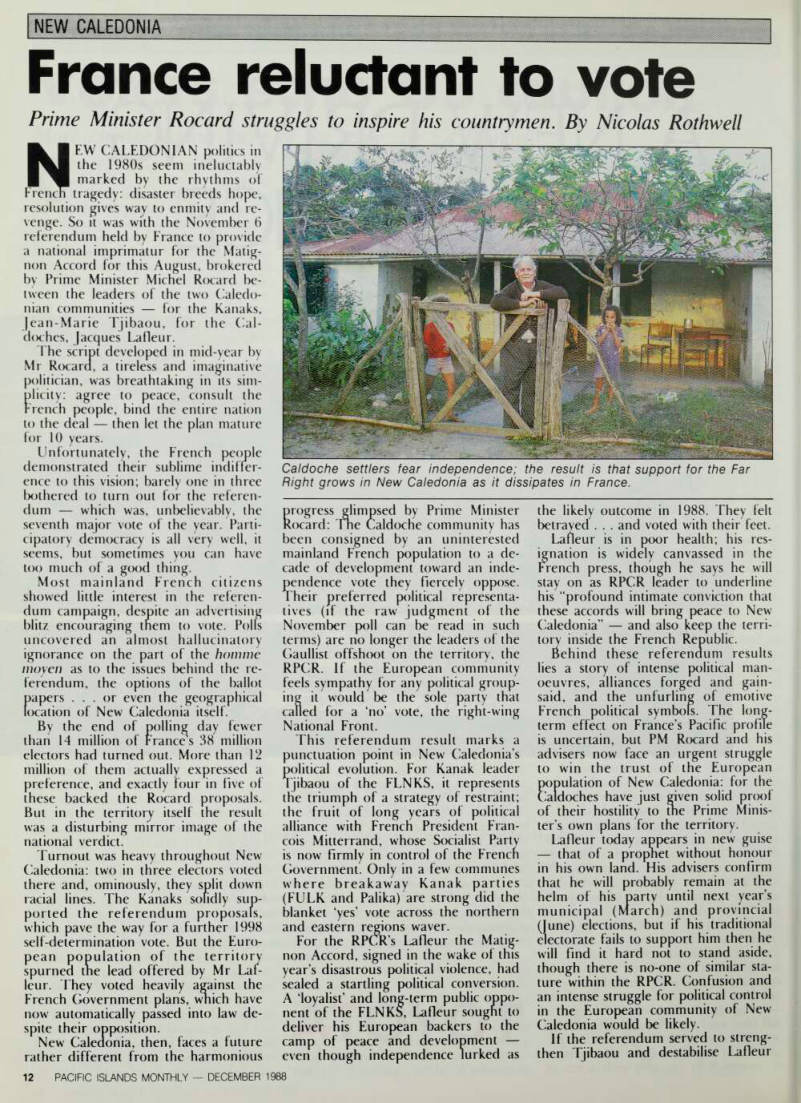
Caldoche settlers fear independence; the result is that support for the Far Right grows in New Caledonia as it dissipates in France.
in the territory itself, its effects in France were equally disconcerting for the political establishment. The social ist Government of Michel Rocard, supported in a last-minute televised appeal to the nation by President Mit terrand, threw its weight behind the referendum proposals. The record ab stention rate undoubtedly reflected the electorate’s disenchantment with
French politics, its ‘voting fatigue’ and
indifference to far-off New Caledo nia’s fate. But the effect was also to damage Rocard’s prestige and even to cheapen the referendum procedure it self, once a keystone of tne Fifth Re
public’s multi-layered democracy.
Though Rocard and Mitterrand had made plain this was a new style of referendum rather than the tradition al ‘vote of confidence’ of the type de Gaulle used to great effect, Opposition politicians were swift to capitalise on the result, hinting broadly that both men should resign.
For the conservative Opposition, the
referendum campaign posed equally
serious problems. The two main strands in the centre-right coalition were split in their stands on the plebis cite: tne Gaullists of the Rassemble ment pour la Republique (RPR), still led by Jacques Chirac, called for ab stention on the grounds that they could not in all conscience either sup port or oppose the referendum prop osals. Their political campaign was im
pressively marshalled by the party’s
rising star, Alain Juppe.
Meanwhile the centrists of the Un ion for French Democracy (UDF) under Raymond Barre had called for a ‘yes’ vote, and general disarray was the order of the campaign among smaller centrist formations.
Thus the vote increased strains in the conservative camp; at the same
lime, it effectively frayed the ties be tween the RPR and Lafleur’s local RPCR. Undoubtedly, Caldoche voters were confused by the spectacle of the
RPR opposing Lafleur’s position.
On the hard right the National Front of Jean-Marie Le Pen waged an unremitting fight against the referen dum proposals, calling for a flat ‘no’ vote. The Front’s efficient number two, Jean-Pierre Stibois, was killed in a car crash on the eve of the vote a development that may yet prove signi ficant m mainland politics. But in New Caledonia itself the Front, led by Guy
George and forcefully supported by a
big gun from the mainland party, Ro ger Holleindre, enhanced its power.
Over the past year this party’s standing has sea-sawed, largely as a result of changes in the voting system.
It has gone from marginal status in New Caledonia and great strength in France itself to weakness on the main land and startling potency among the European community of the territory.
The Rocard Government assiduous ly portrayed the referendum vote as a final mandate for its New Caledonia policy, despite the low turnout. Gov ernment spokesmen discounted sug gestions from the RPR camp that the record level of abstentions would jus-
tify a future Gaullist Prime Minister revising crucial elements of the Matig non Accord package.
Imminent visits to the territory by both Prime Minister Rocard and Minister for Overseas Territories Louis Le Pensec will underline the Government’s determination to ensure the new laws are smoothly introduced.
The nuts and bolts are as follows: the territory is to be divided into three regions and a wide range of economic projects launched; a controversial poli tical amnesty comes into force, cover ing all political offences committed in New Caledonia before the 20 August signing date of the Accords (murder alone excepted); and next June sees the elections for the three Caledonian provincial assemblies the North, with 15 members, the Loyalty Islands, with 7 members, and the South, with 32 members. The first two are certain to be controlled by the FLNKS while the southern region (centred on Noumea) will reflect a strong Euro pean majority. The regionalisation en ters into force on July 14, 1989.
These three assemblies, whose mem bers will serve six-year terms, are to act as local parliaments with indepen dent budgets and administrations. Sit ting together, they will make up the Congress of the territory under the direction of a president. Executive power will remain in the hands of the
High Commissioner.
Mr Le Pensec, who will oversee the implementation of the New Caledonia statute, has a ticklish task ahead of him. Faced by the unavoidable facts of the vote ana the choice of six large European communities in the south of New Caledonia (Noumea, Dumbea, Mont-Dore, Bourail, La Foa, Parino) for the ‘no’ ballot in the referendum, the Minister admitted that “clearly the Caldoches did not want” the regiona lisation called for by the Accords. “But insofar as violence is born from injus tice,” he said, “it is up to us to ensure that equality of opportunity is a fact of life in New Caledonia.”
Jean-Marie Tjibaou of the FLNKS, with his customary 20-20 vision in matters political, summed up the re ferendum result: “Three parlies signed the Matignon Accord, and that Accord will be fulfilled by three par ties. If any one party fails to fulfil the Accord, men that will be the end of the accord. With 57 per cent of New Caledonian voters voting ‘yes’, we can put the Accord into force. But the 42 per cent who voted ‘no’ are a signal for a great, great deal of vigilance the decade ahead will tell us whether a rejectionist front can ruin things; I
hope not.”
For the Government in Paris, the task of establishing a harmonious poli tical culture is also linked to a broader
regional diplomacy. □
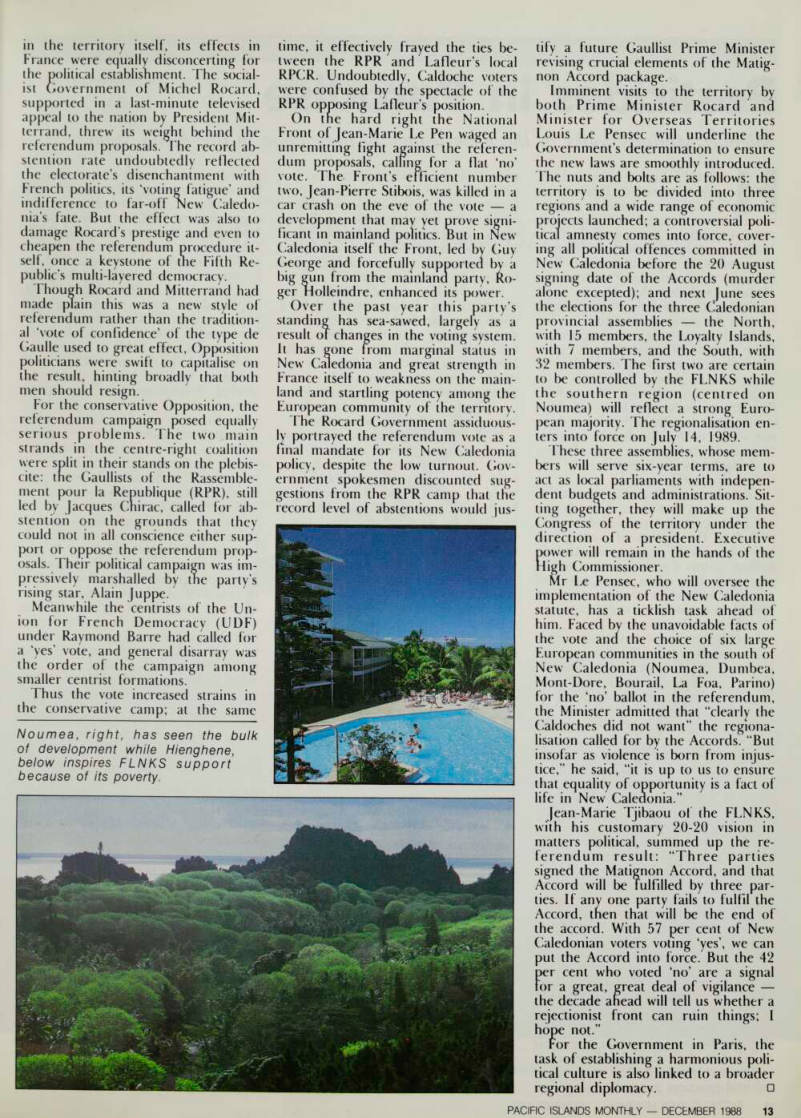
Noumea, right, has seen the bulk of development while Hienghene, below inspires FLNKS support because of its poverty.