Island Affairs minister ousted
New Zealand
Richard Prebble’sdismissal outrages islanders.
By Robin Bromby
THE New Zealand Government has achieved political synergy in its approach to the South Pacific . . . by making the same minister re sponsible for both foreign and Pacific Island affairs. Given that New Zealand claims the Pacific has top priority in its overseas relations, the decision to give the Minister of Foreign Affairs, Rus sell Marshall, the Pacific Islands port folio does make sense (associate minis ter Fran Wilde will also be involved in both: she will probably bear the brunt of the Pacific Islands work).
Marshall has taken on the job after former minister Richard Preoble said that Prime Minister David Lange was not making rational decisions, and was dismissed from Cabinet. The Pacific Island Affairs portfolio was an accidental victim; Prebble clashed with the PM over his administration of his
major responsibility, the State-Owned
Enterprises portfolio, because he had wanted to speed up the sale of gov ernment-owned assets. He ended up being NZ’s first Minister to be dismis sed from office this century even Native Affairs Minister Sir Apirana Ngata was allowed to resign after financial irregularities were discovered in his department back in 1934.
The Prebble dismissal has upset many Pacific islanders resident in New Zealand, for whom the Pacific Island Affairs portfolio was established. And Richard Prebble was the ideal choice for the job: he is MP for Auckland central, where 64 per cent of the islan ders resident in New Zealand live.
Russell Marshall, on the other hand, represents the provincial city of Wan ganui, which has a large Maori population but few Pacific migrants.
Prebble supporters are reported to have circulated a petition seeking his reinstatement, their argument being that it was the State-owned Enterprises role and not the Pacific portfolio at the centre of the dispute with Prime Minister Lange. Just a few days after the dismissal, Mr Lange had been due to open the new Auckland office of the Ministry of Pacific Island Affairs.
The opening was cancelled, apparent ly because it was feared island com munity leaders would have used the occasion to present their petition to him. The cancellation of the opening also angered island people in Au ckland; the news came after a food had been ordered, cultural displays readied and singing groups had prac
tised. About 1000 invitations had already been mailed.
Mr Marshall told Pacific Islands Monthly his initial reaction had been reluctance to take on more work. But he said he realised the sense of com
bining the two portfolios.
New Zealand’s most recent census shows 127,000 resident Pacific islan ders, and it is expected the 1991 fi gure will be about 170,000 slightly more than the entire population of Western Samoa. About naif the islan ders living in New Zealand are Sa moan and roughly a quarter are of Cook Island origin, with large Niuean and Tongan communities. There are few Melanesians or Micronesians, re flecting New Zealand’s long connec tion with Polynesia.
The community has substantial problems, hence the setting up of a separate ministry to deal with their concerns: islanders populate the poor er inner city suburbs of Auckland (or the even more bleak suburban state housing estates), fill the more menial
jobs and have problems adjusting to
the language and cultural life in New Zealand. But island people can earn good money if employed, and their remittances are crucial to their home lands’ economies.
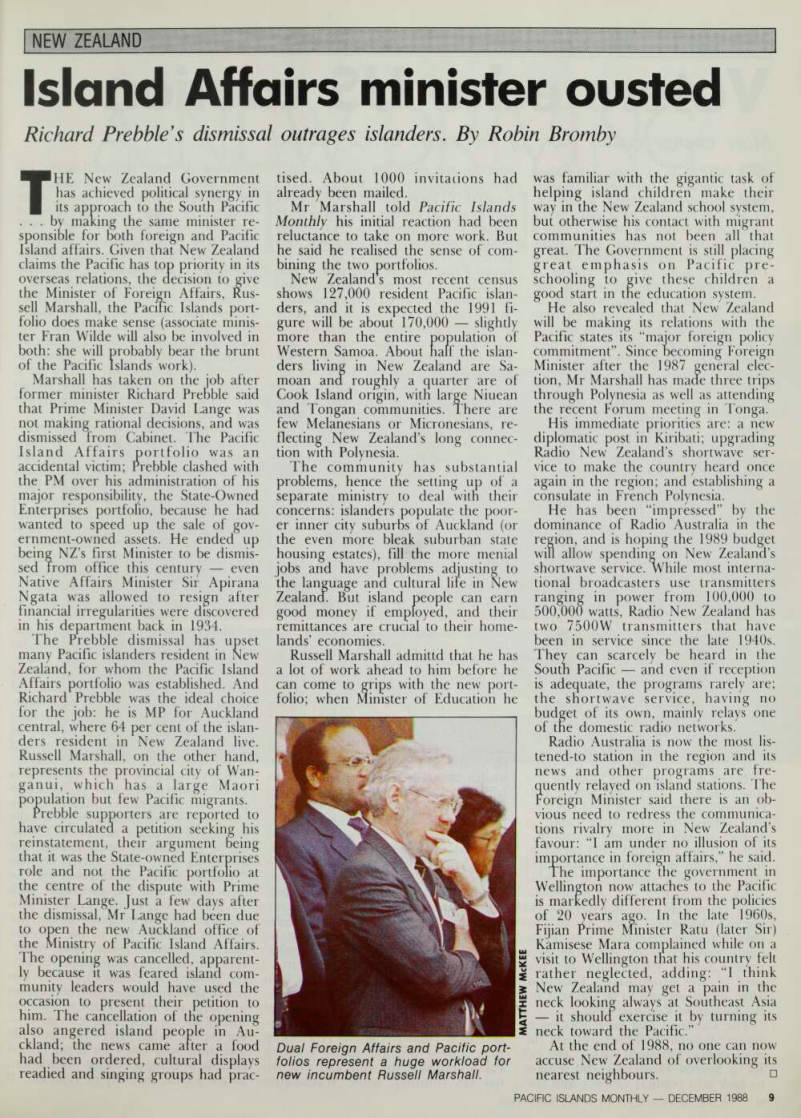
Russell Marshall admittd that he has a lot of work ahead to him before he can come to grips with the new port folio; when Minister of Education he
was familiar with the gigantic task of helping island children make their way in the New Zealand school system, but otherwise his contact with migrant communities has not been all that great. The Government is still placing great emphasis on Pacific pre schooling to give these children a good start in the education system.
He also revealed that New Zealand will be making its relations with the
Pacific states its “major foreign policy
commitment”. Since Decoming Foreign
Minister after the 1987 general elec tion, Mr Marshall has made three trips
through Polynesia as well as attending
the recent Forum meeting in Tonga.
His immediate priorities are: a new diplomatic post in Kiribati; upgrading Radio New Zealand’s shortwave ser vice to make the country heard once again in the region; and establishing a consulate in French Polynesia.
He has been “impressed” by the dominance of Radio Australia in the region, and is hoping the 1989 budget will allow spending on New Zealand’s shortwave service. While most interna tional broadcasters use transmitters ranging in power from 100,000 to 500,000 watts, Radio New Zealand has two 7500 W transmitters that have been in service since the late 19405.
They can scarcely be heard in the South Pacific and even if reception is adequate, the programs rarely are; the shortwave service, having no budget of its own, mainly relays one of the domestic radio networks.
Radio Australia is now the most lis tened-to station in the region and its news and other programs are fre quently relayed on island stations. The Foreign Minister said there is an ob vious need to redress the communica tions rivalry more in New Zealand’s favour: “I am under no illusion of its importance in foreign affairs,” he said.
The importance the government in Wellington now attaches to the Pacific is markedly different from the policies of 20 years ago. In the late 19605, Fijian Prime Minister Ratu (later Sir) Kamisese Mara complained while on a visit to Wellington that his country felt rather neglected, adding: “I think New Zealand may get a pain in the neck looking always at Southeast Asia it should exercise it by turning its neck toward the Pacific.”
At the end of 1988, no one can now accuse New Zealand of overlooking its nearest neighbours. □
Dual Foreign Affairs and Pacific port folios represent a huge workload for new incumbent Russell Marshall.