Trade Winds
p. 35 · Read in the full issue
Joint Ventures Boosted
More money for regional enterprises.
By Robin Bromby
MOVES are under way in Canberra to expand Australia’s Joint Ven ture Scheme so more Pacific is land enterprises can be financed, in reply to criticisms that in the past the scheme has been cumbersome, it took long for proposals to be approved . . . and that it was one of Australia’s best-kept secrets.
The Joint Venture Scheme (JVS), after almost 10 years of existence, is still not widely known either in Australia or the South Pacific. Proposals are currently with the Department of Foreign Affairs and Trade in Canberra to rectify this.
The scheme was established in 1978 to provide equity finance for ventures in the South Pacific, and is administered by the Australian International Development Assistance Bureau (AIDAB). Ventures must have an Australian equity partner to qualify (though the Australian enterprise receives none of the grant money) and the grant can be up to 50 per cent of the re quired equity. There is also a base of 25 per cent in terms of share of capital for the Australian partner; it was felt that any less would make it too easy for the Australian to cut and run if the going got tough.
Ten schemes have been approved to date: critics say that 10 schemes in 10 years is not enough, but defenders argue that finding 10 viable projects to finance in the South Pacific is pretty good going. The conservative attitude of those administer ing the scheme is evident, though, in the choice of projects supported: $A900,000 to the Solomon Islands National Bank and $A294,000 to help set up the Bank of Kir ibati (with Westpac as the venture part ner) is not exactly chancing one’s arm.
The other schemes are; SAI.B million to Fiji Forest Industries, $470,000 to Sa moa Veneer Products, $189,000 to Polyne sian Airlines, $26,000 to Talofa Wines of Western Samoa, $312,000 for an agricul tural venture in Fiji, $950,000 for cattle raising in Vanuatu and $515,000 for a ce ment factory in Vanuatu. A tannery in Vanuatu was also approved, but did not proceed. The cement factory is the only scheme to have collapsed. The others are all still in business at varying degrees of profitability, from the Bank of Kiribati (which is thriving) to the Samoan veneer factory (which has an uncertain future).
The JVS was meant to finance both government-backed and private business ventures, but as it turned out only one pri vate scheme has been approved fruit wines production in Western Samoa. If the recipient government is the local equity
partner, the money is paid over as a grant; if it is a private venture partner, on the other hand, the money is handed to the government to be lent at a concessional in terest rate. The private venturer, unlike the government one, must repay the loan; there is no provision for forgiving the advance (though the island government gets to keep the repaid loan the money never goes back to Canberra with the understand ing that it should be spent on some other development project).
The failure of private businessmen to use JVS money is attributed by some to the poor publicity given to the project, and the failure in early guidelines to make it clear that interest rates would be markedly below ruling commercial levels. The re view of the Joint Venture Scheme is under stood to suggest that in future the scheme be limited to projects requiring $A500,000 and above. This will almost certainly limit the grants to projects associated with government projects.
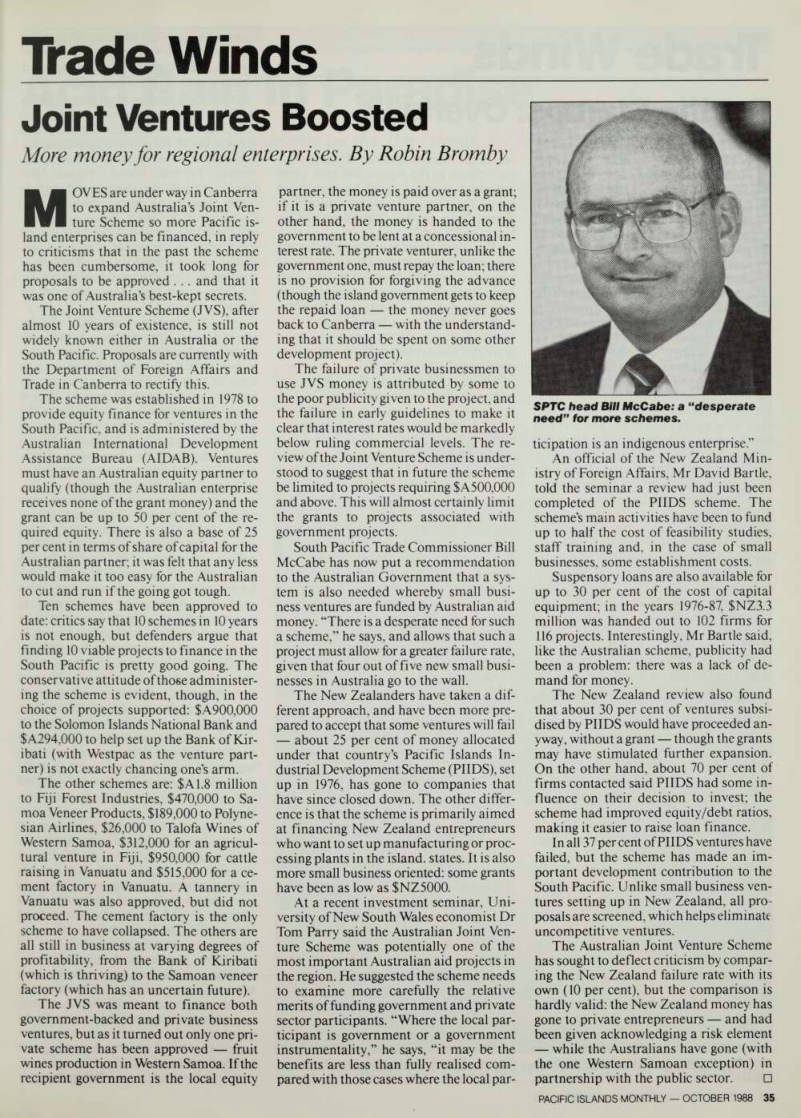
South Pacific Trade Commissioner Bill McCabe has now put a recommendation to the Australian Government that a sys tem is also needed whereby small busi ness ventures are funded by Australian aid money. “There is a desperate need for such a scheme,” he says, and allows that such a project must allow for a greater failure rate, given that four out of five new small busi nesses in Australia go to the wall.
The New Zealanders have taken a dif ferent approach, and have been more pre pared to accept that some ventures will fail about 25 per cent of money allocated under that country’s Pacific Islands In dustrial Development Scheme (PUDS), set up in 1976, has gone to companies that have since closed down. The other differ ence is that the scheme is primarily aimed at financing New Zealand entrepreneurs who want to set up manufacturing or proc essing plants in the island, states. It is also more small business oriented: some grants have been as low as SNZSOOO.
At a recent investment seminar, Uni versity of New South Wales economist Dr Tom Parry said the Australian Joint Ven ture Scheme was potentially one of the most important Australian aid projects in the region. He suggested the scheme needs to examine more carefully the relative merits of funding government and private sector participants. “Where the local par ticipant is government or a government instrumentality,” he says, “it may be the benefits are less than fully realised com pared with those cases where the local par-
ticipation is an indigenous enterprise.”
An official of the New Zealand Min istry of Foreign Affairs, Mr David Bartle, told the seminar a review had just been completed of the PUDS scheme. The scheme’s main activities have been to fund up to half the cost of feasibility studies, staff training and, in the case of small businesses, some establishment costs.
Suspensory loans are also available for up to 30 per cent of the cost of capital equipment; in the years 1976-87, SNZ3.3 million was handed out to 102 firms for 116 projects. Interestingly, Mr Bartle said, like the Australian scheme, publicity had been a problem; there was a lack of de mand for money.
The New Zealand review also found that about 30 per cent of ventures subsi dised by PUDS would have proceeded an yway, without a grant though the grants may have stimulated further expansion.
On the other hand, about 70 per cent of firms contacted said PUDS had some in fluence on their decision to invest; the scheme had improved equity/debt ratios, making it easier to raise loan finance.
In all 37 per cent of PUDS ventures have failed, but the scheme has made an im portant development contribution to the South Pacific. Unlike small business ven tures setting up in New Zealand, all pro posals are screened, which helps eliminate uncompetitive ventures.
The Australian Joint Venture Scheme has sought to deflect criticism by compar ing the New Zealand failure rate with its own (10 per cent), but the comparison is hardly valid; the New Zealand money has gone to private entrepreneurs and had been given acknowledging a risk element while the Australians have gone (with the one Western Samoan exception) in partnership with the public sector. □
SPTC head Bill McCabe: a “desperate need” for more schemes.