Sunia’s Tragedy Unfolds
pp. 18-19 · Read in the full issue
American Samoa
David North reports on the Congressman’s fall from grace.
THE scandal-marked departure of American Samoa’s Fofo Sunia from the halls of Congress is a tragedy not only for the island delegate it is a major setback for American Samoa as well.
Indicted by federal prosecutors on multiple counts of payroll fraud, ,51 -year old Sunia pleaded guilty, resigned from the House of Representatives on September 6, and faces a federal judge for sentencing on October 4. He could spend years in prison and pay substantial fines.
Meanwhile the interests of America’s only southern hemisphere territory will suffer; it will take years for Sunia’s succes sor to leam the ropes and, more impor tantly, to secure the seniority Sunia was beginning to enjoy.
The American House of Representa tives is a big place there are 435 voting members and five territorial delegates. An individual member, even with a vote on the floor of the House, can get lost in the body as a whole, but competent politi cians can make themselves felt by moving up in the complex committee structure of the House and Sunia had begun that long process.
Given both the size of the House and the usual lack of party discipline in floor votes, the committees make many of the detailed decisions of the body; and com mittee and subcommittee chairmen, who become experts in their fields, make many of those decisions.
Early last year Sunia made a break through for a territorial delegate when he was selected as chairman of the subcom mittee on public buildings of the House of Representatives Public Works Commit tee. No other territorial delegate had ever chaired a non territory-related committee or subcommittee. Suddenly Congressmen for all over the country were coming to Sunia, asking him for help as they sought federal buildings (usually courthouses) for their home towns. Sunia had power in his own committee, and could begin to wheel and deal with the rest of them.
He began using his new power to have projects for American Samoa funded through new and different legislative ve hicles: he didn’t have to place all his hopes on the traditional “omnibus” territorial authorisation bills that historically had been the focus of island delegates. Now, however, those new powers are again lost to American Samoa for at least a decade the time it usually takes for a new mem ber to move up to a subcommittee chairmanship.
“Sunia will be missed,” said Larry
Morgan, a longtime observer of the terri tories and the house of Representatives Director of Legislative and Public Affairs for the Interior Department’s Office of Territorial and International Affairs.
“In his own modest Pacific way, Sunia had became the most quietly effective ter ritorial delegate,” Morgan said, recount ing Sunia’s accomplishments, sometimes won against the wishes of the Interior De partment. “Everybody likes Fofo, he is a very pleasant person. That helped his cause, and that of American Samoa,” ac cording to Morgan who carefully sep arated his evaluation of Sunia’s legislative work from the charges against him. Mor gan had met Sunia when principal assist ant to a member of the House Interior Committee, another committee of which Sunia was a member.
Sunia addressed his legislative duties, often dealing with funding questions, with such success that government in Ameri can Samoa has many more resources than nearby Western Samoa: only the French colonies in the Pacific receive the kinds of largesse experienced by American Samoa and Guam. Part of the American Samoa- Western Samoa discrepancy related to Sunia’s work and part to the affluence of the US Government and its attitude that the islands should be treated as generously as the mainland.
Among Sunia’s recent projects were an effort to bring mainland money to Pago
Pago for such projects as a mainland-style welfare system, funds for fighting drug addiction and support for a National Guard (militia) unit. Throughout his term in the House he routinely secured Congressional passage for a tiny item in fund-allocation programs mandating that Samoa receive one quarter of one per cent of various special purpose funds distrib uted among states and territories. Nobody objected to 0.25 per cent of the funds (one dollar in $400) going to the islands, but then no one realised that 0.25 per cent of those funds was pretty good treatment for a territory that is home to only 0.015 per cent of the nation’s population.
What will happen now to American Samoa’s representation in Washington?
For the next four months Sunia’s seat will be vacant, despite efforts by both Sunia himself and Governor A P Lutali to avoid a vacancy. They had wanted the new Sa moa delegate to be seated this year so he would have more seniority than the other newcomers to the House, who will be seated in January.
Sunia had hoped that by resigning on September 6 his seat could be filled quickly by another Samoan, but a snarl of Terri torial and Federal laws prevented this. Part of the problem is that Pago Pago is new to this segment of mainland law, and its ter ritorial legislators (in the Fono) had not prepared for a resignation from the House of Representatives.
Territorial law says that if there is a va cancy in the delegate’s position of six months’ duration or less, the Governor may appoint an interim delegate (just as mainland governors can fill comparable vacancies in the US Senate.) But the Fono was looking at the wrong precedent mainland governors cannot appoint members of the House.
When Sunia resigned he knew Mr Lu tali would probably be unable to appoint someone to succeed him, but hoped the Governor could nevertheless call a special election to fill the vacancy, as mainland governors can. But the principal lawyer for the mainland House of Representatives ruled on the basis of territorial law that the Governor in fact had no power to call a special election, as the (useless) appoint ment option was the only thing available in the situation.
Meanwhile, several prominent Amer ican Samoans are busily running for the seat Sunia is vacating. Three of the prom inent candidates, all with territory-wide political backgrounds, are: • Eni Hunkin, current Lieutenant Gov
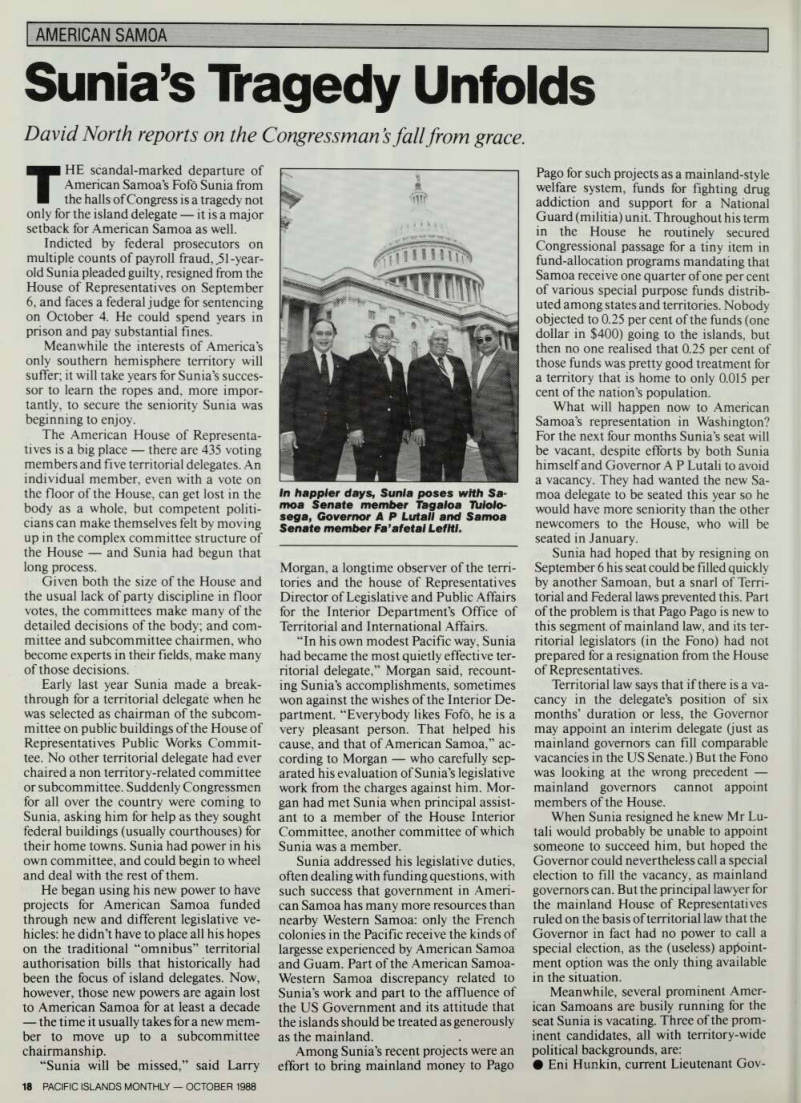
In happier days, Sunla poses with Sa moa Senate member Tagaloa Tuiolo sega, Governor A P Lutall and Samoa Senate member Fa’a fetal Lefltl.
emor of the Territory and former Congres sional staffer, a protege of controversial late Congressman Philip Burton. • Tufele Li’a, former Lieutenant Gover nor under Peter Tali Coleman, is said to have a perhaps trivial edge in one aspect of the race: it seems there are more Li’a bumper stickers than there are for the other candidates. • Soli Augmoeualago, the Territorial Public Defender, has run for the office twice before and came within 600 votes of beating Sunia two years ago.
Though the House of Representatives is organised along party lines, and though Sunia sat with the Democrats (and earned a chairmanship thereby), party lines are not very important in American Samoa.
Lutali and Hunkin identify themselves as National Democrats, and Augmoeualego received a contribution of SUSIOOO from the Republican National Committee last time he ran, but each party does not nom inate a single candidate as is the practice on the mainland.
Since there are no party nominations and since there are several candidates in the field it is likely none will win an ab solute majority of the vote on election day, November 8. If this occurs, the two lead ing candidates will fight it out in a second election, called a “runoff’, on November 22. American Samoa will then have a fur ther distinction, as its delegate will be the very last member of the House to be se lected; the others having been chosen on November 8, together with the President, Governors and Senators.
Why did Sunia do what he did? Why did temptation cause him to blow a pleas ant, high prestige job where he was doing useful things for his island territory? Sunia stopped talking to the press more than a year ago, but the one mainland reporter who has been following the story, Shan non Bradley of Washington Roll Call (which covers the Congress) had this to say: ’’Several current and former Sunia staf
fers ... have painted their boss as not a crook but as a Samoan out of his realm in Washington, a man bound by a culture that demands that he give in order to receive. ’They described Sunia, a father of eight, as perpetually hard up for money, yet ob ligated to prove his loyalty to visiting Sa moans by spending lavishly on them.
Staffers recall being invited to parties at fine restaurants when constituents came to town. ’lf Fofo didn’t fuss over them, they’d say “he doesn’t care about us any more’”, one former aide explained.
“Another added that Sunia adhered to the Samoan custom of showing his pres tige by flaunting his wealth, even though he didn’t have it.”
If Sunia had trouble breaking even on his $U589,500 a year salary (and a gen erous expense account for travel) he will be in worse shape shortly. He will probably be fined (he has pleaded guilty to taking SUS 130,000 that did not belong to him), and may well be unemployed. He may, of course, also go to prison.
It is a sad and sharp comedown for one whose biography shows a steady climb.
Following his graduation from the Uni versity of Hawaii (with a BA in Econom ics) in 1960, he spent 10 years in a series of increasingly important posts in American Samoa’s Government, such as appoint ment as the Territorial Elections Commis sioner and as a delegate to various South Pacific Conferences.
A high chief and a matai, he was se lected by his fellow matai to be a member of the Territorial Senate in 1970, and stayed there for many years before his first elec tion to the delegate’s seat in the US House of Representatives in 1980 the first Sa moan to hold the position.
Sunia has said he will return to Amer ican Samoa. But there may be a detour along the way, a spell in one of those pub lic buildings over whose planning, fund ing and construction he used to preside: a federal penitentiary. □