New Directions For The Region
pp. 16-17 · Read in the full issue
South Pacific Forum
Politics take a back seat to economic issues in
By Mesake Koroi
Disagreements on a re gion-wide scale marked the days leading up to this year’s South Pacific Forum meeting in the Tongan capital of Nuku’alofa. Au stralian Prime Minister Bob Hawke, Australian Foreign Minister Senator Gareth Evans and Fiji PM Ratu Sir Kamisese Mara were already embroiled in arguments over whether Senator Evans could pay a formal visit to deposed Fijian PM Dr Timoci Bavadra during a stopover in Fiji en route to Tonga.
Permission was refused by Fiji’s interim government, which caused Mr Hawke to publicly consider the matter of a SAIO million aid package to Fiji, aimed at helping the coun try’s economic recovery. Mr Hawke also foreshadowed discussions on Fiji’s proposed new Constitution, which some observers feared would further disadvantage Fiji’s large Indi an population.
However, by the time the Forum got under way the leaders’ differ ences had been ironed out. Senator Evans said on his arrival in Tonga that there was no desire to have the Forum take any initiative on Fiji; it would allow Fiji to sort out its own internal affairs. Senator Evans’ re marks were decried by Mr Jone Dakuvula, a New Zealand based Fi jian who represents Dr Bavadra’s ousted government: Mr Dakuvula called for a formal discussion on Fiji because it was “the main issue of public interest in the region”.
Prime Ministers Hawke and Mara sorted out their disagreements at a breakfast meeting on the Tuesday be fore the Forum began. Mr Hawke supported his Foreign Minister’s hopes that the whole of Fiji society would benefit by the new Constitu tion, and agreed that withdrawal of the proposed aid package would only hurt those most in need of assist ance. For his part, Ratu Mara ex plained the interim government’s stand on “outside interference” in Fiji’s affairs, and welcomed an opportunity to “make a start on res toring the relationships” between Fiji and both Australia and New Zealand.
Apart from general resolutions ack nowledging the changes in Fiji and calls for a Constitution that would give fair and equitable protection to
Fijians of all ethnic backgrounds, and unanimous acclaim for the efforts of France’s new government in resolv ing the long-running conflict in New Caledonia, most of the Forum’s busi ness concentrated on economic and development concerns.
One of the first subjects for discus sion was Japan’s intransigence with regard to regional fishing agreements.
That country insists on negotiating treaties with individual nations which, island leaders say, results in Japanese interests being able to “play off” one Pacific nation against another with promises of develop ment funds and aid in return for con cessions on catch levels.
Catch levels themselves are a sub ject of concern to Forum members, since the only figures provided are those from Japanese tuna vessels.
It was largely as a fence-mending gesture that Australia’s Prime Minis ter volunteered to use his country’s influence with Japan in pressing for a multilateral fishing agreement be tween all 16 Forum members and the Japanese Government. Mr Hawke said it would “sit better” with Japan’s aim of playing a greater re gional economic role if it were to agree to fishing treaties that took the needs of Pacific states into account,
and if official checks could be made on the numbers of fish offloaded in Japanese ports.
Other environmental issues were addressed during the meeting: not ably the threat posed by the “Green house Effect”, whereby gradual glob al warming could see some low-lying islands (especially Kiribati, Tuvalu and Tokelau) as well as more popu lous areas such as Bangladesh, dis appear as sea levels rise. The Austra lian delegation introduced the debate, and Forum leaders agreed to devote finances and research efforts to the search for solutions to a potentially cataclysmic situation.
Perhaps the most immediately sig nificant outcome of the Forum was the decision to streamline the South Pacific Bureau for Economic Co operation SPEC and to reorga nise its activities. In line with the emphasis on economic activities rather than politics, SPEC will now be known as the Forum Secretariat and will concentrate on improving the economies of member nations.
“The Forum has almost exhausted its role in dealing with political issues,” said Vanuatu PM Father Walter Fini.
“We are particularly satisfied in the case of New Caledonia, but the Forum now needs to look more spe cifically at economic issues; issues that are no longer of concern to in ternational bodies like the United Nations.”
Father Fini said the Forum, through the Secretariat, needed to work out procedures and guidelines regarding its contribution to member states; a vital part of protecting their security in the international sphere.
As well, the Forum voted to rationalise regional bodies such as the University of the South Pacific to protect it and its staff and students against political pressure. Co ordination of all such activities will be handled by the South Pacific Organisations Co-ordinating Commit tee (SPOCC), a new body established by the Forum at this year’s meeting.
Under the aegis of the revitalised SPEC or Secretariat and SPOCC will be the implementaton of recommendations contained in a re port on regional economic issues that was presented to (and endorsed by) members. It deals at length with
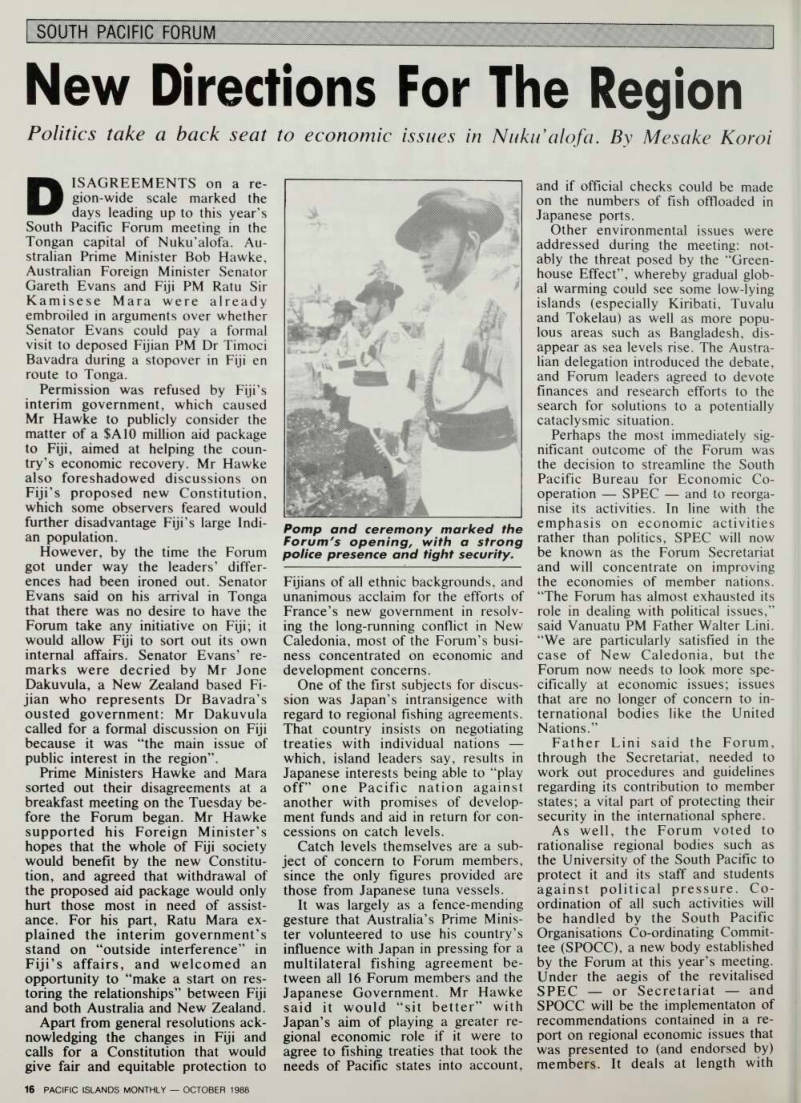
Pomp and ceremony marked the Forum's opening , with a strong police presence and tight security.
trade, investment, small business de velopment and the enhancement of economic planning capacity, and donors will be sought to supplement funds already available in realising the report’s aims.
Despite the provisions of the SPARTECA agreement giving South Pacific nations access to Australian and New Zealand markets, fun damental problems have meant some Forum countries (especially the smal ler nations) have actually been dis advantaged by the agreement: the meeting resolved to investigate ways of boosting production and marketing for member nations rather than “tink ering with” SPARTECA, which has been, on balance, a success.
One of the most far-reaching agree ments in Nuku’alofa concerned the proposal for a regional satellite-based communications network that was outlined in the May issue of Pacific
Islands Monthly.
With international giants such as British Telecom and Cable & Wire less looking to expand their holdings in the region, Bob Hawke lobbied successfully (or was at least given in principle support) for the adoption of an Australian satellite system de signed by OTCI, Australia’s govern-
ment-owned Overseas Telecommunications International.
As the meeting came to a close, President leremia Tabai announced that next year’s Forum would be held in Tarawa . . . and Western Samoan PM Tofilau Eti responded to criticisms of the way in which the international Press contingent had
been treated in Nuku’alofa (see this month’s Opinion pages) by urging Forum members to be “conscious of how the international community reacts to Forum decisions. The Forum has become much better known, and its activities are moni tored constantly by the international community.” □
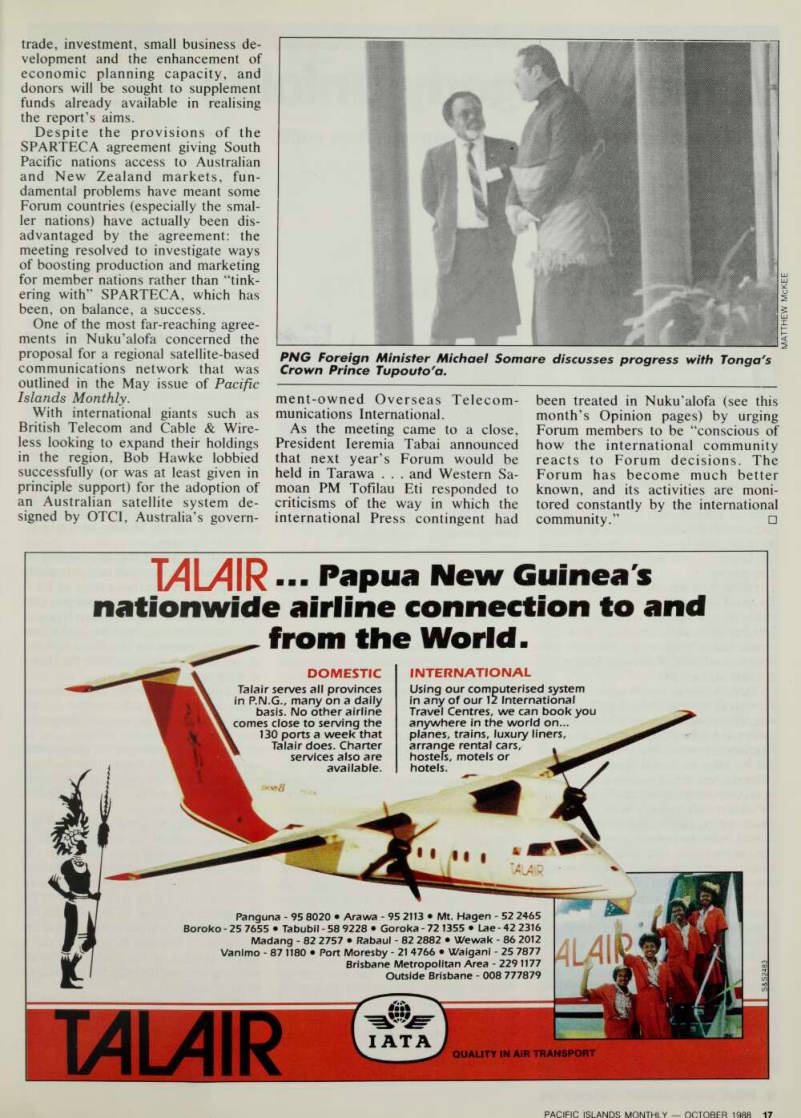
PNG Foreign Minister Michael Soma re discusses progress with Tonga's Crown Prince Tupouto'a.