Samoa’s Principled PM
pp. 46-49 · Read in the full issue
Pacific People
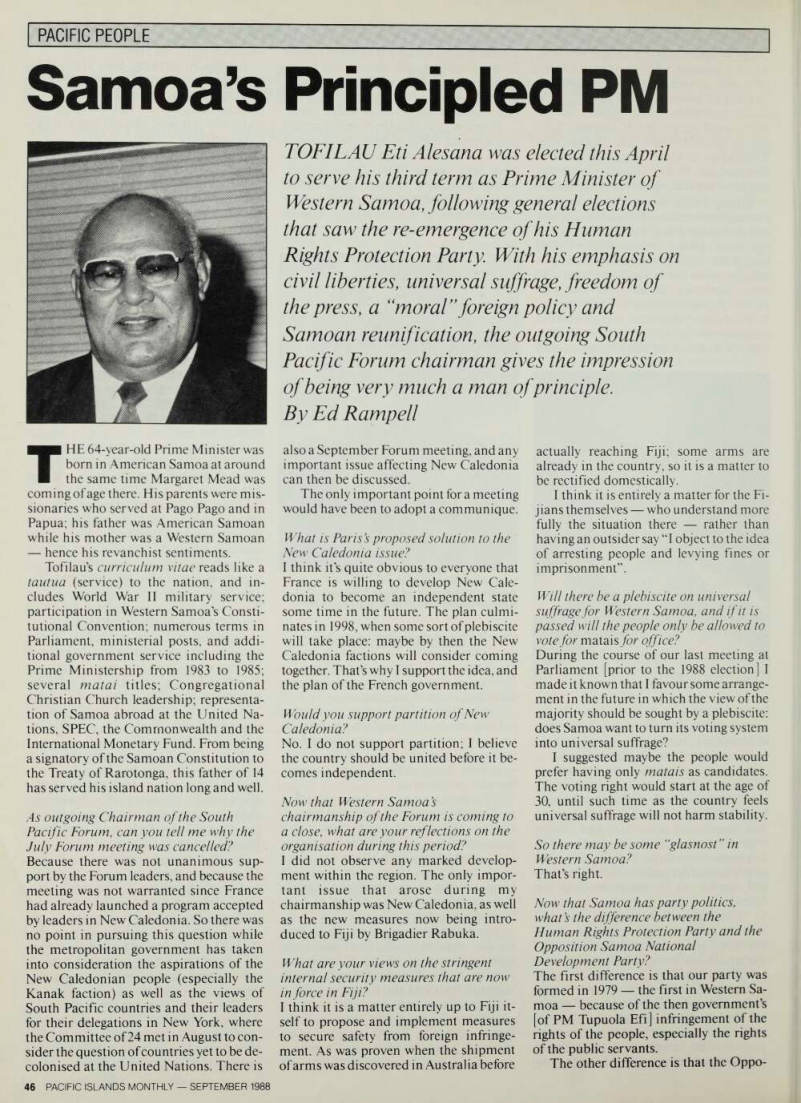
TOFILAU Eti Alesana elected this April to serve his third term as Prime Minister of Western Samoa, following general elections that saw the re-emergence of his Human Rights Protection Party. With his emphasis on civil liberties, universal suffrage, freedom of the press, a “moral” foreign policy and Samoan reunification, the outgoing South Pacific Forum chairman gives the impression of being very much a man ofprinciple.
By Ed Rampell
THE 64-year-old Prime Minister was born in American Samoa at around the same time Margaret Mead was coming of age there. His parents were mis sionaries who served at Pago Pago and in Papua; his father was American Samoan while his mother was a Western Samoan hence his revanchist sentiments.
Tofilau’s curriculum vitae reads like a tautua (service) to the nation, and in cludes World War II military service; participation in Western Samoa’s Consti tutional Convention; numerous terms in Parliament, ministerial posts, and addi tional government service including the Prime Ministership from 1983 to 1985; several matai titles; Congregational Christian Church leadership; representa tion of Samoa abroad at the United Na tions, SPEC, the Commonwealth and the International Monetary Fund. From being a signatory of the Samoan Constitution to the Treaty of Rarotonga, this father of 14 has served his island nation long and well.
As outgoing Chairman of the South Pacific Forum, can you tell me why the July Forum meeting was cancelled?
Because there was not unanimous sup port by the Forum leaders, and because the meeting was not warranted since France had already launched a program accepted by leaders in New Caledonia. So there was no point in pursuing this question while the metropolitan government has taken into consideration the aspirations of the New Caledonian people (especially the Kanak faction) as well as the views of South Pacific countries and their leaders for their delegations in New York, where the Committee of 24 met in August to con sider the question of countries yet to be de colonised at the United Nations. There is
also a September Forum meeting, and any important issue affecting New Caledonia can then be discussed.
The only important point for a meeting would have been to adopt a communique.
What is Paris’s proposed solution to the New Caledonia issue?
I think it’s quite obvious to everyone that France is willing to develop New Cale donia to become an independent state some time in the future. The plan culmi nates in 1998, when some sort of plebiscite will take place; maybe by then the New Caledonia factions will consider coming together. That’s why I support the idea, and the plan of the French government.
Would you support partition of New Caledonia?
No. I do not support partition; I believe the country should be united before it be comes independent.
Now that Western Samoa’s chairmanship of the Forum is coming to a close, what are your reflections on the organisation during this period?
I did not observe any marked develop ment within the region. The only impor tant issue that arose during my chairmanship was New Caledonia, as well as the new measures now being intro duced to Fiji by Brigadier Rabuka.
What are your views on the stringent internal security measures that are now in force in Fiji?
I think it is a matter entirely up to Fiji it self to propose and implement measures to secure safety from foreign infringe ment. As was proven when the shipment of arms was discovered in Australia before
actually reaching Fiji; some arms are already in the country, so it is a matter to be rectified domestically.
I think it is entirely a matter for the Fi jians themselves who understand more fully the situation there rather than having an outsider say “I object to the idea of arresting people and levying fines or imprisonment”.
Will there be a plebiscite on universal suffrage for Western Samoa, and if it is passed will the people only be allowed to vote for matais for office?
During the course of our last meeting at Parliament [prior to the 1988 election] I made it known that I favour some arrange ment in the future in which the view of the majority should be sought by a plebiscite: does Samoa want to turn its voting system into universal suffrage?
I suggested maybe the people would prefer having only matais as candidates.
The voting right would start at the age of 30, until such time as the country feels universal suffrage will not harm stability.
So there may be some “glasnost” in Western Samoa?
That’s right.
Now that Samoa has party politics, what ’s the difference between the Human Rights Protection Party and the Opposition Samoa National Development Party?
The first difference is that our party was formed in 1979 the first in Western Sa moa because of the then government’s [of PM Tupuola Efi] infringement of the rights of the people, especially the rights of the public servants.
The other difference is that the Oppo
sition party is not yet a firm party. For ex ample, you can see that it has changed its name three times; plus we seriously take into our policy the general public; ours is more or less the pragmatic party. We think of the rights of everyone.
If I see that rural people are not receiv ing what we are entertaining in Apia, we try to see how we can help people in the rural areas. For example, I will be travell ing to Savaii with five ministers for five days to go to each village to see what is necessary for them, development wise.
The Opposition does not truly operate on a set, expounded number of policies: before the election they didn’t have a plat form at all. But whenever we go to the gen eral election, we always have a platform spelt out for the people. Our platform for this coming three years emphasises elec trification, sealed roads and water supply for the whole country.
Is the main role of the Opposition simply to oppose your power bloc?
I think so. The Opposition’s notion is just to block the proposed activities of the HRPR While attending Commonwealth parliamentary procedural seminars I’ve discussed the role of the Opposition.
Its role does not mean it should object to or place difficulties in the path of the administration; the true role of the Op position is to check whether the Govern ment has thought out its programs well.
Rather than just criticising, they should also make an input.
During this year’s general election campaign, you charged that the SNDP received overseas money (which is illegal) and that you had proof. Is there an investigation into these allegations: and if so what are the results?
Well, to be frank with you, we have talked with some people involved with the bring ing in of this money to Samoa.
It was not from Hawaii; maybe it came through Hawaii some way, but we have been informed it came from Tahiti.
Are you suggesting that perhaps the French are behind some of these moves?
I don’t say the French government is in volved ... I was thinking of somebody in a responsible position in Tahiti.
Maybe Gaston Flosse, who was then Paris’s Pacific Minister?
Well, I don’t know; it could be (laughs).
Is there an official investigation into this illegal money?
No, not yet.. . We are discussing the pos sibility of launching one. It is proven nonetheless, because the Opposition lent some money to people in the country. Last week I was informed that one person had received money in the form of a loan from the Opposition party; well, a political party is not a bank.
We try to get money so we can pay for
expenses such as political campaign lea flets. But we are not here to give money to people, you know!
You signed the anti-nuclear Rarotonga Treaty. Considering that the French nuclear testing site is located in French Polynesia, do you believe the alleged illicit funding was an attempt to prevent an anti-nuclear leader becoming Prime Minister and Forum Chairman?
Well, I’m sorry I can’t answer that ques tion. But during the SNDP’s term of of fice, one of its ministers went to Mururoa at the invitation of either the French Government or Gaston Flosse. He was flown from here to Mururoa and on his re turn stated in Parliament that he ate fish there fish that were caught in the area and that they were not affected by ra dioactivity. I challenged him, saying those fish were from New Zealand.
“I do not support the idea of small regional blocs: if we are here as a group we should discuss things in that spirit”
What did you think of Le Tagaloa Pita s Mururoa trip, and was it officially sanctioned?
No. According to the Prime Minister [Vaai Kolone] he said he didn’t know. I said: “Prime Minister, you are also the Minis ter of Foreign Affairs. Was it the policy of your Government that you allow your ministers to go to a place we have explic itly rejected?” And the Prime Minister said he didn’t know . . .
Returning to the corruption issue: is it true that an HRPP MP was offered T 25,000 to switch over to the other side?
We were told it’s more than that... I signed an affidavit that if I switched from HRPP I’d have to pay the party T 150,000. There have been some members of our party who have been enticed by an offer of T 150,000 to switch to the Opposition, but that par ticular member said “I don’t think T 150,000 is sufficient. You must also pay all those who voted me into Parliament T 150,000 each!” And that is where the buck stopped.
Literally. Moving on: what does Western Samoa have to show today for more than a quarter of a century of
independence?
We have shown further improved eco
nomic development. When we first came into office in 1983, our foreign exchange holdings could only last three days.
Now our foreign reserve funds can last six or seven months. Also, we are going to have the Royal Samoan Hotel, an inter national five-star hotel, built. We’ve fin alised discussions now with the developer as well as the financiers, the Overseas Pri vate Investment Corporation of the United States. I think we are on the right course now to the beginning of the project.
What are your future economic development plans?
Since Samoa is still a country relying on agricultural products, we have launched a program to increase the agricultural sector by way of offering incentives to the plant ers. We have the land, but it is then a ques tion of the people; how we can urge the people to go. The best way we can do that is to subsidise the price, because though the Government would provide the funds to a certain extent, all over the world in the US, New Zealand and Europe the government has to subsidise the planters.
The fruits therefrom will be sold over seas, enabling us to earn foreign exchange and at the same time businesspeople will be entertaining results. So it is not an in vestment that will be wasted.
We are also looking into areas where we can attract more investors to develop in dustries here. As a matter of fact, I have been asked by some foreign entrepreneurs who’d like to establish fabric and garment factories here because labour costs over seas are so high. This includes Hong Kong, Taiwan, Korea even New Zealand and Australia. They think that with a very nominal labour cost in Samoa they’d like to invest here in this area.
What s the state of your offshore banking?ls that in operation now?' We still have another piece of legislation yet to be introduced in the House, but we can go ahead now. The Minister of Fi nance has received some people who’d like to take part, and a gentleman involved with offshore banking in Vanuatu and other countries was also interested.
There’s a controversy that’s been in the media for years now, and recently a documentary has been made about it, regarding Margaret Mead and her anthropological classic Coming Of Age In Samoa. What’s your personal opinion: was Mead a pepelo (liar)? (Laughs) I think she was not very accurate with her assessments, especially when she generalises about the Samoan people. You know, I go along with some local people’s point of view that Margaret Mead was in American Samoa at a young age and she went to Manu’a, a place regarded as se cluded in those days mind you, it’s more than 60 years ago and regarded as pri mitive, you know.
Well, I don’t mean to say that they were ►
4 unchristian, they were already christian ised; but the general attitude of the men and women was more or less open and perhaps Margaret Mead, when she lived there, more or less acted like them: on a moonlit night spend some time with the boys under the coconut trees.
Maybe the book should have been called Coming Of Age In Manu’a? (Laughs) That’s right, that’s right. Or Coming Of Age In Ta ’u\ You didn’t actually say that Margaret Mead was a pepelo, but are you suggesting that maybe she was a
pa’umuta [loose woman]?
(Laughs) Well, I don’t know. Maybe she was a little bit too . . . diplomatic.
Moving on to another famous woman associated with Samoa: recently, Aggie Grey died. What comments would you like to make on Aggie and her passing?
She contributed quite a lot. She was a re markable lady, especially in terms of her energetic development.
She started off in a very, very small way.
In those days liquor was not permitted to the community as it is now: people were issued liquor in the form of a permit sys tem. I was given to understand that some people, when they received their issue of liquor from the customs department, sold the issue to her at double or even triple the price, because she needed those things for some of her guests she already had a very small bar.
Nevertheless, she kept on until the Ma rines came to Samoa and she opened the hamburger bar that made her so well known around the world.
The United States will be building an embassy here. Will Samoa’s anti nuclear policy change once Washington has a major presence here?
I don’t think so. We have signed the Rar otonga Accord. We also contributed our signature to the Nuclear Non-Prolifera tion Treaty at the United Nations. I don’t think any change in our attitude will oc cur when the US Embassy is located here.
In the Rarotonga Treaty there are spe cific requirements regarding storage, use or dumping of nuclear weapons and things of that sort, so we don’t want any of these things to happen.
But what about transit? In June, an American warship was at Apia: did the US confirm or deny whether it was nuclear capable or armed?
No. We didn’t ask the Americans that, be cause we think that if an American nu clear warship calls in on transit, since it is home berthed in a country within the Pa cific such as Hawaii (because there are quite a number of nuclear driven subs and warships there) we thought that it would not be endangering our environment if a boat just calls in then leaves again. And that is not taboo in the South Pacific Nu clear Free Zone Treaty.
What is the current state of the 300room-plus Nauru Hotel project?
We are in full support of the Nauru Hotel, but the only reason why the Ministry of Lands stopped reclamation is because there were no plans, not even the consent of the Lands Department which is re quired by law. It might cause spoilage to our environment, especially to our lagoon.
That’s why the Lands Department
wants to negotiate with the interested party; the Nauru Government has some representatives here, so the cabinet deci sion was that we do not want to hinder the progress of the hotel but would like them to discuss it with Lands and Survey.
What has happened to the Special Projects Development Corporation and its money?
I’d say it is a scandal. It was mainly geared to be the project development wing of the Public Works Department when the law was passed in 1972. It performed accord ing to expectations, but there was some mismanagement; that’s the reason why on the financial side it didn’t make a very ro seate profit.
Nevertheless, the government from time to time injected some funds into it so the SPDC could be enlivened. In 1985, when accounts were presented, we did consider the notion of privatising the SPDC but how to privatise it?
The former Government, when it de cided on privatisation, should have re pealed the 1972 Act of Parliament enabling the existence of SPDC but didn’t do so: neither the Government or the board un der the act has any power to dissolve the Corporation.
What is your policy regarding the National University of Samoa?
I still maintain the attitude that we should go slow. I strongly support the concept in the future; I’d rather see it implemented at a slow pace, rather than it to be launched tonight and see the fruits tomorrow.
We should look into the availability of funds, gearing our needs to the ability of the Government to finance the Univer sity, because if the donors of USP don’t want to donate also to the National Uni versity of Samoa, we’ll be facing the dif ficulty of obtaining money for it.
Starting in 1984, we looked fora 15-year period of educational development from primary to tertiary level: by then the do nors abroad would be convinced that Western Samoa is a country that should have its own National University.
Division of the Samoan archipelago is a continuing legacy of Great Powers colonialism. What are your views on the reunification of the Samoas?
It is a good thing, but will not materialise as easily as some people thought. There are American Samoans, and some Western Samoans, resistant to the idea.
American Samoans resist the idea be cause they think it might result in losing their relationship with the United States, which is so important to them. But some Western Samoans are not in favour of the merging of the two because they fear it would overburden Western Samoa’s eco nomic development: it would never be known then if Uncle Sam would say, ‘Okay, you merge the country; we will give
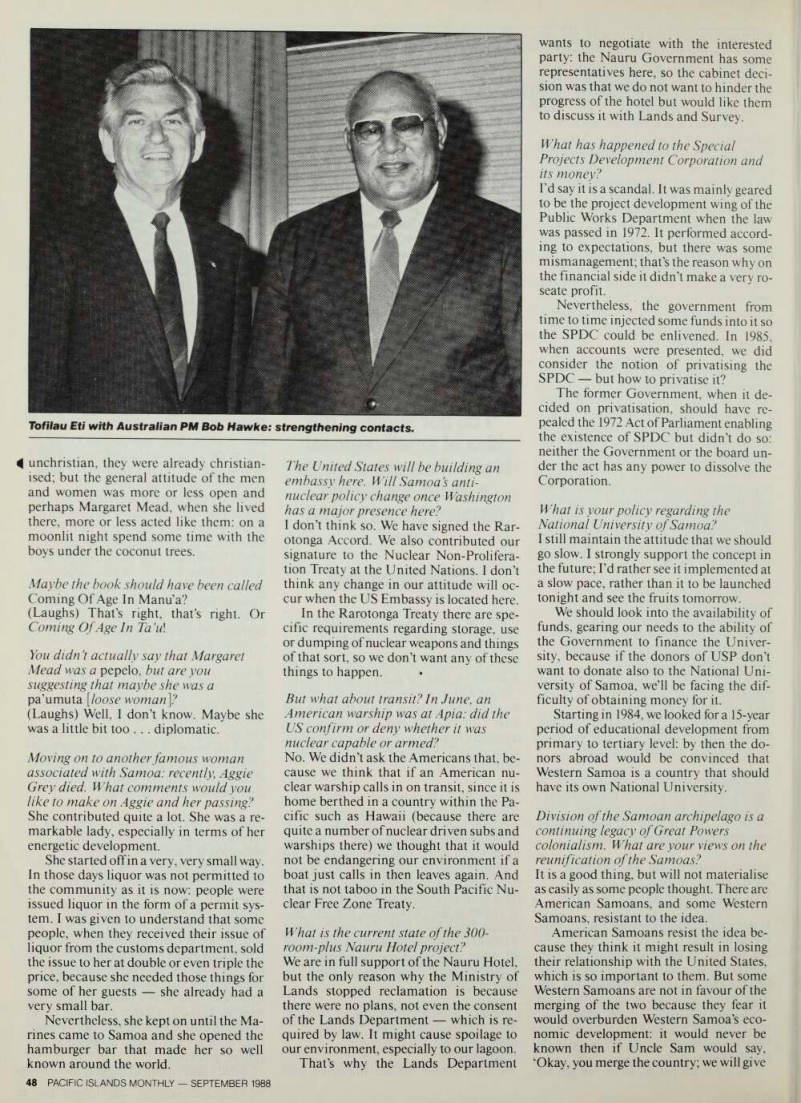
Tofilau Eti with Australian PM Bob Hawke: strengthening contacts.
you SUS 100 million a year for 10 or 20 years until you become economically stable’.
But it is a good thing. I support the merging of the two because we are Polyne sians like them; we have some aigas [fam ilies] there, and vice versa.
One of your relatives, Lieutenant Governor Eni Hunkin, is running for the US Congress and says that if elected he will try to change American Samoa’s political status to one of Free Association, similar to the arrangement between the Cooks and New Zealand.
What are your thoughts on this idea?
It is a good move for American Samoa’s future standards, even if there should be a merger. It is a good thing to review the political status in terms of the USA vis-a vis American Samoa: the difference of the Cook Islands’ status vis-a-vis New Zea land is that the Cooks can pass and im plement their own laws, whereas in American Samoa the legislature there can pass legislation, send it to the Secretary of the Interior and if he vetoes it, that’s it.
You mentioned then-Minister Le Tagaloa Pita’s trip to Mururoa; but King Taufa’ahau of Tonga also went to the atomic atoll last year.
His comments in support of the French nuclear testing site in terms of its purported safety for the environment
and workers there went far beyond Tagaloa’s more neutral comments.
Last year the King was seeking a closer relationship with Paris; now he is courting Washington and has signed a Treaty which, among other things, reaffirms the Pentagon’s right to transit nuclear craft within Tonga.
Are you concerned that with Tonga’s rise to the Chairmanship of the Forum this month, there is a possibility Nukualofa will seek to sell its influence within the South Pacific Forum in exchange for foreign aid?
The Forum cannot be dictated to by one, two, or three governments. It is operated on a consensus of opinion.
The reason I did not go ahead with the July meeting is that though I had a ma jority of nations supporting the idea, I thought it would cause some friction if those nations went ahead. Thai’s why I don’t think there will be any great influ ence on other nations that are resistant to French nuclear testing if the new Chair man introduces his own points of view, because we are at liberty at any time to say ‘No, we object to that’.
King Taufa ’ahau has also been proposing a Polynesian Commonwealth of Nations. What are your views on this Commonwealth, and do you believe this is a move to split the Forum?
I made it quite clear when I first came into office that I abhor the Spearhead Group of the Melanesian nations, because I do not support the idea of having small, regional blocs created within the region because of colour, creed or religious belief. If we are here as a group we should discuss things in that spirit, rather than having the Me lanesians form a bloc, the Polynesians form their own bloc, and the Palagis form an other. That would not result in any form of stability or harmony. We should work in the spirit of understanding.
Although I am brown, I understand the problems of the black: though you are white, you 100 understand the problems.
The only way we can understand one an other is through discussions.
Do you think the French may be behind this Commonwealth of Polynesia? (Laughs) To be truthful with you, I don’t know. But if the French are behind it, I am sorry, but I don’t support it.
Any last thoughts?
I am very appreciative that you have come to Samoa in order that others in the region can be reached with what I am feeling and thinking about the future of this country and the region as a whole.
One last thing I’d like to emphasise is that I support the press, because freedom of the press is a sign of a country operating within true democracy. □