Pacific Bishops “Ignored”
pp. 44-45 · Read in the full issue
Religion
This year’s Lambeth Conference paid scant attention to the special needs of the region s Anglicans, writes Nicolas Rothwell
THE Lambeth conference of the worldwide Anglican churches, held this August in the historic British city of Canterbury, gave the heavy contin gent of bishops in attendance from the Pa cific islands little chance to highlight special concerns.
An intriguing marriage of religious “rap session” and political convention, the Lambeth conference is held only once each decade and despite the international character of the Anglican communion, this meeting was dominated by pressing mat ters chiefly of interest to the great churches of England and North America. But it was precisely the key issue of the conference the debate over the consecration of women bishops that most strikingly illustrated the differences between many Pacific churches and the liberal Anglican estab lishment. There was a clear feeling among some Pacific bishops that their needs and anxieties were paid scant attention as Western delegates discussed problems far removed from Pacific experience.
In the islands the Anglican church is strongest in Papua New Guinea and Me lanesia the result of patterns of 19th century missionary activity. It is deeply implanted in Australia, which it reached with the First Fleet 200 years ago, and in New Zealand, but it has less purchase in Micronesia and Polynesia (though an An glican Bishop based in Suva is attached to the Province of New Zealand, and a Maori Bishop serves his community as Bishop of all Aotearoa).
Yet the members of the Lambeth con ference were primarily concerned with the high profile Western political issues of the day: the fate of the Archbishop of Canter bury’s special envoy, Terry Waite, held hostage by pro-Iranian militiamen in Bei rut, the struggle in South Africa and the controversy over the role of women priests.
Only one resolution addressed the con cerns of the South Pacific islands, but this resolution, proposed by the influential Bishop of Polynesia, the Right Reverend Jabez Bryce, threw a brief spotlight on the strong stand the regional Anglican Church has taken in defence of the environment and a nuclear-free Pacific. The resolution stressed the concern of many Pacific is land states “concerning the abuse and ex ploitation of their lands and seas by powerful external political and economic forces”, and affirms the desire of the re gion’s peoples for self-determination and control of the use of their resources.
The conference also gave its support to
Pacific states in their opposition to the “testing of nuclear weapons, the dumping of nuclear waste and the establishment of further military bases in the region”, and called on France and the superpowers to “cease these activities forthwith”. Fur ther, the Anglican bishops backed “resist ance to all those powerful states and multinational corporations which, for im mediate economic and political gain, rape and destroy the forests, fisheries and min eral deposits of the region.”
This radical declaration of principles
“Bishop Willis Rwaisiho of Malaita put the Melanesian view quite bluntly: the ordination of women as priests, let alone their consecration as bishops, was Satanic”
encapsulated the main concerns of re gional church leaders, and its passage by the Lambeth Conference was expected but the resolution on the Pacific was more notable, according to some observers, for what it did not say.
Despite its overt political intent, no mention was made of the sensitive situa tion in Fiji, nor of the problems of New Caledonia topics where discretion was felt to be the wiser course of action.
Given the preponderance of bishops at Canterbury from American churches it was inevitable that the burning issue of the conference should be the role ofwomen in the church, but this emphasis was calcu lated to upset both the African and the Melanesian bishops. Their different cul tural backgrounds have one point in com mon, however women’s role in both societies makes impossible their partici pation in the priesthood.
Both the African and Melanesian churches also favour a more literal inter pretation of the words of the New Testa ment on the role of women than their more modish European counterparts, so an un easy division opened up between the
mainly white faction in favour of women priests and bishops, and the group (made up of Africans, Melanesians and the more traditionalist white bishop) that was op posed to the idea in principle.
Given the loose structure of the Angli can communion, the decisions of the Lambeth conference have no force: it was already clear before the bishops met on the campus of the University of Kent that some American dioceses would conse crate women bishops before this year is out, but votes on the crucial resolutions at Lambeth indicated a disturbing gap be tween the perceptions of bishops from the developed and developing worlds a gap that some critics said made nonsense of the very notion of a unified Anglican church.
More optimistic onlookers and partici pants explained that the unity was “in the groups”; that the Anglican communion consisted not in the details of doctrine and ritual, but in the shared sense of identity, in mutual love and common faith.
Vet the controversy over women priests is a crucial litmus for the Pacific church, and its treatment by the Anglicans at Lam beth suggested many uncomfortable con clusions: about the relations between Western and Pacific societies and coun tries, about the differing values of these two cultures, and even about the nature of re ligious belief in a fast-changing world.
The protracted debate over women in the Anglican Church took the form of ar gument over two key resolutions: one sought to limit disunion between the var ious “provinces”, and called for under standing and the creation of a commission to help ensure continued links even after some churches decided to consecrate women bishops. This damage-limiting compromise, memorably described by the traditionalist Archbishop of Sydney, Donald Robinson, as akin to “stationing an embulance at the bottom of the cliff’, was widely supported. But a more exact measure of the division between the two camps could be seen in the 40 per cent backing given to Robinson’s own resolu tion urging against the consecration of women bishops.
And during the debate, the forthright Bishop Willis Pwaisiho of Malaita put the Melanesian point of view quite bluntly saying that if women’s ordination as priests, let alone their consecration as bishops, came as a result of women’s lib eration, then it was “Satanic”.
Melanesian and Papua New Guinea bishops felt strongly that the debate about
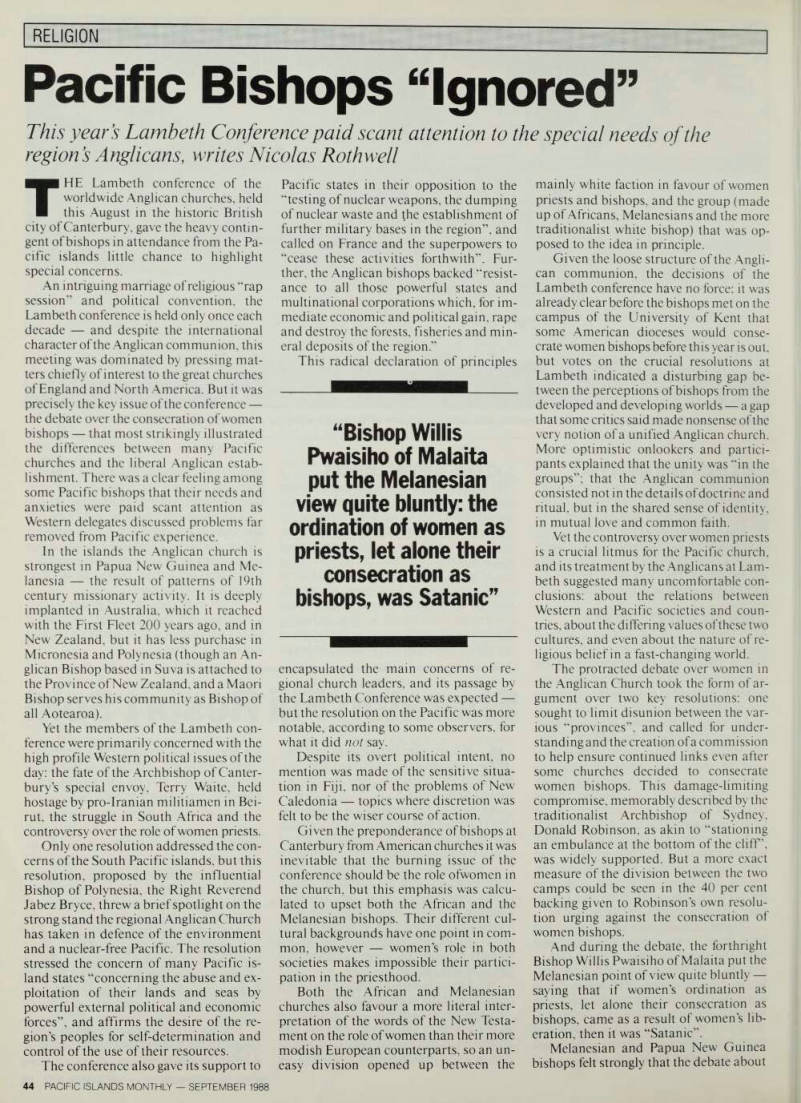
women in the church overlooked their opinions and objected to the terms in which it was cast, which tended to portray all moves to keep women out of the pri esthood as unjust. One of the most nu anced interpreters and backers of the concerns of indigenous Melanesian bish ops at the conference was Bishop Paul Richardson of Aipo Rongo, a 41 year-old Harvard and Oxford trained missionary bishop something of a rarity these days.
Bishop Richardson is a young man for a young diocese; Aipo Rongo has only one parish that predates World War 11. A for mer pupil of the outspoken British liberal bishop David Jenkins of Durham, he put the case of his fellow Pacific bishops with deep conviction in an interview with Pacific Islands Monthly in Canterbury.
He stressed that there was general en thusiasm for the resolutions or relations with the Roman Catholic Church reached
by the Lambeth conference, since Angli cans and Catholics are on excellent terms in Melanesia, but he was sharply critical on the key question of woman priests.
“I detect an inability on the part of people in the West to really understand the viewpoint of entirely different cultures,” he said. “Many people in the West assume that equality for women means that in terms of ritual and liturgy, men and women will do the same thing. But this goes com pletely against Melanesian beliefs that men and women can be complementary but different.”
“This is a hard thing to get across Western people say it’s a question of jus tice, and if you’re against the ordination of women it’s like being in favour of aparth eid; it’s sexism.”
Bishop Richardson is an ardent sup porter of equality for women, and speaks out for better high school education for women in his diocese in Mount Hagen and for campaigns to end wife-bashing. But he feels there are certain cultural reasons why
the priesthood in Melanesia is restricted to men, and his solution is to develop other forms of ministry for women and to en courage women to have a greater say in de cision-making through their own organisations, such as the mothers’ union.
He points out that the wives of priests play a special role already in the Christian life of Melanesia: in both the Solomon Is lands and Papua New Guinea priests’ wives are all called “mother”, just as in the Russian Orthodox Church, and have a “definite ministry” of their own. Women are also encouraged to participate in the
church through three local sisterhoods the Community of the Visitation in Po pondetta, the Sisters of the Church in Honiara, and a new indigenous commu nity, the Sisters of Melanesia.
Both Bishop Richardson and other participants at the Lambeth conference, reviewing the progress made, formed the impression that the terms of the discus sion were being defined from a purely Western perspective.
“Westerners have got to be careful about pushing their model; it’s cultural imperi alism and ethnocentricity, for this is not a question of justice, and I am completely with the Melanesian bishops on this. I don’t think they have done anything against justice in voting against women bishops or priests,” the Bishop of Aipo Rongo contended.
His arguments were given an intrigu ing and important echo from one of the leading African opponents of ordination of women, the Bishop of Harare, Ralph Hatendi, who told the conference flatly; “In my cultural tent, a women does not qualify to offer the family sacrifice at the family altar. She may be queen, prime minister, judge, doctor or bank manager, but she will not mount the altar for a sac
rifice. The male being is the minister of sacrifices by divine right.”
Bishop Richardson feels many Me lanesians share this view, since in tradi tional society it is women who tend the gardens, bear children, look after pigs: who create life. It is men who kill pigs and per form sacrifice.
On this argument, if the Eucharist is the showing forth of the death of Christ, then, as Bishop Richardson explains, “it is ob viously culturally appropriate that a male priest presides at that offering.”
The outspoken cleric noted that the Lambeth Conference cannot instruct the autonomous Anglican provinces on the is sues off women priests, but he (like others at Canterbury) clearly fell the chill winds of conformity blowing, and warned against the consequence for Western churches of trying on dictate to Melanesia. “I hope there will be no pressure from outside bodies or outside churches to make us or dain women priests. If missionary socie ties or funding agencies try to do this it would be disastrous, and I would resist it myself; for on this particular issue we will go our own way.”
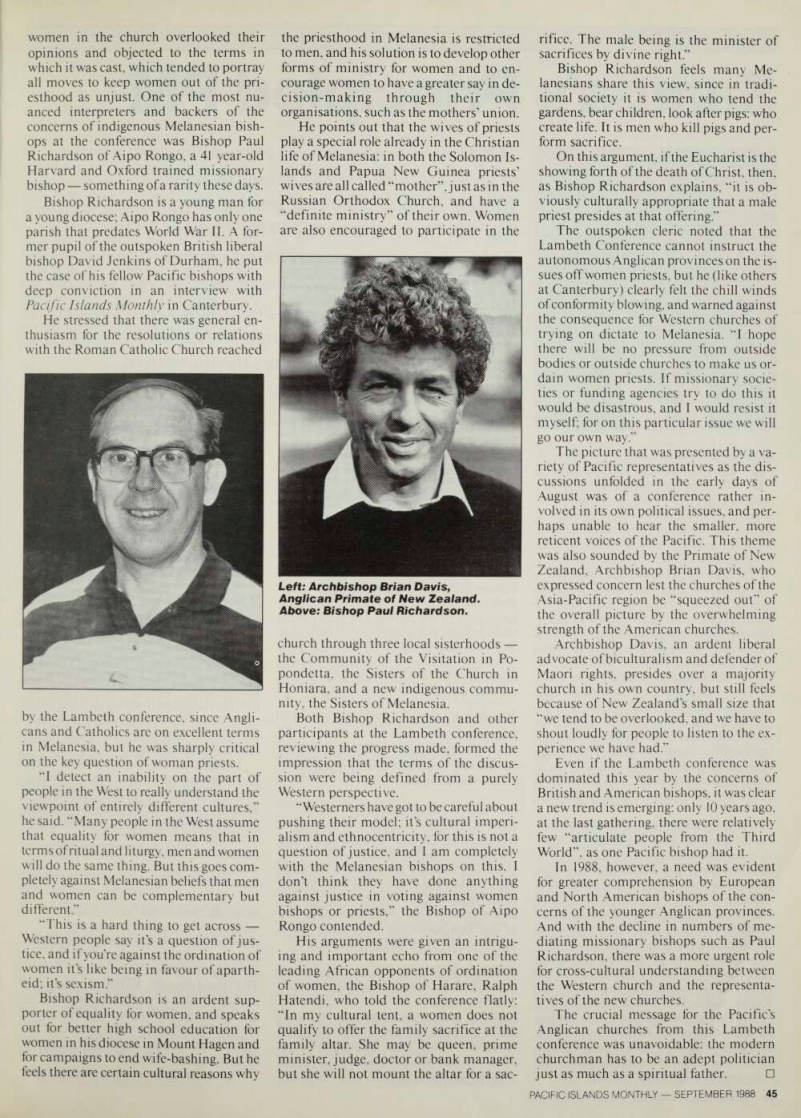
The picture that was presented by a va riety of Pacific representatives as the dis cussions unfolded in the early days of August was of a conference rather in volved in its own political issues, and per haps unable to hear the smaller, more reticent voices of the Pacific. This theme was also sounded by the Primate of New Zealand, Archbishop Brian Davis, who expressed concern lest the churches of the Asia-Pacific region be “squeezed out” of the overall picture by the overwhelming strength of the American churches.
Archbishop Davis, an ardent liberal advocate of biculluralism and defender of Maori rights, presides over a majority church in his own country, but still feels because of New Zealand’s small size that “we tend to be overlooked, and we have to shout loudly for people to listen to the ex perience we have had.”
Even if the Lambeth conference was dominated this year by the concerns of British and American bishops, it was clear a new trend is emerging: only 10 years ago, at the last gathering, there were relatively few “articulate people from the Third World”, as one Pacific bishop had it.
In 1988, however, a need was evident for greater comprehension by European and North American bishops of the con cerns of the younger Anglican provinces.
And with the decline in numbers of me diating missionary bishops such as Paul Richardson, there was a more urgent role for cross-cultural understanding between the Western church and the representa tives of the new churches.
The crucial message for the Pacific’s Anglican churches from this Lambeth conference was unavoidable: the modern churchman has to be an adept politician just as much as a spiritual father. □
Left: Archbishop Brian Davis, Anglican Primate of New Zealand.
Above: Bishop Paul Richardson.